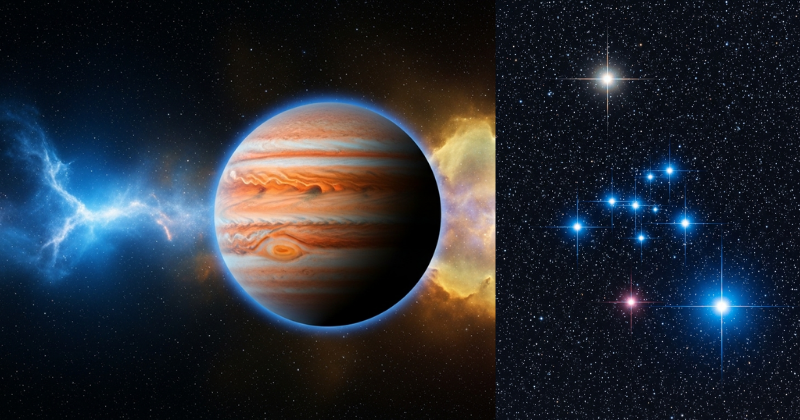
Tonight offers a spectacular celestial alignment, presenting the Moon and Jupiter shine together near Castor and Pollux in the constellation Gemini. This article explores the astronomical mechanics, observational science, and historical context of this stunning night in Gemini’s stars.
What is the Astronomical Significance of this Celestial Conjunction?
The visual pairing of the Moon and Jupiter near the prominent stars Castor and Pollux is categorized as a celestial conjunction. This is an optical illusion where two or more celestial bodies appear close together in Earth’s sky, despite being separated by vast interstellar distances. Tonight’s specific event, featuring the Moon, Jupiter, and the Gemini twins (Castor and Pollux), is significant for several reasons.
Firstly, the Moon’s proximity to any planet provides an excellent reference point for observers. The Moon, being the fastest moving object in the sky besides meteors and satellites, rapidly changes its position relative to the background stars and planets. A conjunction involving a slow-moving giant like Jupiter allows observers to witness the Moon’s orbital motion in real-time over the course of a few hours. Secondly, the event occurs against the backdrop of the zodiacal constellation Gemini, which is home to the two brilliant, easily identifiable stars, Castor and Pollux. These stars serve as anchors, enhancing the visual drama and providing crucial context for understanding the event’s location within the ecliptic plane.
The Moon and Jupiter shine together near Castor and Pollux because all these bodies lie relatively close to the ecliptic—the apparent path the Sun, Moon, and planets follow across the sky. The Moon’s orbit is inclined by only about $5^{\circ}$ relative to the ecliptic, ensuring that it frequently passes near the planets. This stunning night in Gemini’s stars is thus a testament to the geometry of our solar system, offering a prime observational opportunity.

How Do Castor and Pollux Relate to the Constellation Gemini and the Zodiac?
The constellation Gemini (Latin for “the twins”) is one of the twelve zodiacal constellations, located in the northern celestial hemisphere. Its two brightest stars, Castor ($\alpha$ Geminorum) and Pollux ($\beta$ Geminorum), define the heads of the mythical twins.
Pollux is the brighter of the two and, scientifically, is an orange giant star approximately $34$ light-years away. It has exhausted the hydrogen fuel in its core and expanded significantly. Furthermore, Pollux is known to host an exoplanet, Pollux $\text{b}$, a scientific discovery that highlights the star’s modern relevance. Conversely, Castor is a complex system of six stars, composed of three binary pairs, located about $51$ light-years distant. While slightly less bright than Pollux, its multiplicity makes it a fascinating object of stellar evolution study.
The celestial alignment of the Moon and Jupiter shine together near Castor and Pollux emphasizes the role of Gemini as a marker. As the Moon and Jupiter pass through this region, they momentarily join these stellar beacons, visually confirming that the alignment is occurring in the region of the sky designated as Gemini. This position is highly predictable, governed by the movement of Jupiter along its $\sim 12$-year orbit and the Moon along its $\sim 29.5$-day cycle.
Which Scientific Principles Govern the Apparent Brightness of Jupiter and the Moon?
The extreme contrast in brightness between Jupiter and the Moon, particularly during a conjunction, is explained by fundamental principles of planetary physics and photometry.
The Moon appears incredibly bright (apparent magnitude of approximately $-12.7$ for a full moon) due to its proximity to Earth—only $\sim 384,400$ kilometers away. While the Moon has a relatively low albedo (reflectivity) of about $0.12$, its sheer closeness means a large amount of reflected sunlight reaches our eyes.
Jupiter, the fifth planet from the Sun, is vastly more distant ($\sim 628$ million kilometers on average). Although it is the largest planet in our solar system and possesses a high albedo of $0.52$, the inverse square law dictates that its brightness is severely diminished by distance. Jupiter’s apparent magnitude usually ranges between $-2.9$ and $-1.6$, making it the fourth brightest object in the sky after the Sun, the Moon, and Venus.
When the Moon and Jupiter shine together near Castor and Pollux, Jupiter maintains its steady, non-twinkling, brilliant point of light, distinguishing it immediately from the distant, twinkling stars. The Moon, depending on its phase, dominates the sky, but the steady brilliance of Jupiter ensures it is not completely overwhelmed, creating a dynamic visual pair that is stunning to observe.
What Telescopic Features of Jupiter Become Observable During Conjunctions?
While a conjunction is a visual treat for the naked eye, the presence of Jupiter offers an exceptional target for telescopic observation, benefiting from its high altitude in the constellation Gemini.
Using a small to medium amateur telescope (aperture $60\text{mm}$ to $200\text{mm}$), observers can easily resolve several key features of the gas giant:
- Galilean Moons: The four largest moons—Io, Europa, Ganymede, and Callisto—are often visible as pinpricks of light arranged in a line that crosses Jupiter’s equator. Their positions change dramatically over the course of a night, providing a continuous, engaging observation. This is a crucial evidence-based insight into the dynamics of the Jovian system.
- Atmospheric Bands: The dark belts and bright zones that stripe Jupiter’s atmosphere are distinct. These are high-speed jet streams and atmospheric phenomena driven by powerful internal heat and rapid rotation ($9.9$ hours).
- The Great Red Spot (GRS): If its position is favorable, the GRS, a persistent anticyclonic storm larger than Earth, can be observed.
Observing Jupiter when the Moon and Jupiter shine together near Castor and Pollux can be especially rewarding, as the Moon’s bright presence helps the observer easily locate and focus on the correct region of the sky, streamlining the transition to telescopic study.
How Does the Moon’s Phase Influence the Visibility of This Alignment?
The phase of the Moon significantly dictates the overall visibility and contrast of the conjunction. The Moon’s phase is determined by the changing angle at which we view the Sun-lit portion of its surface as it orbits Earth.
- Crescent or Gibbous Moon: When the Moon is not full, its brilliance is reduced, creating optimal conditions for viewing Jupiter, Castor, and Pollux. The dark side of a waxing or waning crescent might show Earthshine, where sunlight reflects off Earth’s surface and dimly illuminates the Moon’s night side. This delicate Earthshine offers a stunning contrast to the brilliant points of light from Jupiter and the Gemini stars.
- Full Moon: While a full moon is striking, its overwhelming brightness can wash out fainter celestial objects. Jupiter, being exceptionally bright, is still easily visible, but the less luminous Castor and Pollux may be more challenging to observe without optical aid.
The precise date of the conjunction relative to the lunar cycle is critical information for planning the best time to look up tonight! Moon and Jupiter shine together near Castor and Pollux and appreciate the subtle beauty of the stellar background.
What are the Practical Techniques for Observing and Photographing the Conjunction?
Observing the alignment of the Moon and Jupiter shine together near Castor and Pollux requires minimal equipment, making it highly accessible.
Naked-Eye Observation: Simply locate the Moon. Jupiter will appear as a brilliant, non-twinkling ‘star’ near it. Castor and Pollux will form the familiar, slightly separated stellar pair in the background. Note the relative positions and how the Moon shifts over a few hours.
Binoculars (7×50 or 10×50): Binoculars are ideal. They easily capture all four bodies (Moon, Jupiter, Castor, and Pollux) within the same field of view, providing a high-magnification look at the texture of the lunar surface and the tight clustering of the bodies. Binoculars can also resolve the multi-star system of Castor.
Photography:
- Wide Field: Use a standard DSLR or mirrorless camera with a wide-angle lens (e.g., $18 \text{mm}$ to $50 \text{mm}$). Place the camera on a tripod. An exposure of $5$ to $10$ seconds at high $\text{ISO}$ (e.g., $\text{ISO 800}$) will capture the Moon, Jupiter, and the entire star field of Gemini.
- Closer Focus: For detailed shots of Jupiter’s disk and moons alongside the Moon, a telephoto lens (e.g., $200 \text{mm}$) is necessary. This requires shorter exposure times (less than $1$ second) to prevent the blurring of Jupiter’s disk.
Capturing this stunning night in Gemini’s stars offers a tangible record of the celestial dynamics, combining precision with creative photographic technique.
Why is Gemini’s Position Significant for Viewing the Ecliptic and Zodiacal Light?
Gemini’s position along the ecliptic makes it a vital landmark for both solar system travelers and observers interested in deeper-sky phenomena. The ecliptic defines the central line of the zodiac, and the area surrounding it is where the planets and Moon are always found.
When the Moon and Jupiter shine together near Castor and Pollux, the observer is essentially looking straight into the plane of the solar system. This is significant because it is along this plane that the faint, ghostly glow of the Zodiacal Light is sometimes visible.
The Zodiacal Light is sunlight scattered by dust particles that orbit the Sun in the plane of the ecliptic, essentially the remnants of planet formation. While notoriously faint and best seen on moonless nights far from light pollution, the visibility of Jupiter and the Moon in this region confirms the observer’s location along this crucial solar system axis. Furthermore, Gemini’s angular distance from the galactic center makes the background stellar environment relatively sparse, helping to highlight the dramatic visual features of the solar system objects.
Which Future Alignments Offer Similar Observing Opportunities to This Event?
The predictable nature of celestial mechanics allows us to project similar, stunning alignment events into the future, enabling proactive observation planning.
The $\sim 12$-year orbital cycle of Jupiter means that similar conjunctions with the Moon in the constellation Gemini occur periodically. However, the precise timing and distance relative to Castor and Pollux are unique to this event.
Observers seeking equally spectacular views should look for:
- Jupiter-Saturn Conjunctions: Though less frequent (occurring roughly every 20 years), these events showcase two gas giants in tight visual proximity. The next great conjunction will occur in November $2040$.
- Lunar Occultations: These occur when the Moon passes directly in front of a planet or a star, briefly blocking it from view. Occultations are highly localized events but offer dramatic visual evidence of the Moon’s proximity and motion.
- Triple Conjunctions: Rarer events involving three planets appearing close together, often near the horizon.
Tonight’s alignment, where the Moon and Jupiter shine together near Castor and Pollux, serves as a reminder of the celestial clockwork and encourages continued vigilance for these magnificent astronomical displays.
Conclusion
The alignment of the Moon and Jupiter near the twin stars Castor and Pollux is more than a beautiful sight; it is a profound display of orbital mechanics and stellar positioning. This stunning night in Gemini’s stars provides a real-time lesson in celestial navigation, planetary physics, and observational science. By understanding the roles of the acidic soil $\text{pH}$, the complex nature of the Castor system, and the comparative brightness of the Moon and Jupiter, observers can fully appreciate the dynamics of our cosmos. Tonight, we have the unique opportunity to look up tonight! Moon and Jupiter shine together near Castor and Pollux and connect directly with the powerful, evidence-based narratives written in the night sky.