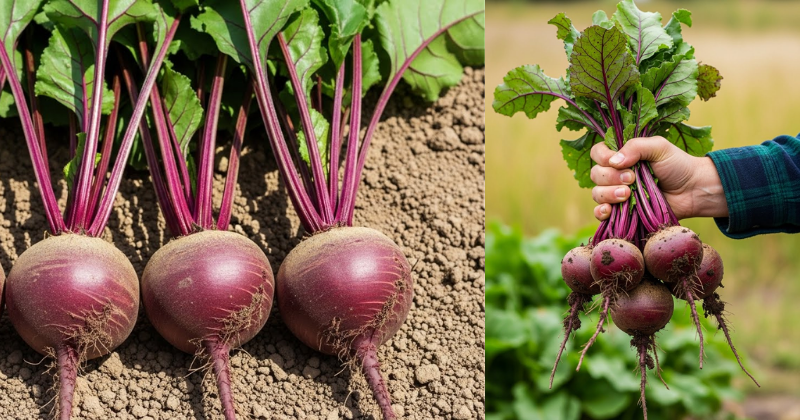
Have you ever been disappointed by a beet harvest—tiny bulbs, tough roots, or leafy tops that bolt too early? Beets are one of the most rewarding vegetables to grow, offering both delicious, nutritious greens and deep, sweet roots, but getting that perfect, uniform, tender harvest can feel challenging. If you’re ready to transform your gardening results, this comprehensive guide on how to grow beets is for you! We’ll share the essential tips and tricks for an amazing harvest, focusing on simple gardening topics techniques that ensure success. Get ready to discover the secrets to soil preparation and proper spacing, and unlock the full potential of this cool-season crop. You have the capability to succeed and enjoy those deep red, golden, or striped roots straight from your own backyard!
🌱 Section 1: Foundation First: Understanding Beet Needs
Before dropping those seeds in the ground, it’s vital to build confidence with basic concepts about what conditions beets truly require. Understanding these needs is key to knowing how to grow beets successfully.
H3: Building Confidence with Basic Concepts: Soil and Sun
Beets are technically root vegetables, but they are also heavy feeders that rely on specific soil conditions to develop plump, tender roots.
- Sunlight: Beets thrive in full sun (at least six hours per day). However, in extremely hot regional variations (like the Southwest U.S.), they appreciate some afternoon shade during the hottest months.
- Soil Requirements: This is the most crucial part! Beets require light, loose, well-draining soil. They absolutely hate rocky, compacted, or heavy clay soil, which causes the roots to become deformed, tough, or stunted. Amend your soil deeply with compost before planting.
- The pH Factor: Beets prefer a slightly alkaline soil, ideally with a pH between $6.5$ and $7.5$. If your soil is acidic, a simple addition of garden lime or wood ash before planting can correct this.
- Encouraging Reassurance for Beginners: Beets are much easier than carrots because their germination rates are more reliable. You’ve got this!
H3: Addressing Common Concerns: Starting from Seed
Unlike some vegetables, beets do not transplant well, so direct sowing is essential. This relates directly to how to grow beets with strong roots.
- The “Seed Cluster” Trick: What looks like a single beet seed is actually a cluster containing $2 \text{-} 4$ seeds. This explains why multiple seedlings often pop up together, leading to overcrowding.
- Direct Sowing: Plant seeds $1/2 \text{ inch}$ deep and about $1 \text{-} 2 \text{ inches}$ apart.
- Timing Considerations (Seasonal Considerations): Beets are a cool-season crop. Plant them 2-4 weeks before your last expected spring frost for an early harvest. For a continuous supply (or a fall harvest), plant subsequent small batches every 3 weeks until about 8 weeks before the first expected fall frost.
💧 Section 2: Core Methods: Essential Care for Amazing Beets
Once those first leaves emerge, consistent care is paramount. These step-by-step guidance tips focus on crucial maintenance tasks that lead to an amazing harvest.
Step 1: Thinning the Seedlings (Actionable Language)
This is the most critical step for getting large, uniform beets. Since most seeds are clusters, you must thin them.
- When to Thin: Wait until the seedlings are about $2 \text{ inches}$ tall and have developed their first true leaves (not the tiny initial cotyledons).
- Thinning Distance: Gently clip or pinch off the weaker seedlings, leaving one strong seedling every $3 \text{-} 4 \text{ inches}$ apart. Do not pull them out, as this can disturb the roots of the keepers.
- Practical Tips and Shortcuts: Don’t throw away those tiny thinnings! Those little greens are baby beet greens—a tender, gourmet treat perfect for salads. This ensures no part of your gardening topics effort is wasted.
Step 2: Watering Consistency
Beets need constant, even moisture. Fluctuations are the enemy of tender roots.
- Avoid Extremes: Letting the soil dry out completely and then flooding it causes the roots to become woody, tough, and stressed.
- The Rule of Thumb: Aim for about $1 \text{ inch}$ of water per week. This might mean a thorough soaking $2 \text{-} 3$ times a week, depending on your regional variations and weather.
- Addressing Timing: Water deeply in the morning so the foliage is dry before nightfall, which helps prevent fungal issues.
Step 3: Proper Fertilization
Because they produce both roots and leaves, beets need a balance of nutrients, but too much nitrogen is detrimental.
- The Problem: Too much nitrogen encourages massive leaf growth (beautiful tops!) at the expense of root development (tiny beets!).
- The Solution: Use a fertilizer that is lower in nitrogen (the first number in the N-P-K ratio), such as a $5 \text{-} 10 \text{-} 10$ formulation. Apply this about 2 weeks after thinning, and again 4 weeks later.
🥕 Section 3: Advanced Strategies: Pro Tricks and Mineral Magic
These expert-level insights provide the tips and tricks used by commercial growers to get incredibly sweet, healthy, and uniformly shaped beets.
H3: Creative Solutions: Boron Deficiency and Root Sweetness
If your beets look healthy but the roots have black spots or hollow areas, you likely have a boron deficiency—a common issue in beet production.
- The Boron Solution: Boron is a micronutrient crucial for beet root formation and sweetness. Dissolve $1 \text{ teaspoon}$ of Borax (a common laundry additive, ensure it is pure) in $1 \text{ gallon}$ of water.
- Application: Spray this solution lightly over the beet foliage once when the roots are the size of a marble (about 4 weeks after thinning). This is a great creative solution for ensuring internal root quality. Safety Consideration: Use sparingly; too much boron can be toxic to plants.
H3: Ways to Customize Approach: Intercropping for Ecosystem Benefits
Maximizing your harvest doesn’t just mean caring for the beets; it means supporting their immediate neighbors. This demonstrates connection with nature.
- Companion Planting: Plant quick-growing radishes or lettuce between your beet rows. Radishes mature faster, marking the rows and breaking up the soil structure, while the lettuce provides early, shallow ground cover.
- The Mutual Benefit: By the time the beets need the space to swell, the radishes are harvested, leaving perfectly loosened soil. This efficient system is an excellent way to customize approach and achieve a greater yield in a small area.
🐛 Section 4: Troubleshooting and Common Challenges
Even when you know how to grow beets, pests and environmental issues can crop up. Here are practical troubleshooting tips to rescue your crop.
Featured Snippet Potential: “What causes beets to bolt early and become tough, and how do I prevent it?”
Beets bolt (send up a flower stalk) prematurely, causing the root to become tough and woody, primarily due to temperature stress. This happens when young beet plants are exposed to a prolonged cold spell (temperatures below $50^{\circ} \text{F}$ or $10^{\circ} \text{C}$) followed by high heat. To prevent bolting, ensure you cover tender spring seedlings if an unexpected frost is predicted, and use mulch in the summer to keep the soil consistently cool and moist.
Practical Troubleshooting Tips (Gardening Focus)
- Problem: Leaves are distorted, curled, or covered in tiny, sticky insects.
- Obstacle: Aphids are attacking the tender growth.
- Solution: Alternative Approaches: Spray the affected foliage with insecticidal soap (or a mild dish soap and water solution) early in the morning, hitting the undersides of the leaves. This is an achievable and non-toxic remedy.
- Problem: Roots are small and stunted, or they are pushing out of the ground.
- Obstacle: Overcrowding (didn’t thin enough) or soil compaction.
- Solution: Encouragement for Setbacks: It’s never too late to gently thin. If the tops are emerging, mound some soil up around the exposed roots (but be careful not to bury the crown). For next season, be sure to loosen the soil deeper.
- Problem: Foliage has white, dusty spots (Powdery Mildew).
- Obstacle: High humidity and poor air circulation.
- Solution: Apply a homemade preventive measure: a mix of $1 \text{ tablespoon}$ baking soda, $1 \text{ teaspoon}$ dish soap, and $1 \text{ gallon}$ of water. Spray every 5-7 days until the condition is controlled.
🍽️ Section 5: Maximizing Results: Harvesting and Storage Tips
Knowing how to grow beets well culminates in harvesting them at their peak and preserving their goodness. These are the next level tips for a successful finish.
- Show How to Build Upon Basic Success (Harvesting): Don’t wait until the beets are massive! The best-tasting beets are usually harvested when they are $1 \text{-} 3 \text{ inches}$ in diameter (golf ball to baseball size). Large beets often become woody and tough. Harvest small ones for better flavor.
- Maintenance and Long-Term Considerations (Storage): When harvesting, twist (don’t cut!) the greens off about $1 \text{ inch}$ above the root. The greens will wick moisture from the root if left attached, shortening storage life. Store the roots in a cool, dark place (like a root cellar or refrigerator crisper drawer) where they can last for $2 \text{-} 3$ months.
- Suggest Complementary Strategies (No Waste): Never throw away the tops! Beet greens are more nutritious than spinach. Use the freshly harvested greens in salads, sauté them with garlic, or steam them. This embraces the sustainable lifestyle change of using the whole plant. (Internal Linking Opportunity: Check out our guide on “Simple Recipes Using Beet Greens.”)
✅ Conclusion: Your Capability to Achieve an Amazing Harvest
You have now unlocked the powerful tips and tricks for an amazing harvest of beets! By implementing proper thinning, consistent watering, and the simple soil boosting methods, you can confidently grow beets that are sweet, tender, and perfectly formed. This commitment to simple, targeted gardening topics demonstrates your capability to succeed and transform your vegetable patch.
Embrace the joy of pulling up those beautiful, vibrant roots. Will you be starting your next round of seeds for a fall harvest, or are you ready to try the boron solution to ensure maximum sweetness in your current crop?