
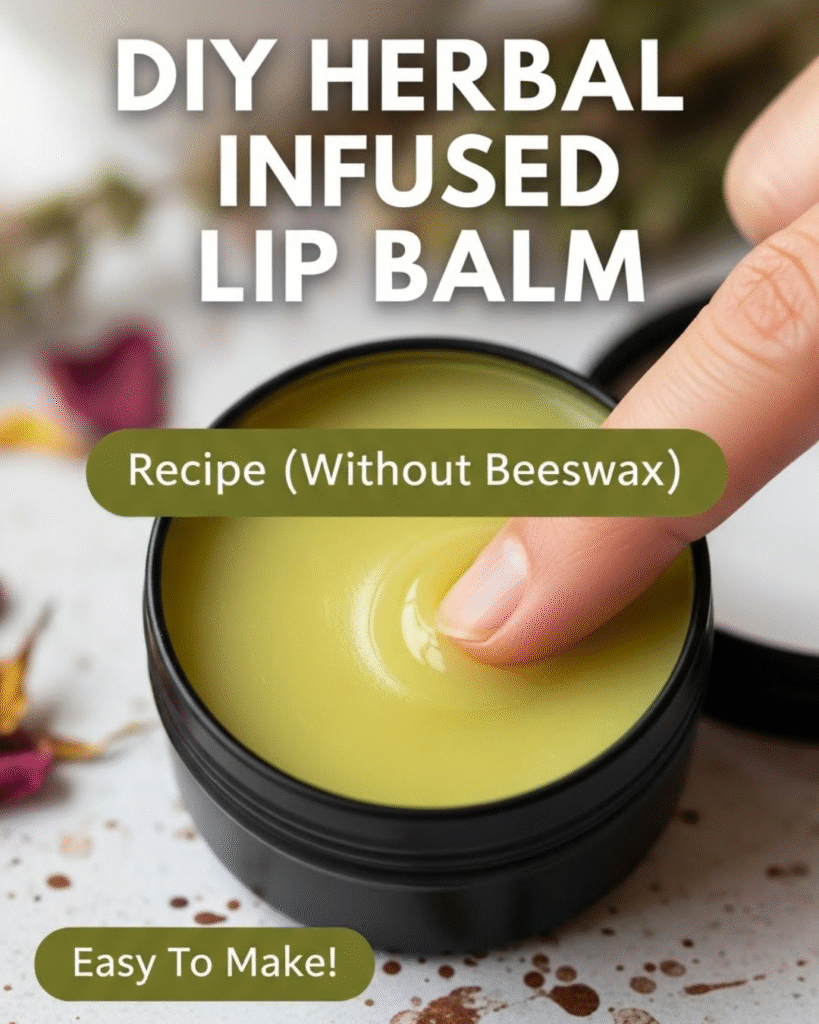
Are you searching for an ultra-nourishing lip balm recipe that avoids common allergens and harsh chemicals? You can achieve buttery-smooth, long-lasting hydration with this simple DIY HERBAL INFUSED LIP BALM recipe (Without Beeswax). This project is a fantastic Home Tips & DIY undertaking that allows you to control every ingredient, eliminating petroleum jelly and standard beeswax while infusing beneficial, natural herbs. Get ready to discover how easy and rewarding it is to transform your daily self-care routine with a vegan, cost-saving benefits alternative that truly heals dry, cracked lips.
🌿 Section 1: Foundation First: The Benefits of Going Beeswax-Free
The foundation of a great lip balm recipe starts with understanding why certain ingredients are chosen—and why we are opting for a vegan, Beeswax-Free alternative.
H3: Building Confidence with Basic Concepts: Why Ditch Beeswax?
While beeswax is a traditional, excellent stiffener for lip balm, it’s not the only option. Our DIY HERBAL INFUSED LIP BALM uses Candelilla wax, offering specific advantages:
- Vegan-Friendly: Candelilla wax is a plant-based wax (from the Candelilla shrub), making this lip balm recipe suitable for a sustainable lifestyle change and for those with ethical preferences.
- Stiffening Power: Candelilla wax is actually harder and has a higher melting point than beeswax, meaning you need to use less of it to achieve the same firmness. This makes the finished balm less tacky on the lips.
- Encouraging Reassurance for Beginners: Working with Candelilla wax is almost identical to working with beeswax, so if you’ve tried balm making before, this transition is easy!
H3: Key Components: Choosing Your Herbal Infusion
The “Herbal Infused” part of this DIY HERBAL INFUSED LIP BALM recipe is where the real healing power lies. The herbs infuse into the base oil, passing on their therapeutic qualities.
| Herb | Benefit (Scientific Backing) | Notes |
| Calendula | Anti-inflammatory; speeds healing (due to carotenoids and flavonoids). | Ideal for cracked or chapped lips. |
| Chamomile | Soothing, anti-irritant, great for sensitive skin. | Provides a gentle, calming scent. |
| Peppermint | Plumping and cooling effect (due to menthol). | Best used sparingly for a mild tingle. |
- Actionable Focus: We recommend starting with Calendula for its incredible healing properties, supporting the gradual progress of repairing damaged lips.
🍯 Section 2: Core Methods: The DIY Herbal Infused Lip Balm Recipe
Follow this precise step-by-step guidance to create the perfect vegan, Beeswax-Free base and incorporate the potent herbal infusion.
Ingredients and Tool Requirements
| Tool Requirement | Quantity (Yields approx. 10 tubes) | Ingredient | Purpose |
| Small Glass Jar (or Double Boiler setup) | $1/4 \text{ cup}$ | Carrier Oil (Sweet Almond or Coconut Oil) | Base for herbal infusion and moisture. |
| Lip Balm Tubes/Tins | $1 \text{ tablespoon}$ | Dried Herbal Material (Calendula or Chamomile) | Infusion for healing properties. |
| Fine Mesh Strainer/Cheesecloth | $1 \text{ tablespoon} + 1 \text{ teaspoon}$ | Candelilla Wax Flakes (Vegan Wax) | The stiffener (higher melting point than beeswax). |
| Small Measuring Spoon (for filling) | $1/2 \text{ teaspoon}$ | Vitamin E Oil | Antioxidant, extends shelf life. |
| — | $5 \text{-} 10 \text{ drops}$ | Essential Oil (Optional, e.g., Sweet Orange) | Scent and flavor. |
Step-by-Step Process (Core Methods)
- Herbal Infusion (Timing and Planning Considerations): Combine the Carrier Oil and the Dried Herbal Material in a small jar. Place the jar in a saucepan filled with $1 \text{ inch}$ of water (creating a double boiler). Heat gently on low for $1 \text{-} 2 \text{ hours}$. The goal is to keep the oil warm (around $150^{\circ} \text{F}$ or $65^{\circ} \text{C}$) without frying the herbs, allowing the scientific backing of the plant’s properties to transfer to the oil.
- Strain the Oil: Remove the jar from the heat. Use a fine mesh strainer or cheesecloth to strain the warm, now-infused oil, pressing out every drop. Discard the herbs. This is now your medicated base oil.
- Melt the Wax: Return the infused oil to the double boiler. Add the measured Candelilla Wax Flakes to the oil. Stir until the wax is completely dissolved and the mixture is clear.
- Final Additions: Remove the mixture from the heat. Stir in the Vitamin E Oil and the optional Essential Oil. Work quickly now, as Candelilla wax sets fast!
- Pour (Achievable Guidance): Carefully use a small funnel or a dropper/pipette to fill the lip balm tubes or tins immediately. Practical Tips: Overfill slightly, as the mixture will contract as it cools.
- Cool and Cure: Let the balms cool undisturbed at room temperature for $3 \text{-} 4 \text{ hours}$ until completely solid.
💄 Section 3: Advanced Strategies: Pro Tips for Texture and Flavor
Once you master the basic DIY HERBAL INFUSED LIP BALM recipe (Without Beeswax), you can integrate expert-level insights to create highly customizable, professional-grade results.
H3: Creative Solutions: Perfecting the Consistency
Since Candelilla wax is harder than beeswax, it requires precise ratios to avoid a waxy, tugging feel on the lips.
- The Cocoa Butter Boost: If you prefer a richer, creamier glide, substitute $1/2 \text{ tablespoon}$ of the infused carrier oil with $1/2 \text{ tablespoon}$ of Cocoa Butter. Cocoa butter melts beautifully at body temperature, giving the balm a luxurious, smooth finish and a hint of natural chocolate scent. This creative solution improves the sensory experience.
- The Gloss Factor: To give your final balm a slight, natural sheen, add $1/2 \text{ teaspoon}$ of Castor Oil during Step 4. Castor oil is known for its high viscosity and glossy finish, improving the General Lifestyle/Casual Tips appeal of the balm.
H3: Ways to Customize Approach: Natural Color and Flavor
You can turn your DIY HERBAL INFUSED LIP BALM into tinted or flavored versions using natural food-grade ingredients.
- Natural Tint: For a subtle pink or red tint, add $1/4 \text{ teaspoon}$ of pure beetroot powder (or a pinch of finely ground alkanet root powder) to the oil after it is strained (Step 2). Stir well and proceed with adding the wax.
- Intense Flavor: If using Peppermint essential oil, use only $5 \text{ drops}$. For a strong, safe flavor (without using synthetic flavor oils), use $10 \text{-} 15 \text{ drops}$ of high-quality food-grade extracts like vanilla, coconut, or raspberry, added during Step 4. This allows you to customize approach based on preference.
🚨 Section 4: Troubleshooting and Common Challenges
Even the most meticulous maker can encounter setting issues. Here are practical troubleshooting tips for common hurdles when making your Beeswax-Free balm.
Featured Snippet Potential: “What should I do if my DIY lip balm is too soft or too hard after it cools?”
If your DIY lip balm is too soft (melts easily), you need to increase the Candelilla wax. If it is too hard (tugs on the lips), you need to increase the liquid oil. To fix consistency: Gently re-melt the entire batch in the double boiler. If too soft, add $1/2 \text{ teaspoon}$ more Candelilla wax. If too hard, add $1 \text{ teaspoon}$ more infused carrier oil. Stir until dissolved, test a drop on a cold surface, and repour.
Practical Troubleshooting Tips (Home Tips & DIY Focus)
- Problem: The finished balm has a grainy texture.
- Obstacle: This usually indicates that the Shea Butter (if used) was melted at too high a temperature and cooled too slowly, causing the fatty acids to crystallize.
- Solution: Encouragement for Setbacks: Re-melt the entire batch. Once fully liquid, place the container in the refrigerator and stir every $5 \text{ minutes}$ until the mixture begins to thicken into a trace (like thick gravy). Then, pour into the tubes quickly. This rapid cooling technique prevents crystallization.
- Problem: My herbs didn’t infuse well; the oil still smells plain.
- Obstacle: The oil was not kept warm enough or infused for long enough.
- Solution: Alternative Approaches: Next time, use the Solar Infusion method. Place the oil and herbs in a sealed jar and leave it on a sunny windowsill for $4 \text{-} 6 \text{ weeks}$. This achieves a potent infusion without any heat stress on the oils.
- Problem: The balm separates in the tubes after pouring.
- Obstacle: The temperature difference between the melted mixture and the tubes was too large, or the mixture wasn’t stirred enough immediately before pouring.
- Solution: Ensure you are stirring constantly until the very last pour. Pre-warming your empty lip balm tubes slightly (place them on a heating pad or under a heat lamp) can reduce the temperature shock and help the balm solidify uniformly.
📈 Section 5: Maximizing Results: Next Level Lip Care
Now that you’ve successfully created your DIY HERBAL INFUSED LIP BALM, let’s look at maintenance and long-term considerations to inspire continued growth and learning in natural skincare.
- Show How to Build Upon Basic Success: Create a Matching Herbal Infused Face Oil. Use the same calendula-infused oil (before adding wax) to create a gentle, healing facial serum. This allows you to integrate your self-care products and create a uniform, holistic routine.
- Maintenance and Long-Term Considerations: Vitamin E oil extends the life of your balms, but as an oil-based product, it’s best used within $12 \text{ months}$ of creation. Store the balms away from direct sun or heat (like a car dashboard) to prevent melting and spoilage. This is essential safety consideration for long-term use.
- Suggest Complementary Strategies: Create a matching Herbal Infused Sugar Lip Scrub. Mix some of the infused oil with fine sugar and store it in a small tin. Use the scrub gently before applying the balm. Exfoliating first removes dead skin, allowing the deep moisturizers in the DIY HERBAL INFUSED LIP BALM to penetrate and heal more effectively. (Internal Linking Opportunity: Read about “The Best Natural Exfoliants for Sensitive Skin.”)
✅ Conclusion: Your Capability to Achieve Natural Hydration
You have now unlocked the simple, elegant formula for creating a high-quality, DIY HERBAL INFUSED LIP BALM recipe (Without Beeswax). By implementing this clean, achievable DIY method and learning how to infuse natural herbs and adjust wax ratios, you have successfully transformed your self-care routine. This creation demonstrates your capability to succeed in crafting natural, effective products tailored precisely to your needs.
Embrace the feeling of your perfectly smooth, nourished lips. Will you try the Calendula infusion for healing, or are you immediately going to make a tinted version with beetroot powder?