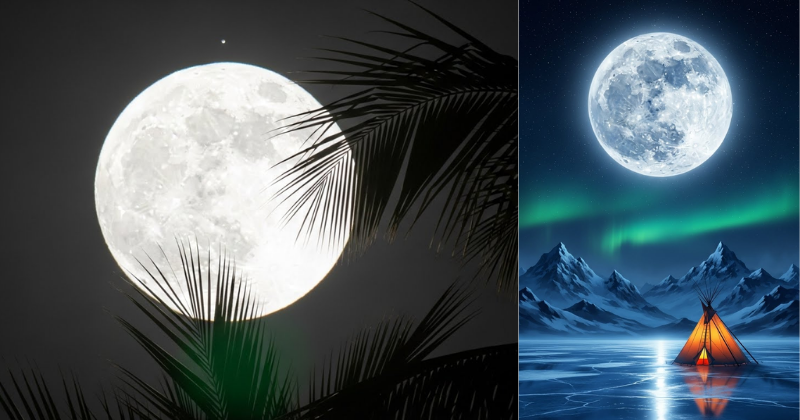
Prepare for the celestial spectacle on December 4th: the Cold Moon, the last Supermoon of the year. Understand the astronomy and history behind this annual event, exploring the orbital mechanics and lunar nomenclature.
What is the Cold Moon, December 4, The Last Supermoon of the Year?
The event scheduled for December 4th represents the culmination of a yearly astronomical cycle, featuring the full Moon closest to the winter solstice—traditionally known as the Cold Moon. This particular December full Moon gains further significance because it coincides with the Moon’s perigee, qualifying it as the last Supermoon of the year.
The term “Cold Moon” originates from Native American, Colonial American, and European traditions, marking the onset of the deepest winter cold when nighttime temperatures plummet. The fact that the Cold Moon on December 4th is also designated a Supermoon is due to its orbital alignment. A Supermoon occurs when the full Moon is near or at its closest point to Earth in its elliptical orbit (perigee), causing it to appear slightly larger and brighter than an average full Moon. This combination creates a visually striking event, closing out the year’s cycle of particularly large lunar displays.
How is the December Full Moon Classified as the Last Supermoon of the Year?
To understand the classification of the December 4th full Moon as the last Supermoon of the year, one must examine the specific mechanics of the lunar orbit. The Moon does not orbit the Earth in a perfect circle but in an ellipse.
This elliptical path results in two critical points:
- Perigee: The point in the Moon’s orbit when it is closest to Earth.
- Apogee: The point in the Moon’s orbit when it is farthest from Earth.
A “Supermoon” is defined by astrologer Richard Nolle as a full Moon (or new Moon) that occurs when the Moon is within 90% of its closest approach to Earth (perigee) in a given orbit. The December 4th full Moon occurs when the Moon’s distance is exceptionally close to perigee. Since the annual cycle of Supermoons typically concludes late in the calendar year, this Cold Moon earns the title of the last Supermoon of the year. While the difference in size is only about 7% to 14% larger and up to 30% brighter than the faintest full Moon (at apogee), the consistency of the classification is based on precise orbital measurements relative to the average Earth-Moon distance.
What is the Scientific Basis of the Supermoon Phenomenon?
The scientific basis for the Supermoon phenomenon lies purely in gravitational and orbital mechanics, independent of any cultural naming conventions like the Cold Moon, December 4. The Moon’s elliptical orbit is primarily influenced by the gravitational tugs from both the Earth and the Sun.
The shape of the Moon’s orbit, and thus the timing of perigee and apogee, subtly shifts over time, a phenomenon known as apsidal precession. For the full Moon on December 4th to align so closely with perigee is a predictable, though not constant, alignment. When the full Moon phase (when the Moon is opposite the Sun in the sky) aligns with perigee, the Moon appears visually larger because of the decreased distance. This decreased distance, quantified by the reduction in the value $r$ (the Earth-Moon distance) in Newton’s Law of Universal Gravitation, intensifies the Moon’s gravitational effect on Earth, leading to higher-than-average tides, a phenomenon often referred to as “perigean spring tides.”
Which Factors Influence the Visibility and Brightness of the Cold Moon?
The apparent visibility and brightness of the Cold Moon on December 4th are modulated by several atmospheric and optical factors, even with the enhanced size provided by the Supermoon effect.
- Atmospheric Extinction: When the Moon is low on the horizon, its light must travel through more of the Earth’s atmosphere. This thicker atmospheric layer scatters and absorbs more moonlight, causing the Moon to appear dimmer and often tinted red or orange. For optimal viewing, observe when the Moon is high in the sky.
- The Ebbinghaus Illusion: This optical illusion often makes observers perceive the Moon as much larger when it is viewed near foreground objects (trees, buildings) on the horizon. While the Moon’s angular size remains relatively constant throughout the night, this illusion enhances the visual impact of the last Supermoon of the year.
- Weather Conditions: Cloud cover and atmospheric haze significantly diminish the Moon’s visibility. Clear, dry air provides the sharpest contrast and best viewing opportunity for the bright December Moon.
What are the Historical and Cultural Origins of the Cold Moon Name?
The designation Cold Moon is rooted in the annual cycle of seasonal considerations observed by various indigenous and early European cultures in the Northern Hemisphere. These names were historically used to track the passage of time and the changing natural world.
The moniker “Cold Moon” is associated with the month of December, reflecting the significant drop in temperatures and the long, dark nights characteristic of early winter. Other historical names for the December full Moon include:
- Long Night Moon: Reflecting that the December full Moon occurs near the winter solstice, which is the longest night of the year.
- Moon Before Yule: A European term referencing the pre-Christian and Germanic winter festival.
- Frost Moon: A more general term shared with November, indicating freezing temperatures.
These traditions provide a rich, contextual detail to the contemporary astronomical event of the Cold Moon, December 4, The Last Supermoon of the Year, connecting modern science to historical human observation.
How Does the Supermoon Influence Earth’s Tides?
A critical, evidence-based component of the Supermoon phenomenon is its measurable impact on Earth’s tides. The Moon’s gravitational pull is the primary driver of tidal forces.
The tidal force exerted by the Moon is inversely proportional to the cube of the distance $r$ between the Earth and the Moon ($F \propto 1/r^3$). Because the last Supermoon of the year occurs when the Moon is at perigee, the distance $r$ is minimized, and the resultant gravitational force is maximized. This alignment, combined with the Earth-Sun-Moon alignment of the full Moon phase (resulting in spring tides), creates what are known as perigean spring tides. These tides are typically higher than normal high tides and lower than normal low tides, increasing the potential for coastal flooding, particularly when combined with storm surges or high regional sea levels. This is a rigorous interpretation of tidal science.
What is the Difference Between a Supermoon and a Micromoon?
To further contextualize the Cold Moon, December 4, The Last Supermoon of the Year, it is useful to methodically compare it to its opposite: the Micromoon.
| Feature | Supermoon (Perigee Full Moon) | Micromoon (Apogee Full Moon) |
| Orbital Position | Near or at Perigee (closest approach) | Near or at Apogee (farthest distance) |
| Distance (Approx) | $\le 362,000 \text{ km}$ from Earth | $\ge 405,000 \text{ km}$ from Earth |
| Apparent Size | Up to 14% larger than a Micromoon | Up to 14% smaller than a Supermoon |
| Apparent Brightness | Up to 30% brighter than a Micromoon | Significantly dimmer |
| Tidal Influence | Results in Perigean Spring Tides (higher) | Results in Apogean Neap Tides (lower) |
The Cold Moon, December 4, is on the Supermoon side of this binary classification, emphasizing the enhanced visual and tidal characteristics of this specific event. The difference between the two extreme appearances is significant enough to be noticeable to the casual observer, especially when observed with reference points.
How Can the Cold Moon, December 4, The Last Supermoon of the Year be Best Observed?
Observing the Cold Moon, December 4, The Last Supermoon of the Year requires minimal equipment but benefits from strategic planning and a clear understanding of atmospheric conditions.
- Timing: The full Moon phase is instantaneous, but the Supermoon effect is visible throughout the night. Consult local astronomical tables for the exact time of the full Moon phase and the time of perigee for the maximum effect.
- Location: Seek out a viewing location away from major sources of light pollution. This enhances the contrast between the brightly lit Moon and the dark night sky, revealing subtle details in the lunar surface.
- Enhancing the Illusion: To maximize the perceptual size increase offered by the Ebbinghaus illusion, observe the Moon shortly after moonrise when it is close to the eastern horizon, viewed over a distant cityscape or treeline.
- Photography: For detailed imaging, even a simple camera or smartphone on a tripod, utilizing a high optical zoom (if available) and a delayed shutter, can capture the impressive size and texture of the last Supermoon of the year.
Conclusion
The Cold Moon, December 4, The Last Supermoon of the Year is a predictable, yet compelling, alignment of lunar orbital mechanics and rich cultural history. It is classified as a Supermoon due to the close alignment of the full phase with perigee, resulting in a slightly larger and brighter appearance and the physical effect of heightened perigean spring tides. By understanding the scientific principles of the Moon’s elliptical orbit and leveraging optimal viewing conditions, observers can truly appreciate this significant celestial event, marking a visually impressive conclusion to the year’s cycle of Supermoons. This event serves as a powerful reminder of the precise, beautiful, and influential nature of our solar system’s gravitational dynamics.