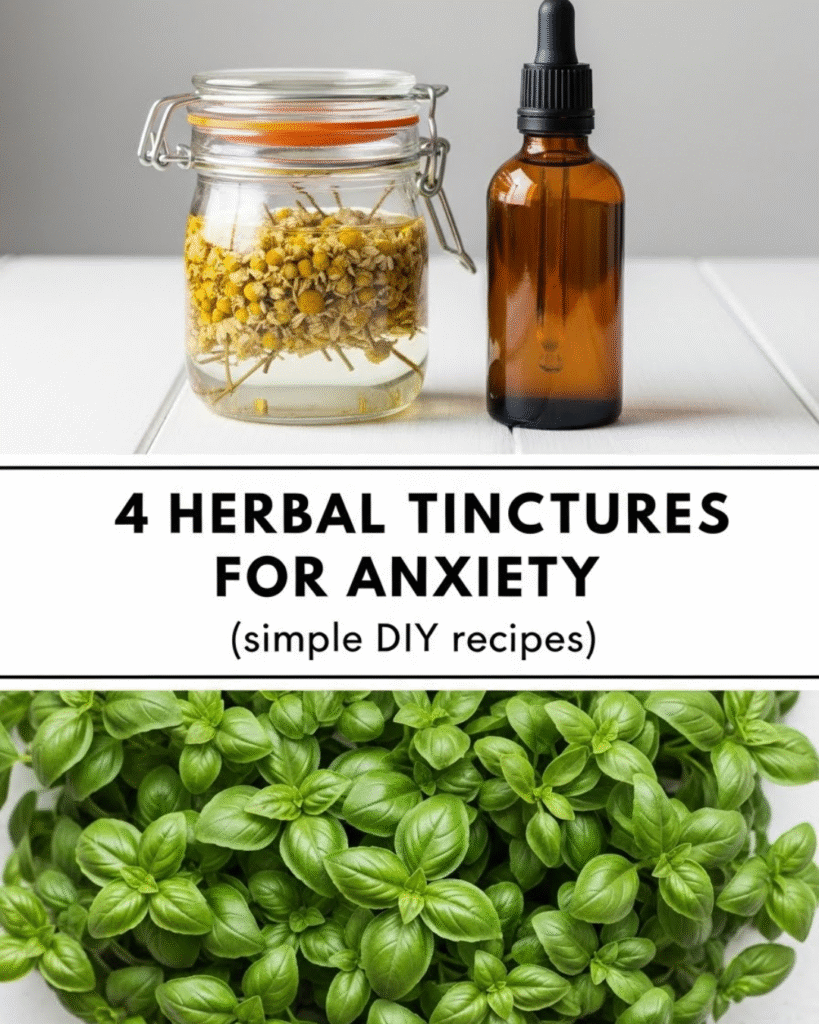
Feeling overwhelmed by stress and seeking natural, time-tested support for your nervous system? Making your own 4 HERBAL TINCTURES FOR ANXIETY is an accessible, empowering Home Tips & DIY project. This guide provides simple recipes to transform your approach to wellness topics, teaching you how to extract the potent, calming compounds from herbs like Lemon Balm and Passionflower. We’ll show you how to discover these simple DIY recipes, offering a cost-saving benefits solution for everyday emotional balance.
🛑 Important Disclaimer
Important Disclaimer: This article is for informational purposes only and should not replace professional advice. For health-related topics, consult healthcare providers. For financial or legal matters, seek qualified professional guidance. For safety procedures, verify current best practices and local regulations. Individual results may vary, and personal circumstances should always be considered when implementing any suggestions.
🌿 Section 1: Foundation First: Understanding Tinctures and Dosage
Before we dive into the 4 HERBAL TINCTURES FOR ANXIETY, let’s build confidence with basic concepts about what a tincture is and how this form of herbal remedy works.
H3: Building Confidence with Basic Concepts: What is a Tincture?
A tincture is a concentrated liquid herbal extract created by soaking herbs (fresh or dried) in a solvent, typically alcohol (ethanol), for several weeks.
- Extraction Power: Alcohol is an excellent solvent that can dissolve and extract compounds (like alkaloids, terpenes, and volatile oils) that water alone cannot, resulting in a potent, shelf-stable remedy.
- The Ratio: Tincture strength is often described by the herb-to-solvent ratio, such as 1:5 (1 part herb to 5 parts solvent by weight or volume). For simplicity in our DIY recipes, we will use the “folk method” (filling the jar with herbs, then topping with liquid).
H3: Addressing Common Concerns: Safety and Solvent Choice
When making 4 HERBAL TINCTURES FOR ANXIETY, your choice of solvent and safety considerations are paramount.
- Solvent Choice: The best solvent for most anxiety-relieving herbs is a grain alcohol (like vodka) that is 80-100 proof (40-50% alcohol). This percentage range is high enough to extract the active compounds but is still safe for consumption in small doses.
- Encouraging Reassurance for Beginners: Always start with a low dose (5-10 drops) to see how your body reacts to the specific herb. Consult your healthcare provider before combining tinctures with prescription medications, especially those for anxiety or sleep.
🌼 Section 2: Core Methods: The General DIY Tincture Process
All 4 HERBAL TINCTURES FOR ANXIETY follow the same core methodology. This step-by-step guidance is the template for all our recipes.
Ingredients and Tool Requirements
| Tool Requirement | Purpose | Safety Consideration |
| Glass Jars (Pint or Quart) | For maceration (steeping) | Must be clean and dry. |
| Parchment Paper or Plastic Lids | To prevent metal lids from touching alcohol | Avoid corrosion, which can taint the tincture. |
| Fine Mesh Strainer & Muslin Cloth | For filtering the finished tincture | Ensures a clean, sediment-free final product. |
| Dark Glass Dropper Bottles | For storage and dosing | Protects the tincture from light degradation. |
| Solvent: 80-100 Proof Vodka or Grain Alcohol | The extraction liquid (40-50% alcohol) | Store securely and clearly label. |
Step-by-Step Process (Core Methods)
- Preparation (Actionable Language): Gather your dried herb. Use the “fill and pour” (folk) method. Fill a clean, sterilized glass jar one-third to one-half full with the dried herb, or three-quarters full if using fresh herbs.
- Maceration (Timing and Planning Considerations): Pour the 80-100 proof alcohol over the herbs, filling the jar completely, leaving about $1 \text{ inch}$ of headspace. Cover the jar tightly. Place parchment paper between the liquid and the metal lid.
- Steeping (The Waiting Game): Store the jar in a cool, dark place for 4-6 weeks. Shake the jar vigorously once per day to ensure the herbs are evenly saturated and to facilitate the extraction process. This achievable routine is key.
- Straining: After 4-6 weeks, place a fine mesh strainer over a large measuring cup and line the strainer with muslin cloth or cheesecloth. Pour the liquid through the cloth. Gather the cloth around the spent herb material (the marc) and squeeze firmly to extract every last drop of precious tincture.
- Bottling and Labeling: Pour the strained tincture into dark glass dropper bottles. Practical tips: Label immediately with the Herb Name, Alcohol Percentage, and the Date it was Strained. Tinctures can last $3 \text{-} 5$ years when stored in a cool, dark place.
🌿 Section 3: Advanced Strategies: The 4 DIY Recipes
Here are the specific recipes for the 4 HERBAL TINCTURES FOR ANXIETY, categorized by their action on the nervous system.
H3: Tincture 1 & 2: Nervine Relaxants (Immediate Stress Support)
These herbs are best for acute moments of stress or tension.
1. Lemon Balm (Melissa officinalis) Tincture
- Herb Part Used: Leaf and flowering tops (fresh is preferred for a better flavor and compound profile).
- Action: Known to soothe the nervous system, elevate mood, and calm anxiety. Scientific Backing: Contains volatile oils that may interact with GABA receptors in the brain, similar to prescription anxiety medications, promoting relaxation.
- DIY Recipe Adjustment: If using fresh herb (highly recommended), fill the jar three-quarters full to account for shrinkage, using 80-proof vodka.
2. Passionflower (Passiflora incarnata) Tincture
- Herb Part Used: Dried aerial parts (leaves and flowers).
- Action: A gentle sedative and nervine indicated for nervous restlessness, worry, and difficulty sleeping due to anxiety.
- DIY Recipe Adjustment: Because it is lighter, fill the jar halfway with the dried herb to ensure adequate solvent coverage. Use 100-proof alcohol to maximize the extraction of its alkaloids.
H3: Tincture 3 & 4: Nervine Tonics (Long-Term Resilience)
These herbs work over time to support and strengthen the nervous system, helping to prevent anxiety from escalating.
3. Oat Straw (Avena sativa) Tincture
- Herb Part Used: Fresh milky oat tops (the unripened grain) or dried oat straw.
- Action: A powerful nervine tonic, famous for “feeding” the nervous system. It supports long-term nerve health, resilience to stress, and recovery from burnout.
- DIY Recipe Adjustment: Use the fresh milky tops if possible (when harvested, they exude a milky sap when squeezed); this requires 100-proof alcohol. If using dried oat straw, fill the jar halfway. This is a sustainable lifestyle change ingredient.
4. Skullcap (Scutellaria lateriflora) Tincture
- Herb Part Used: Dried aerial parts.
- Action: Often used to calm “chattering” thoughts and nervous exhaustion. It’s excellent for anxiety characterized by muscle tension, restlessness, and insomnia.
- DIY Recipe Adjustment: Use the percolation method if possible for maximum extraction, or simply follow the folk method, ensuring the herb is completely submerged to prevent mold.
🛠️ Section 4: Troubleshooting and Common Challenges
Making 4 HERBAL TINCTURES FOR ANXIETY is simple, but issues can arise. Here are solutions to common Home Tips & DIY challenges.
Featured Snippet Potential: “My homemade herbal tincture is cloudy and has sediment. Is it safe to use?”
If your homemade herbal tincture is cloudy and has sediment, it is likely safe to use, assuming you followed sanitary procedures. The cloudiness is often caused by fine herbal particles or the precipitation of certain compounds (like resins) when the tincture is cooled or diluted. The best solution is filtering: simply re-strain the tincture one or more times using a fine coffee filter or several layers of clean muslin cloth to achieve a clear final product.
Practical Troubleshooting Tips (DIY Focus)
- Problem: Mold/Fuzz is growing on the top of the herbs.
- Obstacle: The herb was not completely submerged (“herb cap”), or the alcohol proof was too low.
- Solution: Alternative Approaches: The batch must be discarded due to potential contamination risks. Next time, always ensure the alcohol completely covers the plant material. If using fresh herbs, increase the alcohol proof to $100 \text{ proof}$ (50%) to counteract the moisture content of the fresh plant.
- Problem: The tincture tastes too strong (too alcohol-heavy).
- Obstacle: The flavor of the alcohol is too harsh for consumption.
- Solution: Encouragement for Setbacks: Tinctures are often diluted for consumption. Add your dose (e.g., $15 \text{ drops}$) to $1 \text{-} 2$ ounces of warm water or juice. This flash-evaporates some alcohol, making the taste much milder and more palatable.
- Problem: The final tincture is watery and not dark/potent.
- Obstacle: The herb-to-solvent ratio was too weak (too little herb for the amount of alcohol).
- Solution: Preventive Measures: Next time, pack the jar more tightly, especially if using dried, fluffy herbs like Lemon Balm. For the current batch, you can perform a double maceration by adding a new batch of fresh/dried herbs to the strained liquid and letting it steep for another 4 weeks.
🚀 Section 5: Maximizing Results: Next Level Tincture Use
Once you have your four powerful herbal tinctures for anxiety, here’s how to build upon basic success for long-term emotional support.
- Show How to Build Upon Basic Success: Create a Custom “Relaxation Blend.” Blend your nervine relaxants (Lemon Balm, Passionflower) with your nervine tonics (Oat Straw, Skullcap) to create a synergistic formula. For example, a blend of $1 \text{ part}$ Passionflower and $2 \text{ parts}$ Oat Straw can address acute anxiety while supporting long-term nerve health.
- Maintenance and Long-Term Considerations: Tinctures are best used consistently over time, especially the nervine tonics. Integrate them into a daily ritual. Keep the Lemon Balm handy for acute panic, but take the Oat Straw daily for sustained support. This represents gradual progress toward a regulated nervous system.
- Suggest Complementary Strategies: Glycerin Tinctures (Glycerites): For those who avoid alcohol, use the same DIY recipes but swap the alcohol for pure vegetable glycerin. The process is the same, though the extraction is less potent, and the shelf life is shorter (about 1 year). This provides multiple options to suit different preferences. (Internal Linking Opportunity: Learn HOW TO GROW MUSHROOMS FROM SCRAPS for additional kitchen DIY projects.)
✅ Conclusion: Your Capability to Achieve Inner Calm
You have now unlocked the simple, effective process for making 4 HERBAL TINCTURES FOR ANXIETY. By embracing these DIY recipes and understanding the specific actions of these powerful herbs, you have successfully transformed your medicine cabinet into a source of natural, sustainable lifestyle changes. This self-care project proves your capability to succeed in harnessing the benefits of herbal medicine.
Which of these four herbal tinctures—the mood-boosting Lemon Balm or the restorative Oat Straw—will be the first you craft in your journey toward inner calm?