
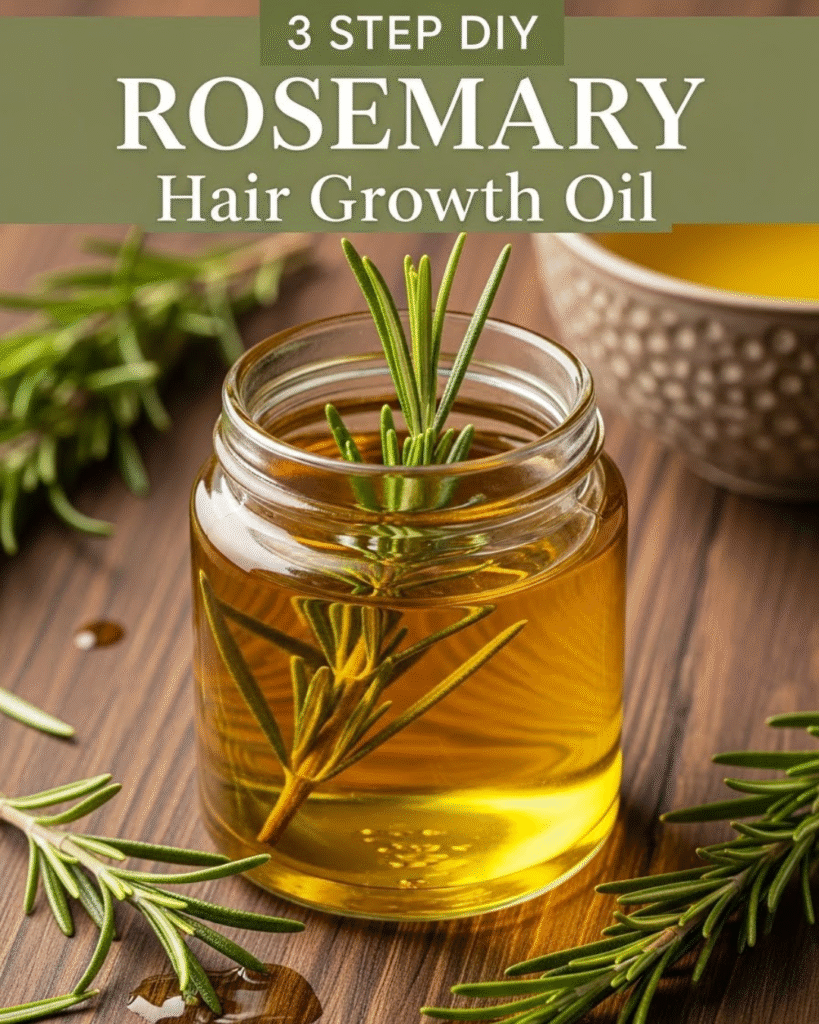
Are you dreaming of thicker, longer, and healthier hair but tired of expensive store-bought serums filled with confusing ingredients? You deserve a powerful, natural solution that promotes real hair growth! This guide is your achievable blueprint for creating a potent 3 STEP DIY ROSEMARY Hair Growth Oil right in your own kitchen. This Home Tips & DIY project taps into ancient botanical wisdom, offering immense cost-saving benefits and the deep satisfaction of creating your own personalized wellness topics treatment. Get ready to discover how to transform your hair care routine using the proven power of rosemary.
🛑 Important Disclaimer
Important Disclaimer: This article is for informational purposes only and should not replace professional advice. For health-related topics, consult healthcare providers. For financial or legal matters, seek qualified professional guidance. For safety procedures, verify current best practices and local regulations. Individual results may vary, and personal circumstances should always be considered when implementing any suggestions.
🌿 Section 1: Foundation First: The Scientific Power of Rosemary
Before diving into the 3 STEP DIY ROSEMARY Hair Growth Oil recipe, it’s essential to build confidence with basic concepts about why rosemary is considered the gold standard for promoting hair health and density.
H3: Building Confidence with Basic Concepts: Rosemary’s Mechanism of Action
Rosemary is not just a fragrant herb; it is a proven natural remedy, earning its spot in serious hair care discussions.
- Scientific Backing: Rosemary oil contains carnosic acid, which has been shown to heal nerve damage and improve local circulation. Specifically, it stimulates the blood circulation in the scalp. Better circulation means more essential nutrients and oxygen are delivered directly to the hair follicles, which encourages growth and helps prevent premature hair loss.
- A Natural Alternative: Studies have suggested that rosemary oil can be as effective as minoxidil (a common over-the-counter hair growth treatment) but with fewer reported side effects. This makes it a fantastic, sustainable lifestyle change for managing hair thinning.
H3: Addressing Common Concerns: Essential Oil vs. Whole Herb
When creating your DIY ROSEMARY Hair Growth Oil, you have two powerful options.
| Ingredient Source | Pros | Cons |
| Rosemary Essential Oil (EO) | Highly concentrated; instant potency; cleaner final oil. | Requires careful dilution; more expensive upfront. |
| Fresh/Dried Rosemary Herb | Lower cost; gentle infusion; adds a connection with nature. | Requires longer infusion time; shorter shelf life due to moisture risk. |
- Encouraging Reassurance for Beginners: This 3 STEP DIY ROSEMARY Hair Growth Oil uses Rosemary Essential Oil for maximum potency, stability, and ease, ensuring an achievable and successful first attempt.
🍯 Section 2: Step-by-Step Process: The 3-Step Recipe
This section provides the clear, actionable language and step-by-step guidance to successfully create your potent Rosemary Hair Growth Oil.
Ingredients and Tool Requirements
| Ingredient | Quantity | Purpose | Tool Requirement |
| Carrier Oil (Jojoba, Grapeseed, or Castor) | 4 oz (1/2 cup) | Dilutes EO, provides moisturizing base | Dark Glass Dropper Bottle (4 oz) |
| Rosemary Essential Oil (Pure 100%) | $30 \text{ drops}$ | The active growth stimulant (5% dilution) | Small funnel |
| Peppermint Essential Oil (Optional) | $5 \text{ drops}$ | Boosts circulation, adds a cooling sensation | Measuring spoons/cups |
Step-by-Step Guidance (Core Methods)
H3: Step 1: Selecting and Measuring the Carrier Oil
The carrier oil is the foundation. It dilutes the potent Rosemary Essential Oil and delivers moisturizing benefits to your scalp and strands.
- Actionable Language: Using your funnel and measuring cup, carefully pour $4 \text{ ounces}$ of your chosen Carrier Oil into the dark glass dropper bottle.
- Practical Tips and Shortcuts: Jojoba Oil closely mimics the scalp’s natural sebum, making it ideal for most hair types. Castor Oil is thicker and excellent for deep conditioning and sealing ends, but it can feel heavy—consider blending $3 \text{ oz}$ of Jojoba with $1 \text{ oz}$ of Castor for a balanced mix.
H3: Step 2: Diluting the Essential Oils
Proper dilution is a crucial safety consideration in this 3 STEP DIY ROSEMARY Hair Growth Oil. A 5% dilution is effective yet safe for the scalp.
- Safety First: Remember, never apply undiluted essential oils directly to your scalp.
- Actionable Language: Drop $30 \text{ drops}$ of Rosemary Essential Oil into the $4 \text{ oz}$ of carrier oil already in the bottle. If using the optional Peppermint Essential Oil, add $5 \text{ drops}$ now.
- Seal and Shake (Timing and Planning Considerations): Tightly seal the dropper bottle. Shake vigorously for at least $30 \text{ seconds}$ to ensure the essential oils are thoroughly dispersed into the carrier oil. This step is instantaneous, making this a quick DIY project.
H4: Step 3: Storage and Curing
For maximum efficacy and safety, store your finished product correctly.
- Store your finished 3 STEP DIY ROSEMARY Hair Growth Oil in a cool, dark place, away from direct sunlight. The dark glass bottle is required to protect the oils from UV degradation, preserving their potency. The oil is ready to use immediately!
🚀 Section 3: Advanced Strategies: Application and Customization
Creating the oil is just the start. Advanced strategies focus on optimal application and enhancing the formula to truly unlock your hair’s growth potential.
- Expert-Level Insights: The most effective way to use the oil is through a targeted scalp massage, which manually enhances the blood flow that the rosemary is stimulating chemically.
H3: Ways to Customize Approach: Advanced Application Technique
- The Nightly Dose: Use the dropper to apply $5 \text{-} 10 \text{ drops}$ directly onto your scalp, focusing on areas of concern (temples, crown).
- The Scalp Massage: Use your fingertips (not nails!) to massage the oil into your scalp using gentle, circular motions for $3 \text{-} 5 \text{ minutes}$. This is a key step in this wellness topics routine, promoting self-care and stimulating follicles.
- Timing Consideration: Leave the oil on overnight and wash your hair in the morning. This allows the rosemary compound enough time to penetrate and work its magic.
H3: Creative Solutions: Boosting the Formula
You can provide multiple options to suit different preferences by adding secondary growth-boosting ingredients to your $4 \text{ oz}$ blend (ensure total essential oil drops do not exceed $45 \text{ drops}$).
- For Thickening: Add $10 \text{ drops}$ of Cedarwood Essential Oil. Cedarwood has traditionally been used to strengthen hair follicles.
- For Dandruff/Scalp Health: Add $5 \text{ drops}$ of Tea Tree Essential Oil. Tea Tree is a powerful antiseptic and antifungal agent that can help maintain a clean, healthy scalp—a prerequisite for good hair growth.
🛠️ Section 4: Troubleshooting and Common Challenges
Even with a simple bath bomb recipe all-natural ingredients or a DIY oil, issues can arise. Here are solutions and practical troubleshooting tips for common hair oil challenges.
Featured Snippet Potential: “How often should I use homemade rosemary oil for hair growth to see results?”
To see visible results from homemade rosemary oil for hair growth, you should aim for consistent use, applying the oil to the scalp 2-4 times per week, massaging it in for at least 3 minutes, and leaving it on for a minimum of 30 minutes (or ideally overnight). Since hair grows slowly (approximately $1/2 \text{ inch}$ per month), expect to see noticeable reduction in shedding and new growth (baby hairs) after 3-6 months of regular application.
Practical Troubleshooting Tips (Wellness Focus)
- Problem: My hair feels excessively greasy, even after washing.
- Obstacle: You are using too much oil or a carrier oil that is too heavy (like pure Castor Oil).
- Solution: Alternative Approaches: Reduce the amount used to $5 \text{ drops}$ and focus application only on the scalp, not the lengths. Try using a lighter carrier oil like Grapeseed or a $1:1$ blend of Jojoba and Argan oil.
- Problem: My scalp feels tingly or slightly irritated after application.
- Obstacle: The essential oil concentration is too strong for your skin sensitivity.
- Solution: Encouragement for Setbacks: This is a safety consideration. Immediately stop using the blend. Dump out half of the current mixture and refill the bottle with $2 \text{ ounces}$ of fresh carrier oil. This re-dilutes the essential oils, making the blend gentler (now approximately 2.5% dilution).
- Problem: The oil appears cloudy or has separated after a few weeks.
- Obstacle: If you used fresh rosemary (which is not recommended for beginners) or if the oil was exposed to water or extreme temperature changes.
- Solution: Preventive Measures: Use only essential oils for this recipe. Ensure your dropper bottle is completely dry before mixing. Store the oil in a cool, dark cabinet. If cloudiness persists, discard and make a fresh batch to maintain potency.
🌟 Section 5: Maximizing Results: Next Level Hair Care
You’ve achieved success with your 3 STEP DIY ROSEMARY Hair Growth Oil. Here are next level tips to compound those benefits and accelerate your hair transformation.
- Show How to Build Upon Basic Success: The Micro-Needle Accelerator. Before applying the oil, gently use a derma-roller (micro-needling tool) with $0.25 \text{ mm}$ needles on your scalp $1 \text{-} 2 \text{ times per week}$. Micro-needling creates tiny channels that significantly enhance the absorption of the Rosemary Hair Growth Oil, maximizing its effectiveness.
- Maintenance and Long-Term Considerations: Incorporate weekly clarifying treatments. Using a growth oil can lead to product buildup over time. A simple apple cider vinegar rinse ($1$ part $\text{ACV}$ to $3$ parts water) once every two weeks helps remove buildup, ensuring your follicles remain clear and receptive to the rosemary oil. This is key for sustainable lifestyle changes. (Internal Linking Opportunity: Learn how to make a natural hair rinse for shine using herbs.)
- Suggest Complementary Strategies: The Internal Boost (Wellness Focus): Hair growth requires nutrients from the inside out. Pair your topical oil treatment with a daily intake of biotin, iron, and protein-rich foods. Consistent internal nourishment supports the topical work of the rosemary oil for faster, stronger results.
✅ Conclusion: Your Capability to Nurture Growth
You have now successfully mastered the 3 STEP DIY ROSEMARY Hair Growth Oil recipe, taking control of your hair health journey. By understanding the scientific backing of rosemary and implementing these achievable steps, you are actively working to transform your hair’s density and resilience. This project proves your capability to succeed in crafting powerful, personalized wellness topics treatments.
Ready to start your journey to thicker hair? Will you use the nightly scalp massage method, or experiment with the advanced micro-needling strategy first?