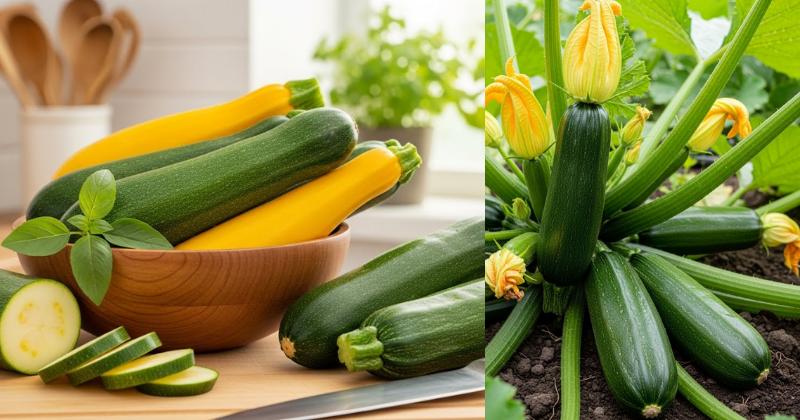
Zucchini is the quintessential summer crop—fast-growing, rewarding, and incredibly prolific. But what if you could move past simply growing zucchini to consistently growing great zucchini? If you are ready to transform your vegetable patch into a vibrant, high-yield home garden, you’ve come to the right place. This guide is packed with the best tricks for growing great zucchini, ensuring you move beyond the common problems of mushy fruit and powdery mildew. We will provide achievable, step-by-step guidance to help you nurture healthy plants, maximize your harvest, and enhance your connection with nature this growing season.

🪴 Section 1: Foundation First: Understanding Zucchini’s Needs
Before you put a shovel in the dirt, it is vital to build confidence with basic concepts about this generous summer squash. Zucchini’s high productivity is matched only by its high demands.
H3: Building Confidence with Basic Concepts: Sun, Soil, and Space
Zucchini (a summer squash, Cucurbita pepo) is a vigorous plant that requires specific conditions to thrive. Ignoring these basics is the quickest path to disappointment.
- Sunlight is Non-Negotiable: Zucchini requires a minimum of 6 to 8 hours of direct, unfiltered sunlight per day. Plant them in the sunniest spot in your home garden.
- The Soil is Key: They are heavy feeders and prefer rich, well-draining soil packed with organic matter. Amending your planting area with plenty of compost before planting is the most important step you can take. They thrive in a slightly acidic to neutral $\text{pH}$ (6.0 to 7.5).
- Space is Your Friend: Zucchini plants are deceptively large, often spreading $3 \text{-} 4 \text{ feet}$ in diameter. Encouraging reassurance for beginners: Give each plant plenty of room—crowding them leads to poor air circulation, which is a major cause of disease.
H3: Addressing Common Concerns: Starting from Seed
While you can purchase starter plants, starting zucchini from seed is easy, cheap, and leads to stronger plants.
- Timing is Everything (Seasonal Considerations): Do not plant zucchini until all danger of frost has passed, and the soil temperature is reliably above $60^{\circ}\text{F}$ ($15^{\circ}\text{C}$). For many regions, this is late May or early June.
- Encouraging Language about Growing: Planting directly into the soil where it will grow is preferred, as this minimizes root disturbance and builds a strong foundation. Plant seeds $1 \text{ inch}$ deep in hills or rows.
💧 Section 2: Step-by-Step Process: Core Methods for Vigor
Once your seeds sprout, consistent care is essential. The best tricks for growing great zucchini involve mastering water, feeding, and protection.
Step 1: Watering Deeply and Consistently
Zucchini is $95\%$ water, meaning it needs massive hydration to produce large, healthy fruits.
- Actionable Language: Water deeply at the base of the plant every morning. Aim for $1 \text{-} 2 \text{ inches}$ of water per week, adjusting for rainfall.
- Practical Tips and Shortcuts: Never spray water on the leaves, especially in the evening. Wet foliage is a prime breeding ground for powdery mildew. Use soaker hoses or drip irrigation to keep the water focused on the root zone, maximizing your cost-saving benefits by reducing evaporation.
Step 2: Fertilizing for the Massive Harvest
As heavy feeders, zucchini need consistent nutrients, especially once they start flowering.
- Actionable Language: Once the first flowers appear, begin feeding with a balanced, organic liquid fertilizer (like $10\text{-}10\text{-}10$) every $2 \text{-} 3 \text{ weeks}$.
- Nutrient Focus: Pay attention to Potassium ($\text{K}$) and Phosphorus ($\text{P}$). While Nitrogen ($\text{N}$) promotes leaf growth, P and K are essential for massive flower and fruit production. Supplement with compost tea for a gentle, steady feed. (Internal Linking Opportunity: Learn how to make “DIY Organic Compost Tea for High-Yield Vegetables.”)
Step 3: Mastering Pollination (The Crucial Trick)
The most common reason for zucchini failure is poor pollination, leading to small fruits that shrivel at the ends (often called “blossom drop”).
- The Problem: Zucchini produces separate male and female flowers. The male flowers appear first, on long, thin stalks. The female flowers have a tiny, baby zucchini visible at their base. Pollen must be transferred from the male to the female flower, typically by bees.
- The Shortcut (Hand Pollination): If you see fruit shriveling, you need to hand-pollinate. Using a small, soft paintbrush or cotton swab, collect pollen from a fresh male flower and gently brush it onto the stigma (the center part) of a freshly opened female flower. This simple, achievable DIY action guarantees pollination and a strong yield.
✂️ Section 3: Advanced Strategies: Pruning and Pest Prevention
To move into growing great zucchini territory, you need to apply expert-level insights for better airflow and targeted defense against key pests.
H3: Creative Solutions: Strategic Leaf Pruning
Pruning seems counter-intuitive, but it’s one of the best tricks for growing great zucchini.
- Why Prune: The massive leaves of a zucchini plant block airflow, trap moisture, and provide cover for powdery mildew spores and squash bugs.
- The Technique: Once the plant is actively producing, use sharp, sterilized shears to remove $3 \text{-} 4$ of the oldest, largest leaves from the center of the plant. Creative Solutions: Only remove leaves that are yellowing or those that cover developing fruits or block air circulation. This redirects energy toward the fruit and minimizes disease vulnerability.
H3: Encourage Experimentation: Vertical Growing
If you have limited space, or just want to increase airflow, try growing vertically!
- Customizing Your Approach: While traditionally grown sprawling on the ground, zucchini can be trained to grow up a sturdy trellis or tomato cage. Secure the main vine loosely to the support as it grows. This dramatically increases the airflow, keeping the leaves dry and reducing pest pressure. This is an excellent example of maximizing yields in small-space home garden setups.
🐞 Section 4: Troubleshooting and Common Challenges
Zucchini is susceptible to a few persistent enemies. Knowing how to quickly address these issues is essential for protecting your harvest.
Featured Snippet Potential: “What is the best way to get rid of powdery mildew on zucchini plants?”
The best way to treat powdery mildew on zucchini plants is to apply a homemade baking soda solution: mix 1 tablespoon of baking soda and 1 teaspoon of liquid soap (like Castile soap) into 1 gallon of water. Spray this solution liberally on the affected leaves, ensuring full coverage, especially the undersides. Always apply the spray in the early morning or late evening when the sun is not directly hitting the leaves to prevent leaf burn.
Practical Troubleshooting Tips (Pest Control)
- Problem: Holes are appearing in the leaves, and the plant is wilting rapidly.
- Obstacle: This is likely the destructive Squash Vine Borer (SVB), which tunnels into the stem base.
- Solution: Practical Troubleshooting Tips: Look for sawdust-like material (frass) near the base. If found, use a sharp, thin knife to carefully slit the stem lengthwise to remove the borer. Cover the damaged area immediately with soil to encourage the plant to reroot. Next season, use preventive measures like covering the young plants with row covers until flowering begins.
- Problem: Small green or brown insects cluster on the stems and leaves.
- Obstacle: These are Squash Bugs, which suck the sap out of the plant.
- Solution: Alternative Approaches: Hand-pick the adult bugs and drop them into a bucket of soapy water. Look for their clusters of copper-colored eggs, usually found on the underside of leaves, and scrape them off immediately.
- Problem: The entire plant suddenly collapsed and died.
- Obstacle: This is often Bacterial Wilt, spread by Cucumber Beetles.
- Solution: Unfortunately, there is no cure once the plant is infected. Encouragement for Setbacks: Immediately remove and destroy the entire plant (do not compost it) to prevent the disease from spreading. Focus on aggressive preventive measures next season by controlling the cucumber beetle population early.
🍽️ Section 5: Maximizing Results: Harvesting and Extending the Season
The true joy of growing great zucchini lies in the harvest. Knowing when and how to pick the fruit is crucial for flavor and production.
- Show How to Build Upon Basic Success: Harvest Early and Often. Do not wait for giant zucchini! The best flavor and texture are found when the fruit is small—$6 \text{-} 8 \text{ inches}$ long. Picking frequently is one of the best tricks for growing great zucchini because it signals the plant to produce more flowers and fruits. If you let one get massive, the plant slows production.
- Maintenance and Long-Term Considerations: Succession Planting. Extend your harvest by planting new seeds every $2 \text{-} 3 \text{ weeks}$ until mid-summer. As your first plants begin to decline due to disease or age in late summer, your new plants will be just hitting peak production.
- Suggest Complementary Strategies: Pest Repellent Companion Planting. Plant deterring herbs nearby to support your ecosystem benefits. Basil is great for repelling cucumber beetles, and Nasturtiums can act as a trap crop, drawing aphids away from your zucchini. (Internal Linking Opportunity: Discover the “Top 5 Companion Plants for a Pest-Free Vegetable Garden.”)
✅ Conclusion: Your Capability to Nurture an Abundant Harvest
You are now armed with the best tricks for growing great zucchini, from mastering pollination to strategically pruning for maximum airflow. By providing rich soil, deep water, and applying targeted pest control, you have proven your capability to succeed in growing and nurturing this vigorous plant. Your home garden is ready to deliver an abundant, high-quality summer harvest that will keep your kitchen well-stocked.
Ready to start planting? Will you focus on mastering hand pollination this year, or will you try vertical growing for better airflow?