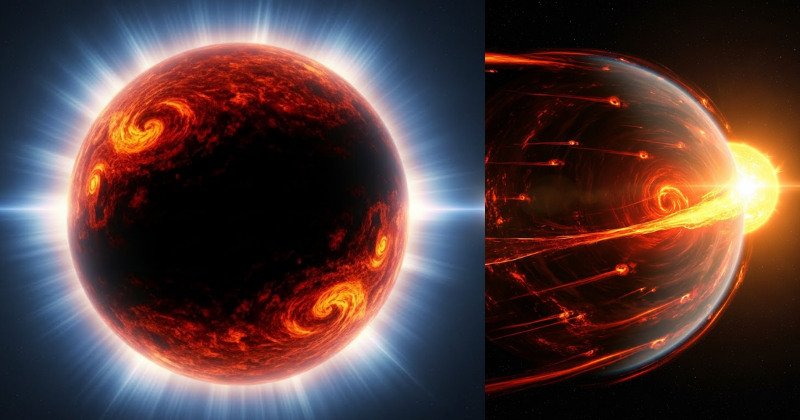
Astronomers discovered a scorching exoplanet where silicate gas condenses into molten glass rain and is blown sideways by $5,000 \text{ mph}$ winds. This finding, epitomized by the bizarre planet $\text{HD }189733\text{b}$, challenges the notion that Earth’s formation is a unique phenomenon.
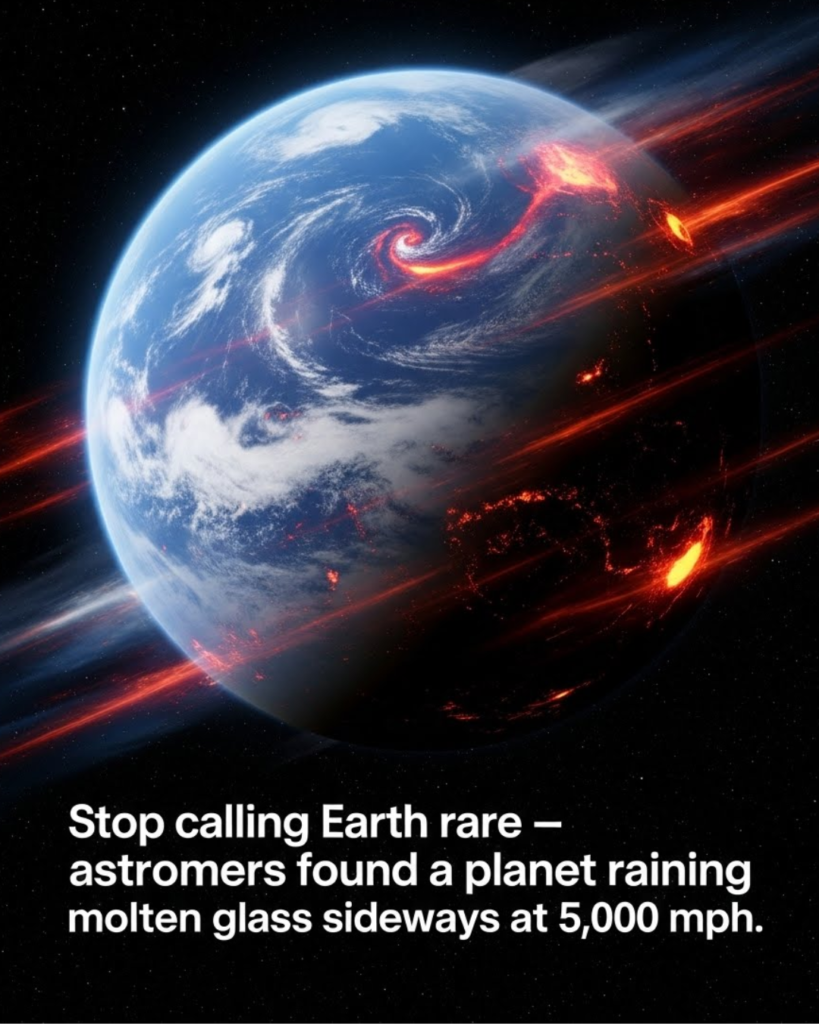
What is the Exoplanet $\text{HD }189733\text{b}$ and Why is it Called the “Molten Glass World”?
The exoplanet $\text{HD }189733\text{b}$ is a hot Jupiter—a class of gas giant exoplanets that orbit extremely close to their parent stars. Located approximately $63$ light-years away in the constellation Vulpecula, $\text{HD }189733\text{b}$ is slightly larger than Jupiter but orbits its star, $\text{HD }189733\text{A}$, every $2.2$ Earth days. This close proximity results in surface temperatures reaching an extraordinary $1,800^\circ\text{F}$ ($1,000^\circ\text{C}$).
The epithet “Molten Glass World” is a direct reference to the planet’s atmospheric composition and extreme weather. Scientists, utilizing advanced spectroscopic analysis, determined that the planet’s thick, turbulent atmosphere is rich in silicates, the primary component of glass and sand on Earth. On the dayside, the immense heat vaporizes these silicates into a gaseous cloud. As this vapor is transported to the cooler nightside by hurricane-force winds, it condenses into droplets of liquid, or molten, glass. These droplets, rather than falling vertically, are propelled sideways at speeds up to $7,000 \text{ km/h}$ ($\approx 5,000 \text{ mph}$), creating the bizarre phenomenon described as a planet raining molten glass sideways at $5,000 \text{ mph}$. This observation underscores the radical diversity of planetary atmospheres outside our solar system.
How Do Astronomers Measure the Extreme Atmospheric Conditions on $\text{HD }189733\text{b}$?
Measuring the composition and velocity of the atmosphere on a distant exoplanet like $\text{HD }189733\text{b}$ requires sophisticated techniques rooted in physics, primarily transit spectroscopy and Doppler measurements.
The key method involves observing the planet as it transits, or passes in front of, its parent star. During this transit, the star’s light filters through the planet’s atmosphere. Different chemical elements absorb light at specific, unique wavelengths.
- Spectroscopic Analysis: Astronomers use instruments like the Hubble Space Telescope to analyze the stellar light that reaches Earth. By detecting specific absorption lines—for example, the distinct signature of sodium or silicates—scientists can deduce the atmospheric composition. The detection of scattering by tiny silicate particles provided the primary evidence for the “molten glass” clouds.
- Doppler Measurement of Winds: The speed and direction of the super-hurricane-force winds—up to $5,000 \text{ mph}$—are determined using the Doppler shift. When the exoplanet’s atmosphere moves toward the observer, the absorption lines are slightly shifted to blue wavelengths; when moving away, they shift to red wavelengths. The magnitude of this shift allows researchers to calculate wind velocities with remarkable precision, confirming the sideways movement of the silicate clouds.
What Causes the Massive Temperature Difference Between the Day and Night Sides?
The immense contrast in temperature on $\text{HD }189733\text{b}$, a characteristic shared by many hot Jupiters, is primarily due to a phenomenon known as tidal locking, combined with an inefficient heat transfer mechanism.
Tidal Locking: $\text{HD }189733\text{b}$ is tidally locked to its star, meaning one side of the planet (the dayside) perpetually faces the star, while the other side (the nightside) remains in eternal darkness. This is similar to how the Moon orbits the Earth. The intense stellar radiation constantly bombards the dayside, superheating the atmosphere to approximately $1,800^\circ\text{F}$ ($1,000^\circ\text{C}$).
Inefficient Heat Transfer: Despite the existence of massive winds (at speeds up to $5,000 \text{ mph}$) that transport heat laterally, the transfer of this heat to the nightside is relatively inefficient due to the planet’s dense, high-opacity atmosphere. This results in the nightside being significantly cooler, dropping to temperatures around $1,200^\circ\text{F}$ ($650^\circ\text{C}$). This $600^\circ\text{F}$ difference is the thermodynamic engine driving the powerful atmospheric currents that create the bizarre molten glass rain that is blown sideways.
How Does $\text{HD }189733\text{b}$ Challenge the “Rare Earth” Hypothesis?
The study of exoplanets like $\text{HD }189733\text{b}$ directly contributes to a comprehensive scientific analysis that challenges the “Rare Earth” hypothesis—the idea that the unique conditions necessary for complex life on Earth are exceptionally improbable.
The existence of a planet with such radical atmospheric processes and a composition so dramatically different from the gas giants in our own solar system highlights the sheer diversity and multitude of outcomes possible during planetary formation. The ongoing discovery of super-Earths, mini-Neptunes, and ultra-hot Jupiters, including $\text{HD }189733\text{b}$, demonstrates that planetary formation is a common phenomenon in the galaxy. While the conditions on $\text{HD }189733\text{b}$ are undeniably hostile to life as we know it—it is a world raining molten glass sideways at $5,000 \text{ mph}$—its mere existence reinforces the conclusion that planetary systems are abundant and that the formation of terrestrial worlds, while perhaps governed by specific rules, is statistically likely across the cosmos. This continuous discovery shifts the focus from asking if planets form to asking under what conditions the specific prerequisites for life emerge.
Which Types of Silicate Clouds Exist in the Extreme Atmosphere?
The clouds on $\text{HD }189733\text{b}$ are fundamentally different from the water-ice or liquid-water clouds found in Earth’s atmosphere. The clouds responsible for the molten glass rain are composed of condensed silicate minerals.
At the extremely high temperatures present on this hot Jupiter, the silicate vapor can condense into different forms:
- Enstatite and Forsterite: These are common silicate minerals that likely form the initial vapor phase of the clouds. These minerals are staples of rocky planets and meteorites.
- Wüstite: Evidence suggests the presence of iron oxide (Wüstite) and other exotic metal oxides. The complex chemistry dictates that as the silicate vapor is pushed by the $5,000 \text{ mph}$ winds toward the cooler nightside, the minerals rapidly condense. These tiny condensed particles act as cloud opacity agents, scattering blue light and causing the planet to appear a brilliant blue color, a hue that provided the first clue to its unusual atmosphere before the more detailed spectroscopic analysis revealed the silicates.
How Do the $5,000 \text{ mph}$ Winds Influence the Planet’s Heat Distribution?
The massive wind speeds, estimated to be up to $5,000 \text{ mph}$, are not merely a curiosity; they are a critical component of the planet’s atmospheric dynamics and heat distribution, despite the overall inefficiency of the process.
These winds represent the atmosphere’s attempt to achieve thermodynamic equilibrium by transporting the enormous energy load from the superheated dayside to the relatively cooler nightside. On Earth, even the most powerful jet streams move at less than $300 \text{ mph}$. The extreme velocity on $\text{HD }189733\text{b}$ is a function of the massive pressure gradient generated by the extreme temperature differential across the tidally locked globe. The winds are a planet-wide phenomenon, essentially a super-rotation of the entire atmosphere. The latent heat released as the silicate gas condenses into molten glass rain provides additional energy to fuel these persistent, high-velocity currents, creating a self-sustaining cycle of extreme weather that is profoundly alien.
Which Detection Methods Confirmed the Existence of Silicates and Water Vapor on $\text{HD }189733\text{b}$?
The comprehensive scientific understanding of $\text{HD }189733\text{b}$ is built upon multiple independent detection methods, primarily focusing on its atmosphere during transit.
- Hubble and Spitzer Transit Spectroscopy: The initial, groundbreaking work utilizing the Hubble Space Telescope’s Wide Field Camera 3 (WFC3) confirmed the presence of water vapor. This was achieved by observing specific absorption features in the near-infrared spectrum. Later observations further refined this, using techniques to detect the scattering signature of silicates.
- Wavelength-Dependent Opacity: Scientists observed that the planet appeared deeper in transit when viewed in blue light compared to red light. This strong, wavelength-dependent scattering is a characteristic fingerprint of tiny, suspended particles, ultimately identified as silicates forming the molten glass rain. These precise measurements, combined with atmospheric modeling, solidified the claims regarding the presence of both water vapor and silicate clouds in the turbulent atmosphere.
How Does the Atmospheric Opacity Affect the Planet’s Appearance?
The sheer density and composition of $\text{HD }189733\text{b}$’s atmosphere significantly influence its visual appearance, a key observation that initially made the planet famous.
The detection of a strong blue light scattering signature—a phenomenon similar to Rayleigh scattering that makes Earth’s sky appear blue—led to the conclusion that $\text{HD }189733\text{b}$ would visually appear a vibrant, deep cobalt blue. However, unlike Earth, where blue is scattered by nitrogen and oxygen molecules, the blue light on $\text{HD }189733\text{b}$ is scattered by the small, high-altitude silicate particles and hazy condensates. This atmosphere is so opaque that it obscures any view of the layers below, meaning that observers would not see the “molten glass rain” itself, but rather the effect of the clouds scattering light back into space, confirming that it is truly a world of sideways-blowing silicate clouds. This heavy opacity traps heat efficiently, further exacerbating the atmospheric temperature extremes.
Conclusion
The exoplanet $\text{HD }189733\text{b}$, with its extreme weather phenomenon of molten glass rain blown sideways at $5,000 \text{ mph}$, stands as a powerful testament to the vast and often violent diversity of planetary environments in the galaxy. The comprehensive scientific analysis, driven by transit spectroscopy and Doppler measurements, has unveiled a world of unimaginable atmospheric chaos. Far from being a rare outcome, the existence of such bizarre exoplanets challenges our conventional notions of planetary formation, reinforcing the evidence-based insight that the universe is teeming with diverse planetary bodies. The study of worlds like $\text{HD }189733\text{b}$ continually expands our understanding of the chemical and physical processes that govern planetary evolution across the cosmos.