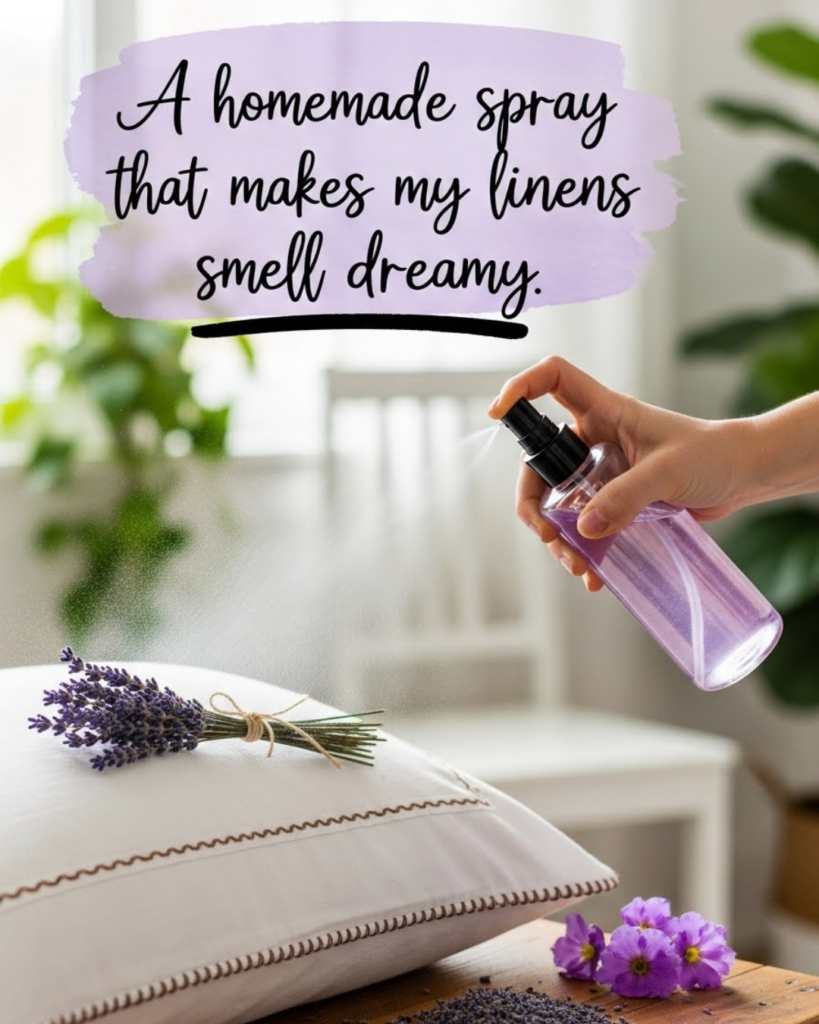
Imagine climbing into a bed where the sheets smell clean, crisp, and wonderfully inviting—or opening a closet that releases a fresh, calming scent. You don’t need expensive store-bought sprays full of chemicals to achieve this luxurious feeling! Learn how to create a homemade spray that makes my linens smell dreamy using simple, natural ingredients. This Home Tips & DIY guide provides achievable, step-by-step guidance that emphasizes cost-saving benefits and the satisfaction of completion, allowing you to transform your home into a fragrant sanctuary.
🌸 Section 1: Foundation First: Understanding Linen Spray Science
Before mixing your first batch of a homemade spray that makes my linens smell dreamy, it’s helpful to build confidence with basic concepts about why these natural ingredients work together, particularly focusing on the role of the carrier agent.
H3: Building Confidence with Basic Concepts: The Role of the Carrier
Simply mixing essential oils and water won’t work effectively. Since oil and water don’t naturally mix (a core principle of chemistry), the essential oils will simply float on the surface, potentially leading to uneven application and staining your linens.
- The Key Component: The solution requires a carrier agent—typically high-proof alcohol or a gentle emulsifier—to help disperse the essential oils evenly throughout the water base. High-proof, unflavored vodka (or rubbing alcohol, though vodka is preferred for linens) is the most common and effective carrier agent in DIY linen refresher recipes.
- Encouraging Reassurance for Beginners: This simple addition of a carrier agent unlocks the ability to create a professional-grade spray at home.
H3: Addressing Common Concerns: Why Avoid Water Alone?
Using water and essential oils without a proper emulsifier can lead to significant problems, including discoloration and microbial growth.
- Safety Considerations: Essential oils, when not properly diluted, can sometimes irritate sensitive skin or even degrade certain synthetic fabrics over time. Furthermore, standing water, even with oil, can encourage bacterial growth within the bottle.
- The Scent Factor: Since the essential oils sit on top, you’ll get a huge blast of oil in the first spray and none in the rest, defeating the purpose of creating a homemade spray that makes my linens smell dreamy. The carrier ensures a uniform, pleasant scent every time.
💧 Section 2: Step-by-Step Process: Core Recipe Methods
The beauty of this DIY linen refresher is its simplicity and reliance on readily available, natural ingredients. Follow this achievable, step-by-step guidance for the perfect base recipe.
Step 1: Gathering Tool Requirements and Ingredients (Actionable Language)
Before you begin, ensure you have the necessary supplies. This is a crucial step in preparing a homemade spray that makes my linens smell dreamy.
- Tool Requirements:
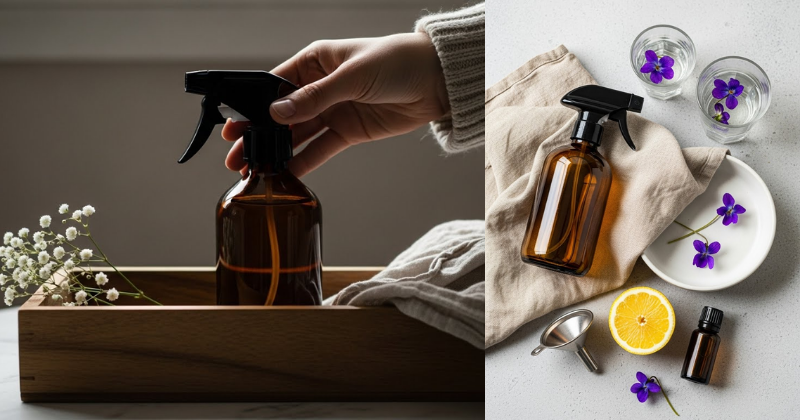
- One $8 \text{ oz}$ clean glass spray bottle (glass is preferred as essential oils can degrade plastic over time).
- Small funnel for mixing.
- Measuring cups and spoons.
- Core Ingredients:
- $1/4$ cup (2 oz) of High-Proof Vodka (unflavored, $80 \text{ proof}$ or higher). This acts as the carrier and a preservative.
- $3/4$ cup (6 oz) of Distilled Water (tap water minerals can cloud the mixture).
- $30 \text{-} 40 \text{ drops}$ of Essential Oils (your scent choice).
Step 2: The Mixing Process (Core Methods)
The order of mixing is important to ensure the essential oils fully integrate with the solution.
- Combine Oil and Carrier: Pour the vodka into the spray bottle first. Add your selected essential oils (30-40 drops). Gently swirl or cap the bottle and shake briefly to allow the essential oils to dissolve fully into the alcohol. This creates a homogeneous, potent base.
- Add Water: Slowly add the distilled water to the mixture using the funnel.
- Final Shake: Cap the bottle tightly and shake vigorously for about $30 \text{ seconds}$ to fully emulsify the ingredients.
Step 3: Timing and Planning Considerations (Practical Tips and Shortcuts)
- Curing Time: While you can use your spray immediately, the scent often deepens if you let it sit for $24 \text{ hours}$ before first use. This gives the fragrance molecules time to fully blend.
- Storage: Store your homemade spray that makes my linens smell dreamy in a cool, dark place away from direct sunlight, which can degrade the essential oils. Always label the bottle with the date and the specific scent blend you created!
👃 Section 3: Advanced Strategies: Customizing Your Dreamy Scent
The true joy of creating a homemade spray that makes my linens smell dreamy lies in customizing the scent to match your mood or the season. This is where you discover creative solutions and provide ways to customize approach.
H3: Creative Solutions: Building Your Signature Scent Blend
Think of fragrance creation in three parts: the top note (the first scent you smell), the middle note (the heart of the fragrance), and the base note (the lingering scent).
| Scent Goal | Top Note (Uplifting) | Middle Note (Balanced) | Base Note (Anchoring) | Example Blend Ratio (Total 35 Drops) |
| Calming Sleep | Bergamot (5 drops) | Lavender (20 drops) | Vetiver or Cedarwood (10 drops) | Lavender-Vetiver Blend |
| Fresh Laundry | Lemon or Grapefruit (10 drops) | Tea Tree or Eucalyptus (10 drops) | Peppermint (15 drops) | Citrus-Mint Blend |
| Cozy Home | Sweet Orange (5 drops) | Cinnamon or Clove (5 drops) | Sandalwood or Vanilla Absolute (25 drops) | Spicy Vanilla Blend |
- Encourage Experimentation: Start with small batches and write down your formulas. You can use less expensive oils like Lemon and Peppermint for everyday use and save expensive absolutes or oils like Rose or Sandalwood for special blends.
H3: Pro Tips for Application
Knowing the best way to apply your DIY linen refresher maximizes the longevity of the scent.
- The Distance Rule: Always hold the bottle at least $12 \text{ inches}$ away from the fabric. This ensures a fine, even mist rather than large droplets that could potentially concentrate the oil and leave a visible spot.
- Timing: Spray linens just before use (e.g., sheets before getting into bed) or when you store them (e.g., towels in the closet). When spraying clothing, focus on the inner lining or the collar area.
⚠️ Section 4: Troubleshooting and Common Challenges
Even with a simple recipe, you may encounter obstacles when making a homemade spray that makes my linens smell dreamy. Here are solutions for frequent issues.
Featured Snippet Potential: “How do I prevent essential oils from staining fabrics when making a linen spray?”
To prevent essential oils from staining fabrics when making a linen spray, you must use a proper emulsifying agent, typically high-proof alcohol (like vodka). Essential oils should always be dissolved in the alcohol carrier first before adding the water. The alcohol ensures the oils are fully dispersed in the solution, preventing oil droplets from clinging to the fabric fibers and leaving a visible residue. Always test the spray on an inconspicuous area of the fabric first.
Practical Troubleshooting Tips (Common Issues)
- Problem: My linens have visible oil spots after spraying.
- Obstacle: The essential oils are not fully emulsified, or too much oil was used.
- Solution: Encouragement for Setbacks: Immediately run the affected fabric through a wash cycle. Next time, ensure you shake the oil and vodka mixture thoroughly before adding the water. You may also need to reduce the total number of essential oil drops to the suggested $30 \text{-} 40 \text{ per } 8 \text{ ounces}$.
- Problem: The scent fades almost immediately.
- Obstacle: Not enough base note oil was used, or the spray was not stored properly.
- Solution: Offer Alternative Approaches: Increase the proportion of base notes (like Cedarwood, Vanilla, or Patchouli) in your blend, as these molecules are larger and heavier, allowing the scent to linger longer on the fabric. Ensure the spray is kept away from heat and light.
- Problem: The sprayer nozzle keeps clogging.
- Obstacle: Sometimes, residue or a too-thick oil clogs the small opening.
- Solution: Rinse the nozzle under hot water. If the problem persists, ensure you are not using thick carriers or very heavy oils that may not fully dissolve.
💡 Section 5: Maximizing Results: Beyond Linens
To maximize results from your DIY linen refresher, recognize that its applications extend far beyond sheets and towels.
- Show How to Build Upon Basic Success: Room and Air Freshener. Your homemade spray that makes my linens smell dreamy can double as a natural, non-aerosol air freshener. Spray into the air, focusing on fabric surfaces like curtains or upholstery, to eliminate stale odors and introduce a burst of natural fragrance.
- Maintenance and Long-Term Considerations: Closet and Drawer Scenting. Spraying the inside of drawers and linen closets periodically keeps stored items from developing a musty smell. This is particularly effective for seasonal considerations like storing winter blankets or summer clothing.
- Suggest Complementary Strategies: Gift Giving and Personal Care. This DIY linen refresher makes a thoughtful, low-cost gift. Pour the mixture into smaller decorative bottles, customize the label, and gift them for housewarmings or holidays. (Internal Linking Opportunity: Check out “DIY Essential Oil Roll-Ons for Natural Self-Care.”) This inspires continued growth and learning in natural home products.
✅ Conclusion: Your Capability to Craft Comfort
You are now an expert in creating a homemade spray that makes my linens smell dreamy, utilizing the powerful synergy of vodka, water, and essential oils. You have transformed your cleaning routine by choosing natural ingredients, realizing significant cost-saving benefits, and gaining the satisfaction of completion that only a truly successful DIY linen refresher can provide. Remember, the scent of your home is a key part of your comfort, and now you have the capability to succeed in making it wonderfully your own.
Ready to start mixing your signature scent? Will you choose the Calming Sleep blend for your bedding tonight, or the Fresh Laundry blend for your towels?