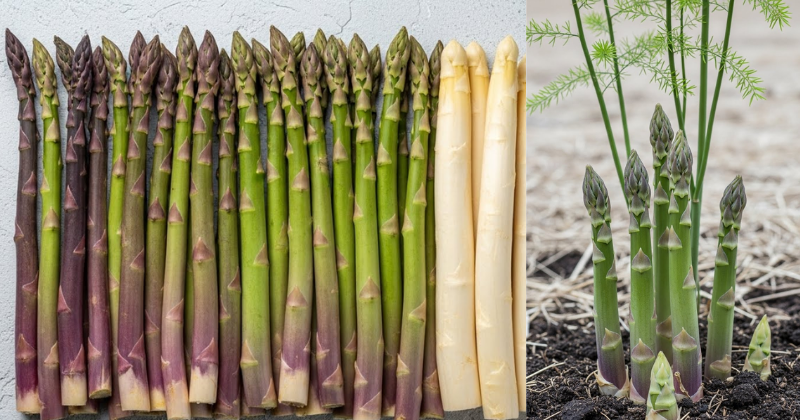
Few gardening efforts offer the long-term payoff and sheer joy of a homegrown harvest quite like asparagus. If you’ve ever dreamt of stepping into your garden on a crisp spring morning and picking your own tender spears, this guide on How to Grow Asparagus is for you. Asparagus is a true perennial vegetable, providing delicious spears for $15$ to $20$ years from a single planting! While it demands a bit of patience initially, we’ll provide achievable, step-by-step guidance that will unlock the secrets to success. Get ready to transform a small corner of your garden into a permanent, productive bed, establishing a wonderful connection with nature that pays dividends every spring.
🪴 Section 1: Foundation First: Understanding Asparagus Basics
Asparagus (Asparagus officinalis) is unique among common garden vegetables because it is a perennial. To successfully learn How to Grow Asparagus, you must first understand the fundamental difference between annual and perennial growing.
H3: Building Confidence with Basic Concepts: Crowns vs. Seeds
The most common decision beginners face is how to start their asparagus patch.
- Seeds: Starting from seed takes extreme patience (up to $4$ years before harvest) but is less expensive. It allows you to discover unique varieties.
- Crowns (The Best Option): Asparagus is almost always planted from $1$-year-old bare-root bundles called crowns. The crown is the central root mass that looks like a tangled octopus. Planting crowns shaves two years off the waiting time, meaning you can often start a light harvest in the third year. This provides encouraging reassurance for beginners that the wait is shorter!
H3: Addressing Common Concerns: Male vs. Female Plants
Asparagus plants are dioecious, meaning they are either male or female. This is an important seasonal consideration for planting.
- Female Plants: Produce spears but also small red berries (which contain seeds). The energy used to produce these seeds detracts from spear production.
- Male Plants: Do not produce seeds, so all their energy is directed into producing more and larger spears.
- Best Practice: Modern, high-yield varieties (like ‘Jersey Giant’ or ‘Jersey Knight’) are predominantly or entirely male hybrids, offering a much better cost-saving benefit and higher yield over the decades. Always choose an all-male hybrid if possible.
📍 Section 2: Step-by-Step Process: Core Planting Methods
The critical step in learning How to Grow Asparagus is the preparation of the bed and the meticulous planting of the crown. Proper preparation is essential, as the bed will last for decades.
Step 1: Choosing the Site and Soil Prep (Actionable Language)
Asparagus requires full sun and excellent drainage. It cannot tolerate waterlogged soil.
- Select the Spot: Choose a permanent, sunny location that won’t be disturbed by yearly tilling.
- Soil Testing: Asparagus prefers a slightly alkaline soil ($\text{pH } 6.5 \text{-} 7.5$). If your soil is acidic, you will need to amend it with garden lime the fall before planting.
- Timing and Planning Considerations: The best time to plant crowns is early spring, as soon as the soil is workable.
- Enrich the Bed: Dig the area deeply, mixing in plenty of organic matter (compost, aged manure). Asparagus plants are heavy feeders and will appreciate this long-term investment.
Step 2: Digging the Trench (Core Methods)
This is the non-negotiable step that gives asparagus its longevity and stability.
- The Depth: Dig a trench about $12 \text{ inches}$ deep and $12 \text{ inches}$ wide. If planting multiple rows, space the rows $3 \text{-} 4 \text{ feet}$ apart.
- The Mound: Place a $2 \text{-} 3 \text{ inch}$ high mound of soil or aged compost down the center of the trench. This provides a soft base for the crowns.
Step 3: Planting the Crowns and Backfilling
The planting process for crowns is unique and requires a specific technique to ensure long-term success.
- Place the Crowns: Carefully spread the roots of the crown over the mound in the trench, allowing the central ‘bud’ to sit upright on the ridge. Space the crowns $12 \text{-} 18 \text{ inches}$ apart.
- Initial Fill: Cover the crowns with only $2 \text{ inches}$ of soil. Do not fill the trench completely!
- Gradual Backfill: As the spears begin to emerge and grow throughout the first year, gradually fill in the trench with more soil. By the end of the first growing season, the trench should be level with the surrounding ground. This deep planting protects the crowns and anchors them for their long life.
📈 Section 3: Advanced Strategies: Feeding and Long-Term Care
Once the crowns are established, your focus shifts to feeding the patch to ensure robust growth and maximize future yield. These expert-level insights are crucial for long-term production.
H3: Sharing Expert-Level Insights: The Annual Fertilizing Schedule
Asparagus is a heavy feeder, especially of nitrogen and potassium. A consistent annual feeding schedule is non-negotiable for success.
- Spring Feed (After Harvest): Once you are done harvesting for the season, apply a balanced fertilizer ($10 \text{-} 10 \text{-} 10$) or side-dress heavily with aged compost or manure. This replenishes the energy reserves needed for the ferns to grow and photosynthesize all summer.
- Fall Feed (Before Dormancy): Just before the first hard freeze, another application of fertilizer high in potassium helps the plant store energy for the winter.
H3: Creative Solutions: Weed Control Strategies
Weeds are the primary competitor for water and nutrients in an asparagus bed and must be controlled to prevent stress on the crowns.
- Mulching: Petit conseil pro: Apply a thick $4 \text{-} 6 \text{ inch}$ layer of organic mulch (straw, aged wood chips, or shredded leaves) after the final backfilling. This is the simplest way to suppress weeds and retain moisture.
- Hand Weeding Only: Never use a tiller or hoe in an established asparagus bed, as the fragile, shallow roots (rhizomes) of the crown can be easily damaged, jeopardizing your decades-long investment. Encourage experimentation with different mulch types to find what works best in your region. (Internal Linking Opportunity: Learn about “Creating the Perfect Compost for Perennial Beds.”)
⚠️ Section 4: Troubleshooting and Common Challenges
Even with the best intentions, you might face some common obstacles when learning How to Grow Asparagus. Here are practical solutions.
Featured Snippet Potential: “When can I harvest asparagus after planting crowns?”
You should not harvest asparagus until the third spring after planting the crowns. The first two years are crucial for the crown to establish a strong, deep root system and produce tall, ferny growth (the “mother ferns”). Harvesting too early weakens the plant and can significantly reduce its lifespan and future yield. In the third year, you can harvest lightly (for about two weeks), increasing the harvest period to six to eight weeks in subsequent years.
Practical Troubleshooting Tips
- Problem: Spears are thin and weak after the third year.
- Obstacle: This usually indicates the plant is stressed, either from nutrient deficiency or over-harvesting in the prior years.
- Solution: Offer Alternative Approaches: Stop harvesting immediately. Give the plant a heavy application of balanced fertilizer and compost. Allow all the spears to grow into ferns for the entire season to allow the crown to rebuild its energy reserves. You must prioritize fern growth over immediate harvest.
- Problem: Ferns develop rusty-looking spots in mid-summer.
- Obstacle: Asparagus rust, a common fungal disease that thrives in humid conditions.
- Solution: Preventive Measures: Ensure good air circulation (do not overcrowd the plants). In the fall, be absolutely meticulous about cutting down the brown ferns and completely removing or burning them. Never compost rusty foliage, as the spores will overwinter and infect the next season’s spears.
- Problem: Small beetles or larvae are feeding on the spears.
- Obstacle: The Asparagus Beetle is the most common pest.
- Solution: Hand-pick the beetles and drop them into soapy water. For heavy infestations, organic controls like Neem oil or Pyrethrins can be used early in the season before the main harvest.
🎯 Section 5: Maximizing Results: Harvest and Winter Care
Once you are harvesting, you want to ensure you get the maximum yield and set the bed up for success the following spring.
- Show How to Build Upon Basic Success:The Harvest Technique. When the spears reach $6 \text{-} 8 \text{ inches}$ tall and are about the thickness of your finger, harvest them. You have two options:
- Snapping: Bend the spear near the soil line; it will naturally snap where the tender part ends. This is the easiest method.
- Cutting: Cut the spear $1 \text{-} 2 \text{ inches}$ below the soil surface using a sharp knife. Be careful not to damage emerging, unseen spears.
- Maintenance and Long-Term Considerations: Knowing When to Stop. The most important rule in How to Grow Asparagus is knowing when to stop harvesting. Once the average diameter of the spears shrinks noticeably, or once you reach the $6 \text{-} 8 \text{ week}$ maximum harvest window, stop. Let the remaining spears grow into tall, ferny foliage. The ferns photosynthesize and create the energy that the crowns need to survive the winter and produce next spring’s harvest.
- Complementary Strategies: Winterization. After the ferns turn brown in the late fall, cut them back to the ground. Clear the debris and apply a layer of fresh compost or aged manure. This seasonal consideration protects the crowns and provides food for the spring. (Internal Linking Opportunity: Read about “Preparing Your Perennial Vegetable Garden for Winter.”)
✅ Conclusion: Your Capability to Nurture a Legacy
You are now equipped with the complete knowledge of How to Grow Asparagus, a commitment that truly rewards patience and care. From planting the crown deep in its trench to diligently protecting the ferns during summer, you are nurturing a permanent, productive food source. This effort is more than just gardening; it’s an empowering connection with nature that will allow you to enjoy some of the freshest, most delicious vegetables for decades to come. You have the capability to succeed in establishing this legacy crop!
Ready to get started? Will you order your all-male crowns this week, or focus on amending that perfect sunny patch in your garden first?