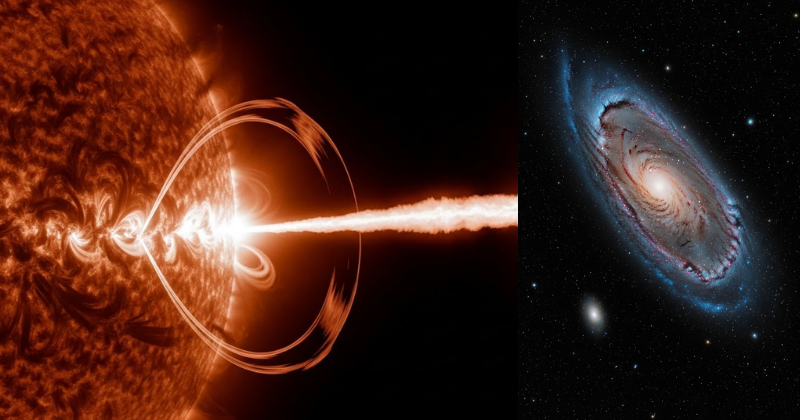
An EARTH-FACING M8 SOLAR FLARE just erupted, launching a massive SOLAR TSUNAMI in real time at incredible speed. This event triggers deep concerns about technological impacts and provides critical data on space weather dynamics.
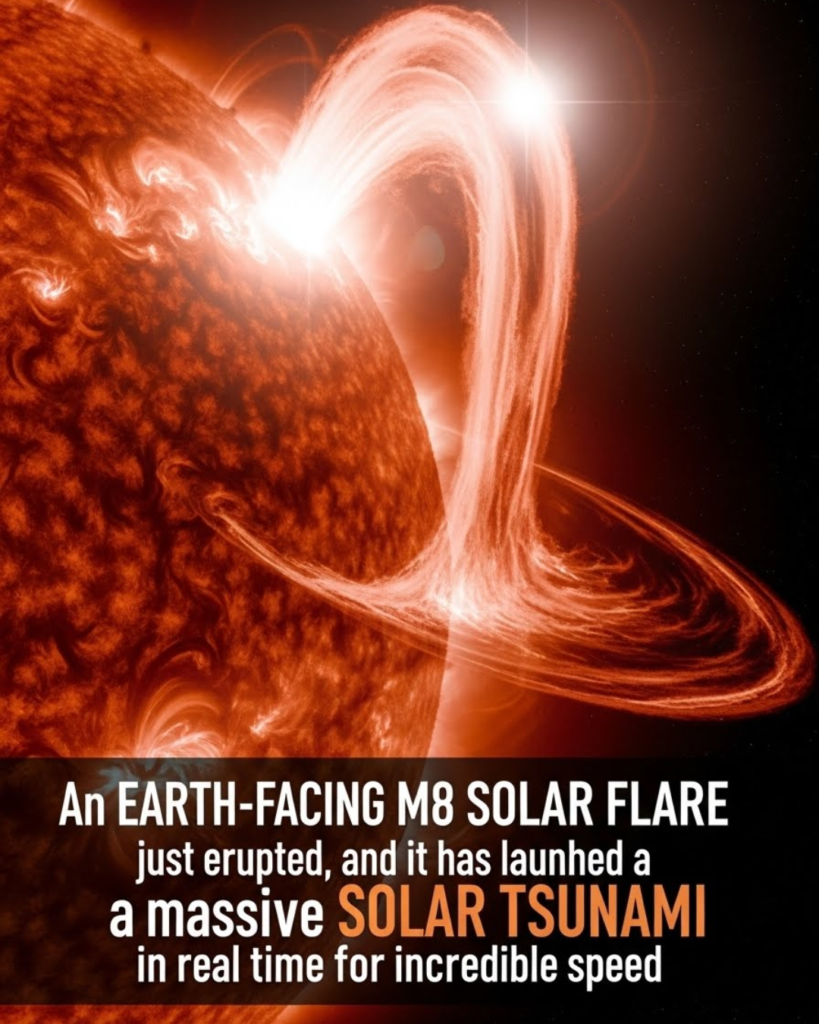
What Does an M8 Classification Signify for a Solar Flare?
The classification of a solar flare—such as the recent M8 solar flare—is derived from the intensity of the X-rays it emits, measured at Earth’s distance. This metric provides scientists with an immediate understanding of the event’s power and its potential terrestrial effects.
- Flare Classification Scale: Solar flares are categorized using letters, where A, B, C, M, and X represent increasing magnitude, with each letter representing a tenfold increase in peak flux (W/m$^2$). An M-class flare is generally considered a significant event.
- The M8 Sub-Class: The number following the letter (in this case, 8) denotes a linear progression within that class, meaning an M8 flare is $80\%$ of the way to becoming an X1 flare (the most powerful category). A flare of this magnitude is capable of causing notable space weather impacts, especially when it is Earth-facing.
- Immediate Impact: The high-energy X-rays and ultraviolet radiation from an M8 flare travel at the speed of light, reaching Earth in approximately $8$ minutes. These radiation bursts immediately affect the ionosphere, causing shortwave radio blackouts primarily on the sunlit side of the planet.
How Did the M8 Solar Flare Launch a Massive Solar Tsunami?
The immense energy release associated with the M8 solar flare was the direct cause of the phenomenon known as a solar tsunami, also scientifically termed a Moreton Wave.
- Coronal Disturbances: A solar tsunami is a colossal, fast-moving wave of hot plasma and magnetic field disturbances that ripples across the Sun’s atmosphere, the corona. These waves are visual evidence of the sheer mechanical force and shockwave created by the sudden, explosive magnetic reconnection during a major flare.
- The Launch Mechanism: When the intense magnetic energy is released during the M8 solar flare, it instantly heats and accelerates a vast amount of coronal plasma outward. This rapid expansion creates a shock front—similar to a supersonic boom—that propagates outward across the solar disk at speeds exceeding $1,000 \text{ km/s}$ (over $2.2$ million mph).
- Real-Time Observation: Observatories like NASA’s Solar Dynamics Observatory (SDO) capture this event in real time at incredible speed, showing the dark filaments and bright features being compressed and displaced by the shockwave moving away from the flare’s epicenter. This observation confirms the tremendous scale of the energy transfer.
What is the Composition and Speed of the Associated Coronal Mass Ejection (CME)?
Nearly all major solar flares, including the Earth-facing M8 solar flare, are accompanied by a Coronal Mass Ejection (CME)—a massive cloud of magnetized plasma erupting from the Sun. The characteristics of this CME are crucial for predicting Earth’s space weather forecast.
- CME Composition: The ejected material consists primarily of electrons, protons, and trace amounts of heavier ions (ionized hydrogen and helium), all carrying the Sun’s powerful magnetic field. This magnetized plasma cloud is the primary source of geomagnetic storms at Earth.
- Incredible Speed: Given the power of an M8 flare and the observed solar tsunami shockwave, the associated CME is likely traveling at an incredible speed, potentially in the range of $1,500 \text{ to } 2,500 \text{ km/s}$. This rapid velocity dictates the short travel time to Earth, which could be as little as $40 \text{ hours}$.
- Predicting Impact: Because the flare was Earth-facing, the resulting CME is likely directed toward our planet. Scientists use coronagraph data from instruments like SOHO (Solar and Heliospheric Observatory) to analyze the CME’s trajectory, mass, and velocity vector to refine the impact forecast.
Which Terrestrial Technologies are Most Vulnerable to an Earth-Facing M8 Flare?
When an Earth-facing M8 solar flare launches a high-speed CME, several critical terrestrial technologies face immediate and long-term risks.
- Radio Communication Blackouts: The initial X-ray burst from the flare immediately ionizes the upper atmosphere, causing Severe Shortwave Radio Blackouts (R3-level) that affect aviation and maritime communication on the day side of Earth. This effect is swift and temporary, lasting hours.
- Satellite Operations: The high-energy particles associated with the flare and the arriving CME can physically damage or temporarily disrupt low-Earth orbit (LEO) satellites. Increased atmospheric drag from heating can prematurely pull satellites out of orbit.
- Power Grids and Infrastructure: The primary long-term concern is the impact of the geomagnetic storm (G-storm) triggered by the CME. Fluctuations in Earth’s magnetic field induce massive ground currents that can overload and damage high-voltage transformers, potentially causing regional power blackouts.
How Does the Solar Tsunami Serve as a Predictor for the CME?
The observation of the massive solar tsunami in real time is a vital tool for space weather forecasters, serving as an almost instantaneous indicator of a powerful, fast-moving CME.
- Precursor Indicator: The rapid propagation of the Moreton Wave confirms that a significant amount of energy was impulsively released, accelerating a plasma cloud into space. A strong, clearly defined solar tsunami is usually correlated with a fast and geoeffective (Earth-directed) CME.
- Velocity Confirmation: The speed at which the solar tsunami propagates across the Sun’s surface provides a lower bound estimate for the speed of the accompanying CME. If the tsunami is measured at incredible speed, it reinforces the urgency of the space weather alert.
- Magnetic Field Clues: The geometry of the solar tsunami’s source region, often tied to highly unstable magnetic filaments, helps scientists infer the magnetic orientation within the CME. The orientation of the CME’s magnetic field ($\text{Bz}$) is the single most critical factor determining the severity of the resultant geomagnetic storm.
What is the Difference Between an M-Class Flare and the Carrington Event?
Understanding the relative magnitude of the M8 solar flare compared to historical benchmarks like the $1859$ Carrington Event is essential for providing contextual risk assessment.
- Flare Intensity Comparison: The Carrington Event is estimated to have been an X45 flare or greater—a massive event several orders of magnitude stronger than the recent M8 flare. An X45 flare is $45 \text{ times}$ more powerful than an X1, and an M8 is still well below the X-class threshold.
- Carrington Impact: The Carrington Event caused aurorae visible near the equator and major disruptions to the nascent telegraph system, physically shocking operators and starting fires.
- Modern Risk: While the Earth-facing M8 solar flare poses a real risk to modern technology, the impact of the resulting G-storm will likely be moderate (G2 or G3 on the $5$-point scale), causing potential satellite anomalies and localized power grid issues, but not the globally catastrophic impact of a Carrington-level event.
When Will the CME Associated with the M8 Flare Arrive at Earth?
The arrival time of the Coronal Mass Ejection following the M8 solar flare depends directly on its speed, which was implied by the solar tsunami observations.
- Calculation Based on Speed: Assuming the CME launched at an incredible speed of approximately $2,000 \text{ km/s}$ ($2 \times 10^6 \text{ m/s}$) and considering the Sun-Earth distance of approximately $1.5 \times 10^{11} \text{ meters}$ ($1 \text{ AU}$), the travel time ($t$) can be calculated:$$t = \frac{\text{Distance}}{\text{Speed}}$$$$t \approx \frac{1.5 \times 10^{11} \text{ m}}{2.0 \times 10^6 \text{ m/s}} \approx 75,000 \text{ seconds}$$This equates to about $20.8 \text{ hours}$.
- Predicted Arrival Window: Given typical deceleration over the distance, the actual arrival is usually slightly longer. Scientists would therefore predict a highly accelerated arrival time, potentially in the $24 \text{-} 36 \text{ hour}$ window following the observation of the solar tsunami in real time.
- Forecasting Precision: Continuous monitoring refines this prediction. The early and accurate observation of the massive solar tsunami has provided critical lead time for governments and utilities to implement protective measures, such as placing satellites into safe modes and preparing power grid load management.
Which Protective Measures Can Be Taken Against Geomagnetic Storms?
In response to the confirmed trajectory of the CME generated by the Earth-facing M8 solar flare, specific protective measures are typically activated across vulnerable sectors.
- Power Grid Protection: Utility companies can temporarily lower voltage levels on transformers to prevent saturation and damage from geomagnetically induced currents (GICs). They may also isolate specific vulnerable lines or systems entirely until the CME passes.
- Satellite Hardening: Satellite operators put sensitive electronics into “safe mode,” turning off non-essential systems and orienting solar panels away from the highest flux of penetrating solar energetic particles (SEPs).
- Navigation and Communication: Aviation authorities monitor the disruption to high-frequency (HF) radio communications over polar routes, which are especially vulnerable to particle precipitation, and reroute aircraft if necessary. GPS and other satellite navigation systems are also monitored for increased error margins due to ionospheric disturbance.
Conclusion
The eruption of the EARTH-FACING M8 SOLAR FLARE, followed immediately by the detection of a massive SOLAR TSUNAMI in real time at incredible speed, represents a significant event in the current solar cycle. This powerful sequence validated the scientific models used to predict the velocity and direction of the resulting Coronal Mass Ejection. While the initial radiation caused shortwave radio blackouts, the immediate focus shifts to preparing terrestrial infrastructure for the incoming geomagnetic storm. The precision with which these solar phenomena are now monitored provides critical lead time, allowing vulnerable sectors to implement mitigation strategies and minimize potential technological disruption. Continuous observation remains vital as the CME races toward Earth.