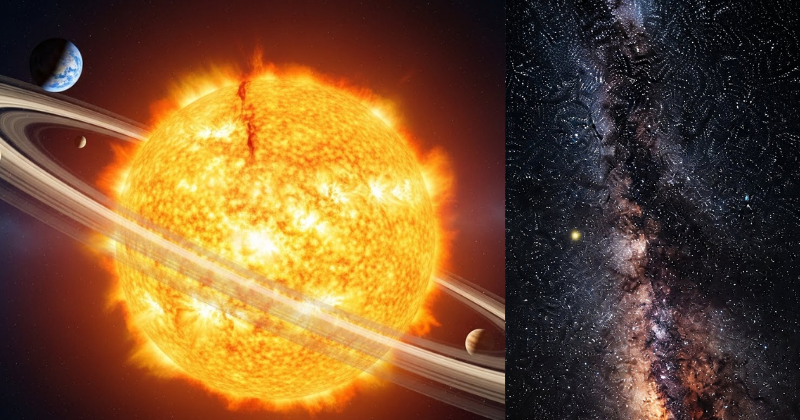
New research suggests the Sun likely used to have Saturn-like rings that prevented Earth from becoming a ‘super-Earth’. This concept profoundly impacts our understanding of solar system evolution, explaining the size difference between Earth and common exoplanets.
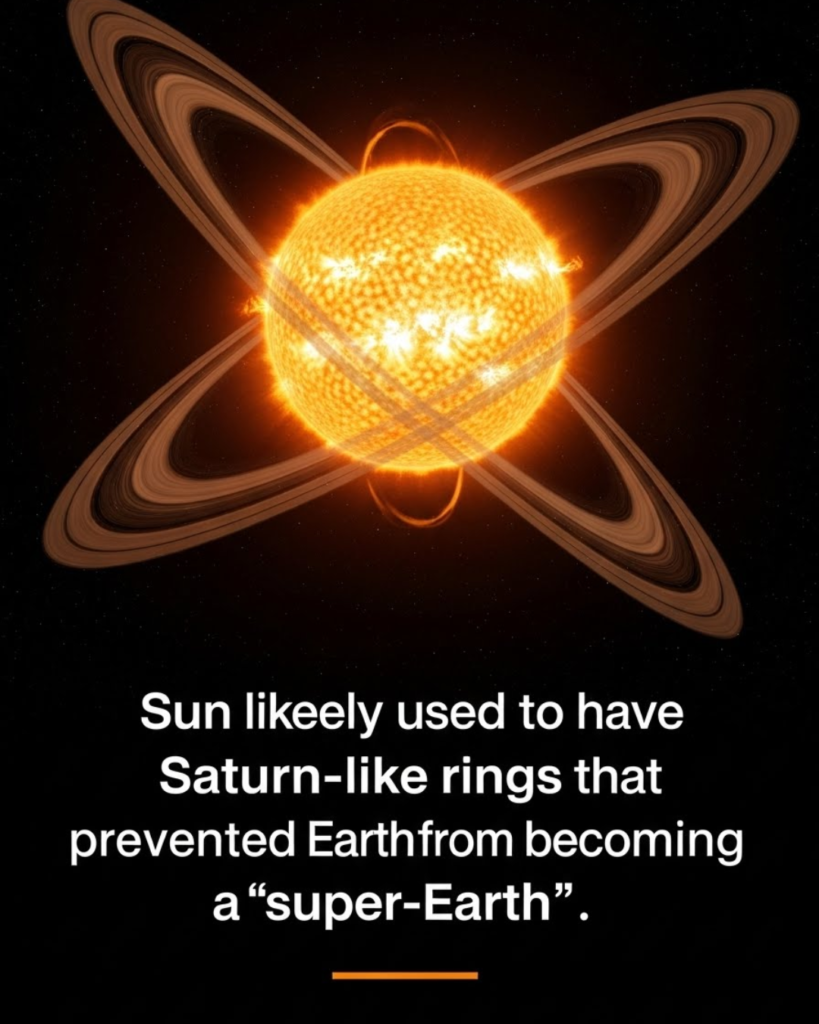
What is the Super-Earth Problem in Exoplanetary Science?
The “Super-Earth Problem” refers to a significant discrepancy between the most common type of planet observed outside our solar system and the planets within it. Most exoplanets discovered are classified as super-Earths or mini-Neptunes, planets with masses generally between one and ten times that of Earth ($1 \text{ M}_\oplus$ to $10 \text{ M}_\oplus$).
- The Size Gap: Our solar system conspicuously lacks planets in this highly prevalent size range. Earth is the largest rocky planet, falling just below this common exoplanetary mass category. Mars and Venus are even smaller.
- The Accretion Challenge: Planetary formation theory suggests that if sufficient solid material is available, planets should naturally grow large and quickly, easily crossing the threshold into the super-Earth classification. The fact that Earth didn’t become a super-Earth requires a mechanism that arrested its growth early in the solar system’s history. This critical observation led astronomers to seek solutions within the mechanics of the early solar system.
How Could Saturn-Like Rings Have Formed Around the Early Sun?
The hypothesis that the Sun likely used to have Saturn-like rings centers on the physics of the protoplanetary disk—the massive cloud of gas and dust from which the solar system formed approximately $4.6 \text{ billion}$ years ago.
- Pressure Bumps: The rings were not solid structures like Saturn’s rings but regions within the gas and dust disk characterized by a sudden increase in pressure, known as “pressure bumps.” These bumps would naturally form at the boundaries where different volatile compounds vaporized, such as the sublimation line for water, silicates, and carbon monoxide.
- The Snow Line Effect: For instance, the snow line (where water vapor turns to ice) would have created a barrier, slowing the inward drift of icy solids. As material piles up at this barrier, it creates a high-density, high-pressure ring structure—a region of accumulated dust and pebbles. This effectively created zones, much like the partitions within Saturn’s iconic ring system.
- Evidence from ALMA: Observations of other young stellar systems using the Atacama Large Millimeter/submillimeter Array (ALMA) consistently show these ring and gap structures in their protoplanetary disks, lending observational support to the idea that the Sun likely used to have Saturn-like rings.
What Role Did These Rings Play in Preventing Earth’s Growth?
The proposed Saturn-like rings acted as highly efficient, selective filters, dictating which materials could reach the inner solar system, directly influencing why Earth was prevented from becoming a ‘super-Earth’.
- Pebble Isolation: The primary mechanism involves “pebble isolation.” In the smooth regions of the disk, small solid particles (pebbles, the building blocks of planets) drift inward toward the Sun. However, when these pebbles hit a pressure bump (the inner edge of a ring), they get trapped.
- Material Starvation: The innermost ring, located at the approximate orbit of Jupiter or slightly closer, would have acted as a gravitational and hydrodynamic dam. It starved the inner solar system (where Mercury, Venus, Earth, and Mars formed) of the necessary influx of pebble-sized material required for runaway growth.
- Size Limitation: Without this steady supply of fresh material from the outer disk, the inner planets—including Earth—could only accrete matter that was locally available or bypassed the ring system. This limited material supply restricted Earth’s growth, ensuring it remained a sub-Super-Earth mass.
Which Pressure Bump is Hypothesized to Have Limited Earth’s Size?
Astrophysical modeling identifies several distinct pressure bumps within the early solar disk, but the one most relevant to the question of why Earth was prevented from becoming a ‘super-Earth’ is the $\text{CO}_2$ (carbon dioxide) sublimation line.
- The $\text{CO}_2$ Ring: Models suggest that the ring associated with the $\text{CO}_2$ snow line, located closer to the Sun than the main water snow line, was the key barrier. This ring would have trapped the majority of the silica- and carbon-rich pebbles drifting inward.
- Timing: This $\text{CO}_2$ ring would have been active during the crucial $0.5 \text{ to } 3 \text{ million}$ years after the Sun’s birth, precisely when the inner planets were undergoing their most rapid phase of accretion.
- Inner System Signature: This model explains the inner solar system’s distinct chemical signature—a composition richer in silicate materials and poorer in volatiles compared to the outer solar system bodies. The ring mechanism explains this elemental separation and why the Sun likely used to have Saturn-like rings to create these differences.
How Does This Theory Explain the Compositional Differences of Asteroids?
The ring hypothesis provides a compelling and methodical explanation for the observed division among asteroids into two major, chemically distinct families: C-type (carbonaceous, volatile-rich) and S-type (siliceous, rock-rich).
- The Asteroid Belt Divide: The current Asteroid Belt, situated between Mars and Jupiter, is not well-mixed. The inner portion is dominated by S-type asteroids, chemically similar to Earth, while the outer portion hosts the volatile-rich C-type asteroids, similar to comets.
- Ring as a Boundary: The proposed pressure bump—the ancient Saturn-like rings—likely existed in the region now occupied by the Asteroid Belt. This ring prevented the outward migration of inner-system material and the inward migration of outer-system material.
- Frozen Diversity: As the ring dissipated, it left behind a distinct chemical and orbital divide in the belt, preserving the evidence of the disk’s segmented structure. This strongly supports the idea that the Sun likely used to have Saturn-like rings that sculpted the entire solar system.
What is the Evidence from Exoplanets That Supports the Solar Ring Model?
The prevalence of exoplanets categorized as super-Earths or mini-Neptunes actually provides critical indirect evidence that supports the solar ring model for our own system’s peculiar structure.
- Unimpeded Growth: In many observed exoplanetary systems, it appears that the stellar disk did not maintain a stable, long-lived pressure bump or ring structure in the critical zone. Without an effective barrier, the building blocks were free to drift and accumulate, leading to the rapid, unimpeded growth of the most common exoplanets into massive super-Earths.
- The Exception Proves the Rule: Our solar system, where Earth was prevented from becoming a ‘super-Earth’, becomes the exception—a system where the formation of stable, long-lasting Saturn-like rings dictated the small size of the inner planets.
- Observational Corroboration: When comparing systems with clear ring structures (like those seen by ALMA) versus those without, scientists can now correlate the presence of rings with the resulting size distribution of the orbiting planets. This offers a potent comparative framework.
When Did the Sun’s Saturn-Like Rings Dissipate?
The fate of the Saturn-like rings and the timing of their dissipation are crucial to understanding the final architecture of the solar system.
- The Dissipation Mechanism: The pressure bumps were not permanent. As the Sun grew hotter and its stellar wind increased, it began photoevaporating the gas and dust from the protoplanetary disk. This gradual loss of gas caused the pressure differential to weaken.
- Timeline: Scientific modeling suggests that the inner rings, particularly the ones that limited Earth’s growth, dissipated relatively early, perhaps within $3 \text{ to } 5 \text{ million}$ years of the Sun’s formation. This timeframe allowed the inner planets to finish their final accretion phase but ensured they did so with a limited material budget.
- The Late Heavy Bombardment (LHB): The final dispersal of the rings and the remaining scattered material may be linked to the chaotic period known as the Late Heavy Bombardment, where a sudden influx of scattered asteroids and comets impacted the inner planets.
Why is This Discovery Significant for Astrobiology and Habitability?
The finding that the Sun likely used to have Saturn-like rings has profound implications for astrobiology, directly tying the physical dynamics of the early disk to the conditions for life.
- The Terrestrial Size Bias: The model suggests that the very unique formation environment that led to a smaller, sub-Super-Earth mass planet—Earth—may be critical. Super-Earths often retain massive, crushing atmospheres, which could complicate surface habitability.
- Atmospheric Implications: By limiting Earth’s mass, the rings ensured Earth did not accrete enough hydrogen and helium gas to become a mini-Neptune. This allowed Earth to develop a secondary, temperate atmosphere capable of sustaining liquid surface water, making the environment where land doesn’t exist less likely.
- The Rare Earth Hypothesis: While the theory doesn’t suggest Earth is unique, it identifies a specific physical mechanism—the solar rings—as necessary to produce a planet of Earth’s size and composition. This moves the search for habitable worlds toward systems where similar ring structures may have arrested planetary growth.
Conclusion
The compelling hypothesis that the Sun likely used to have Saturn-like rings that prevented Earth from becoming a ‘super-Earth’ provides an elegant solution to the Super-Earth Problem. These transient pressure bumps within the early solar disk acted as filters, starving the inner solar system of the vast reservoir of pebbles needed for runaway planetary growth. This mechanism explains the small mass of Earth, the compositional divide in the Asteroid Belt, and why Earth remained a rocky world rather than growing into a massive mini-Neptune. This new understanding profoundly informs our search for habitable worlds, suggesting that the rare occurrence of such a filtering system may be key to forming temperate, terrestrial planets capable of supporting life.