
Introduction (meta description):
A dramatic X-ray flare erupted from the supermassive black hole in NGC 3783. As it faded, ultra-fast winds at 60,000 km/s emerged. Explore the science behind this event.
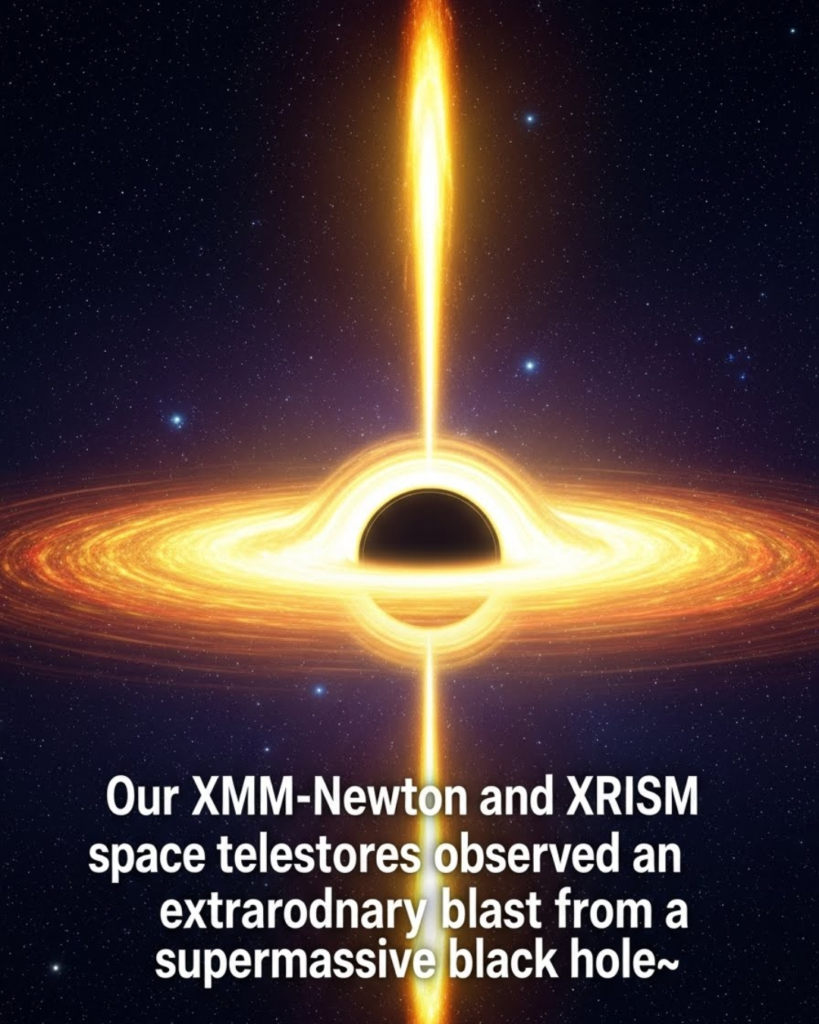
What Makes the X-Ray Flare in NGC 3783 One of the Most Extraordinary Black Hole Events Ever Observed?
In a remarkable convergence of advanced instrumentation and cosmic timing, the European Space Agency’s XMM-Newton telescope and Japan’s XRISM (X-Ray Imaging and Spectroscopy Mission) jointly witnessed a rare and violent outburst from the supermassive black hole at the heart of NGC 3783, a Seyfert galaxy located roughly 135 million light-years away. The telescopes captured a sudden, intensely bright X-ray flare erupting from the accretion disk surrounding the black hole. As the flare diminished, ultra-fast winds—moving at nearly 60,000 kilometers per second, or 20% the speed of light—emerged from the region.
This event is extraordinary not only for its dramatic energy release but also for the clarity and precision with which modern X-ray observatories recorded it. Such flares are believed to originate from abrupt changes in the accretion process, magnetic reconnection events, or structural instabilities in the inner regions of the accretion disk. The winds that followed the flare provide key evidence about how black holes interact with their host galaxies, regulating star formation and redistributing energy across vast interstellar distances.
What Is NGC 3783 and Why Is Its Supermassive Black Hole Scientifically Significant?
NGC 3783 is a barred spiral galaxy that has long been a focus of astrophysical study due to the active galactic nucleus (AGN) embedded at its core. Its central black hole—estimated to have a mass of approximately 30 million solar masses—is surrounded by a turbulent environment of hot gas, dust, and high-energy radiation.
Several factors make NGC 3783 particularly valuable to researchers:
1. Its Active Galactic Nucleus
The AGN emits powerful X-rays and UV radiation, making it an ideal laboratory for observing accretion physics in real time.
2. Historically Variable Emission
NGC 3783 has a long record of variable brightness, indicating dynamic conditions within the inner accretion disk.
3. Proximity and Clarity
Compared to more distant AGNs, NGC 3783 is close enough for high-resolution, spectroscopy-based observations, allowing researchers to reconstruct physical processes with exceptional detail.
4. Well-Studied Accretion Environment
For decades, scientists have observed warm absorbers, variable continuum emissions, and ionized outflows in this galaxy. The new flare and wind event adds another layer to its already complex portrait.
Because of these features, NGC 3783 serves as a benchmark for understanding how supermassive black holes grow and influence their galaxies.
How Do XMM-Newton and XRISM Detect and Analyze Such Powerful X-Ray Events?
Capturing an eruption of this magnitude requires exceptional sensitivity, spectral resolution, and imaging capabilities. XMM-Newton and XRISM represent two generations of X-ray astronomy, each bringing unique strengths to the observation.
XMM-Newton’s Role
Launched in 1999, XMM-Newton remains one of the most powerful X-ray observatories ever built. Its capabilities include:
- High-efficiency mirrors that collect faint X-ray signals
- Reflection grating spectrometers capable of resolving subtle spectral shifts
- Large collecting area for monitoring long-duration events
These features allowed XMM-Newton to detect the intense flare’s rapid rise, its spectral evolution, and changes in X-ray luminosity.
XRISM’s Contribution
XRISM, a mission led by JAXA with contributions from NASA and ESA, specializes in high-resolution X-ray spectroscopy. Its Resolve instrument provides unprecedented detail for analyzing:
- Ionization states
- Energy signatures
- High-velocity outflows
- Plasma composition
XRISM was instrumental in measuring the ultra-fast winds and confirming their extraordinary velocity of 60,000 km per second.
Combined Observations
Together, the telescopes offered a synchronized view of both the flare’s emergence and the physical transformations that followed, yielding one of the most complete datasets ever recorded for an AGN outburst.
How Did the X-Ray Flare Erupt From the Supermassive Black Hole’s Accretion Disk?
Supermassive black holes do not emit light themselves; the radiation we observe comes from the accretion disk, a swirling structure of gas heated to extreme temperatures. The X-ray flare in NGC 3783 likely emerged from one or more of the following mechanisms:
1. Magnetic Reconnection
Highly magnetized plasma in the inner disk may have undergone a sudden rearrangement—similar to solar flares but vastly more powerful—releasing massive amounts of energy.
2. Accretion Rate Instability
A rapid surge of infalling material can temporarily increase luminosity, driving the disk into a hotter, more energetic state before stabilizing again.
3. Collapse of a Disk Structure
A dense clump of matter may have spiraled inward, heating violently as it neared the event horizon.
4. Corona Restructuring
The corona—an energetic region of hot electrons above the disk—can shift or collapse, altering the radiation output.
The flare’s brightness indicates a sudden, violent release of energy. As the flare faded, the surrounding disk underwent structural and energetic changes, transitioning from intense radiation emission to a phase dominated by high-speed outflows.
What Are the High-Velocity Winds That Emerged After the Flare, and How Do They Form?
The 60,000 km/s winds observed by XRISM are known as ultra-fast outflows (UFOs). These winds are among the most extreme forms of AGN-driven feedback.
Several physical processes can generate such winds:
1. Radiation Pressure Acceleration
When X-ray radiation becomes intense, photons can push ionized gas outward at relativistic speeds.
2. Magnetic Launching
Magnetic field lines can act like cosmic slingshots, flinging gas away from the accretion disk.
3. Thermal Driving
Extremely hot plasma can expand explosively, forming powerful outflows.
In the case of NGC 3783, the timing suggests a direct link between the flare and the wind’s emergence. The flare likely reorganized the disk’s corona or altered radiation pressure, triggering a sudden release of high-energy gas.
These winds are not merely local phenomena—they can reshape the entire galaxy by removing gas that would otherwise form stars.
Which Physical Signatures Help Scientists Confirm Wind Velocities of 60,000 km/s?
Measuring such extreme speeds requires analyzing spectral shifts in X-ray emission and absorption lines. XRISM’s high-resolution spectrometer played a central role.
Researchers look for:
1. Blueshifted Absorption Lines
These indicate gas moving toward us at tremendous speeds. The higher the blueshift, the faster the wind.
2. Ionization States
Ions such as Fe XXV and Fe XXVI (highly ionized iron) are signatures of extremely energetic environments.
3. Broadening of Spectral Features
Turbulent, high-speed flows broaden absorption and emission lines.
4. Temporal Evolution
The timing between flare decay and wind emergence confirms a cause-and-effect relationship.
The combination of these signatures gives researchers high confidence in the measured wind velocity of 60,000 km/s, making this one of the fastest AGN-driven outflows ever observed.
How Does This Event Expand Our Understanding of Black Hole Feedback in Galaxies?
Supermassive black holes do far more than pull matter inward. They also shape their host galaxies through energy release and outflows. The NGC 3783 event provides a rare, real-time example of this feedback cycle.
Key Insights Include:
1. Flares Can Trigger Winds
The transition from radiation-dominated flare to kinetic wind supports models of disk instability and coronal restructuring.
2. Winds Influence Star Formation
By removing gas from galactic centers, UFOs can suppress or delay star formation.
3. Energy Injection Affects Galactic Evolution
The kinetic power of these winds can heat the interstellar medium, alter galactic chemistry, and regulate luminosity.
4. Feedback Is Dynamic
Events like this show that black hole feedback is not steady—it can occur in violent, episodic bursts.
This single flare-and-wind sequence offers a compact snapshot of processes that unfold over millions of years.
What Questions Does This Observation Raise for Future Black Hole Research?
Although the flare-and-wind event provided unprecedented clarity, it also opened new scientific questions.
Key Areas for Further Investigation:
- What precise mechanism triggered the flare?
- How often do such events occur in AGNs like NGC 3783?
- What determines whether a flare will produce ultra-fast outflows?
- How much mass and energy do these winds carry away?
- How do these episodic events contribute to long-term galaxy evolution?
Upcoming observations from XRISM, XMM-Newton, and future missions such as Athena will deepen our understanding of these processes. Each new dataset brings scientists closer to reconstructing the dynamic life cycles of supermassive black holes.
Conclusion
The extraordinary X-ray flare and subsequent ultra-fast winds observed by XMM-Newton and XRISM in NGC 3783 represent one of the most dramatic and data-rich supermassive black hole events ever recorded. The eruption illuminated the violent physics of accretion disks, the mechanisms that drive high-velocity winds, and the interplay between radiation and matter in environments shaped by extreme gravity.
These observations not only highlight the power of coordinated space-based astronomy but also provide rare insight into how supermassive black holes influence galactic evolution. As next-generation instruments come online, events like the NGC 3783 flare will provide critical foundations for understanding the complex behavior of black holes across the cosmos.