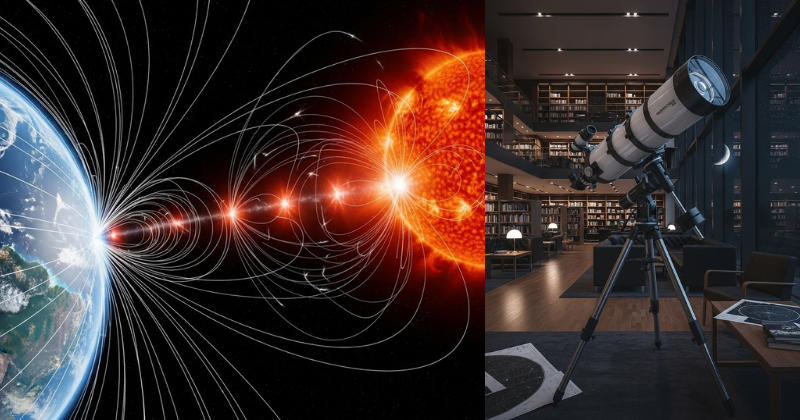
Earth is constantly interacting with the Sun’s magnetic activity, and scientists now monitor this invisible connection in real time using satellites, ground-based sensors, and advanced physics models. This article explores how solar magnetism shapes space weather, affects Earth’s protective shields, and how researchers track these processes minute by minute to protect technology, infrastructure, and scientific understanding.
Introduction
Earth is not an isolated planet drifting quietly through space. It exists within a dynamic magnetic environment shaped by the Sun’s intense and ever-changing magnetic activity. Streams of charged particles, bursts of radiation, and shifting magnetic fields constantly interact with Earth’s own magnetic shield, creating a complex and sometimes volatile relationship. Scientists now monitor this interaction in real time, combining space-based instruments with ground observatories to anticipate disruptions and decode fundamental space physics. Understanding how Earth interacts with the Sun’s magnetic activity is critical not only for astronomy but also for modern society, which depends on satellites, power grids, and global communication systems.
What Is the Sun’s Magnetic Activity and Why Is It So Powerful?
The Sun’s magnetic activity originates deep within its interior, where electrically charged plasma flows generate intense magnetic fields through a process known as the solar dynamo. Unlike a solid object, the Sun rotates at different speeds depending on latitude, stretching and twisting magnetic field lines over time.
These stressed magnetic fields eventually reorganize themselves in dramatic events such as solar flares and coronal mass ejections. In these moments, enormous amounts of energy are released, sending radiation and magnetized plasma outward through the solar system. This activity follows an approximately 11-year cycle, during which the Sun transitions from relatively calm periods to phases of heightened magnetic instability.
The sheer scale of solar magnetism is difficult to comprehend. Magnetic loops can span hundreds of thousands of kilometers, and a single eruption can release energy equivalent to billions of nuclear explosions. This magnetic power is the engine driving space weather throughout the solar system.
How Does Earth’s Magnetic Field Interact With Solar Activity?
Earth is protected by its magnetosphere, a vast magnetic bubble generated by motions in the planet’s molten outer core. When solar magnetic activity reaches Earth, it collides with this protective field rather than the atmosphere directly.
The interaction is not passive. Solar wind pressure compresses the magnetosphere on the Sun-facing side and stretches it into a long tail on the opposite side. When solar magnetic fields align unfavorably with Earth’s, energy can be transferred into the magnetosphere through a process called magnetic reconnection.
This energy transfer fuels geomagnetic storms, intensifies radiation belts, and drives electrical currents through Earth’s upper atmosphere. The result can be visually stunning auroras, but also potentially damaging effects on satellites, navigation systems, and electrical infrastructure.
What Are Solar Flares and Coronal Mass Ejections?
Solar flares and coronal mass ejections are two of the most significant expressions of solar magnetic activity, though they differ in nature and impact.
Solar flares are sudden bursts of electromagnetic radiation produced when magnetic energy is rapidly released in the Sun’s atmosphere. They travel at the speed of light and can disrupt radio communications on Earth within minutes.
Coronal mass ejections, by contrast, involve the physical expulsion of billions of tons of magnetized plasma into space. These clouds move more slowly, taking one to three days to reach Earth, but they carry immense magnetic energy capable of triggering major geomagnetic storms.
Scientists closely monitor both phenomena because their timing, strength, and magnetic orientation determine how strongly Earth will be affected.
How Do Satellites Monitor the Sun’s Magnetic Activity in Real Time?
Space-based observation is the backbone of real-time solar monitoring. Satellites positioned between Earth and the Sun provide continuous measurements of solar behavior long before disturbances reach our planet.
Solar observatories track sunspots, magnetic field configurations, and high-energy radiation. Instruments measure the speed, density, and magnetic orientation of the solar wind as it flows outward. This data allows scientists to estimate when solar disturbances will arrive and how severe their effects might be.
Some satellites are positioned at gravitational balance points where they maintain a stable view of the Sun-Earth system. From these vantage points, they act as early warning systems, providing critical minutes to hours of advance notice before geomagnetic disturbances strike Earth.
Which Ground-Based Systems Support Real-Time Monitoring?
While satellites observe the Sun and space environment, ground-based systems are essential for measuring how Earth responds. Networks of magnetometers distributed across the globe continuously track changes in Earth’s magnetic field.
These instruments detect subtle fluctuations caused by solar-driven currents in the magnetosphere and ionosphere. Radar systems measure charged particle motion in the upper atmosphere, while radio telescopes observe solar emissions that signal rising magnetic instability.
Together, these systems provide a full picture of space weather as a coupled Sun–Earth system, allowing scientists to validate satellite data and refine predictive models.
How Do Scientists Model and Predict Space Weather Events?
Monitoring alone is not enough. Scientists rely on sophisticated computational models to translate observations into forecasts. These models simulate plasma physics, magnetic field interactions, and particle motion across vast spatial scales.
By assimilating real-time data from satellites and ground stations, models can predict how solar magnetic disturbances will evolve as they travel through space and interact with Earth. Forecasts estimate storm intensity, duration, and potential impacts on technology.
Although space weather prediction remains challenging due to the complexity of magnetic interactions, advances in computing power and data integration have dramatically improved accuracy over the past two decades.
Why Does Real-Time Monitoring Matter for Modern Society?
The practical importance of monitoring Earth’s interaction with the Sun’s magnetic activity cannot be overstated. Modern civilization is deeply reliant on technologies vulnerable to space weather.
Geomagnetic storms can induce currents in power lines, damaging transformers and causing widespread outages. Satellites can experience electronics failures, orbital drag changes, and communication disruptions. Navigation systems such as GPS can lose accuracy during intense solar activity.
By monitoring solar magnetic activity in real time, scientists provide critical warnings that allow operators to take protective measures. These efforts transform abstract astrophysical research into a direct safeguard for global infrastructure.
What Are the Future Challenges in Monitoring Solar–Earth Interactions?
Despite remarkable progress, significant challenges remain. The Sun’s magnetic behavior is inherently complex, and small changes can produce dramatically different outcomes at Earth.
Improving predictions requires better understanding of magnetic reconnection, plasma turbulence, and the three-dimensional structure of solar eruptions. New missions are being developed to observe the Sun from multiple angles and closer distances, providing unprecedented data resolution.
As technology advances, real-time monitoring will increasingly merge artificial intelligence with physics-based models, opening new frontiers in forecasting accuracy and scientific insight.
Conclusion
Earth’s constant interaction with the Sun’s magnetic activity is an ongoing cosmic dialogue shaped by powerful forces and delicate balances. Through satellites, ground-based instruments, and advanced modeling, scientists now monitor this relationship in real time, transforming invisible magnetic storms into measurable, predictable events. This effort not only deepens our understanding of fundamental space physics but also protects the technological foundations of modern life. As monitoring capabilities continue to evolve, humanity moves closer to fully understanding—and adapting to—the magnetic heartbeat of our star.