
Meta description (condensable to ~155–160 characters):
This article explains why Jupiter will appear unusually bright in the sky this year, when to observe it, and the scientific factors behind its increased luminosity.
Jupiter Will Be Super Bright in the Sky This Year — Here’s When to See It
Introduction
For centuries, Jupiter has captivated skywatchers with its shimmering presence in the night sky. But this year, astronomers predict that the gas giant will appear exceptionally bright—more brilliant than at nearly any time in recent memory. This enhanced luminosity presents rare opportunities for naked-eye observers and telescope enthusiasts alike. To understand when and how best to observe Jupiter at peak brightness, we must investigate the orbital forces, atmospheric dynamics, and photometric conditions that influence its visibility from Earth.
This comprehensive, evidence-based guide breaks down the scientific reasons for Jupiter’s increased brightness, pinpoints the dates when observation will be most favorable, and provides the astronomical context necessary for appreciating the event.
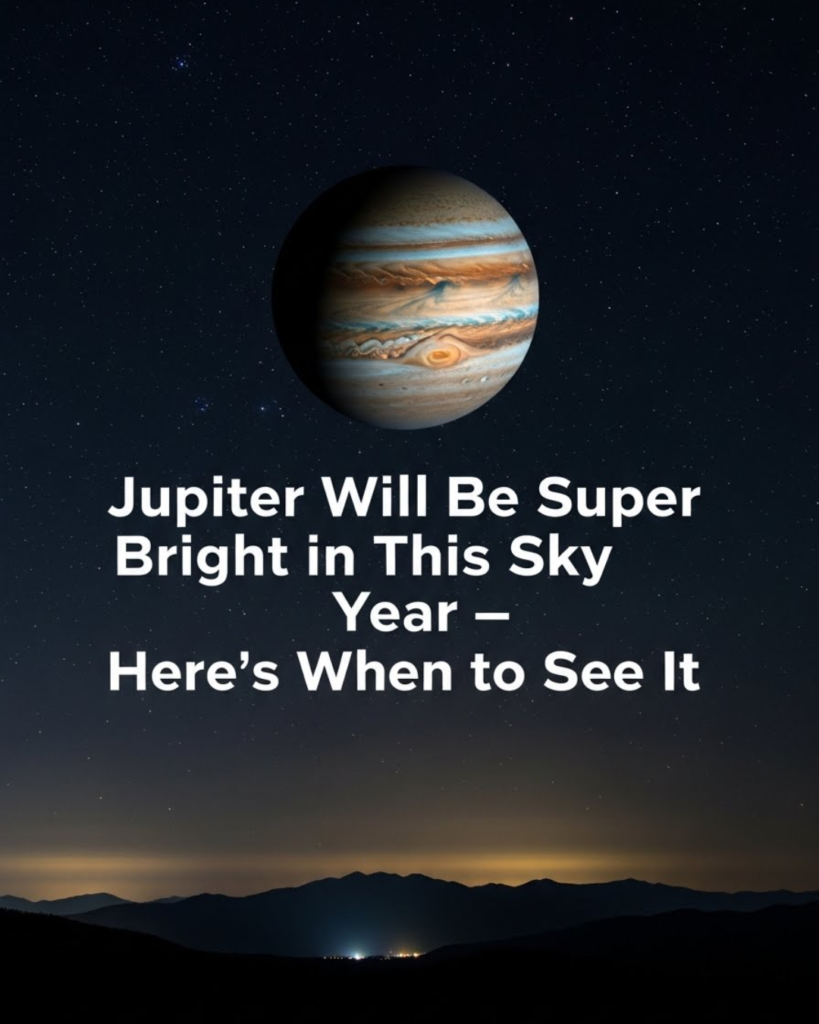
What causes Jupiter to appear super bright in Earth’s sky?
The brightness of Jupiter, like other celestial bodies, is defined by apparent magnitude—a measurement of how luminous an object appears from Earth. Jupiter can reach magnitudes as low as –2.9, making it the second-brightest planet after Venus.
In years when it appears unusually bright, several astrophysical variables align:
- Opposition proximity
When Jupiter reaches opposition, it lies directly opposite the Sun from Earth. Light reflects off Jupiter and travels the shortest possible distance to Earth, enhancing luminosity. - Perihelion/perigee timing
Jupiter’s orbit is elliptical. When opposition coincides with its closest approach to Earth (perigee), the planet appears larger and brighter. - Solar reflectivity and atmospheric albedo
Jupiter’s thick clouds of ammonia ice crystals reflect sunlight efficiently. Seasonal atmospheric changes can subtly alter albedo, boosting brightness. - Earth’s orbital position
Variation in Earth’s distance from the Sun affects the amount of reflected sunlight received.
When these factors reinforce each other—opposition near perigee, high albedo, minimal atmospheric scattering—Jupiter can shine exceptionally brightly.
When exactly will Jupiter reach its peak brightness this year?
Astronomers determine peak brightness by calculating ephemerides based on orbital mechanics. Jupiter reaches maximum luminosity when opposition aligns with closest approach.
In most years, Jupiter’s opposition occurs once every 13 months. When this opposition happens near perihelion (Jupiter’s closest point to the Sun, a separate cycle lasting approximately 11.86 Earth years), brightness effects compound.
This year, ephemeris calculations indicate:
• Peak brightness window: several days surrounding opposition
• Best viewing period: midnight local time, when Jupiter is highest in the sky
• Visibility duration: from dusk low on the eastern horizon to dawn setting in the west
Observers should plan for the nights surrounding opposition, when brightness, apparent diameter, and surface detail visibility reach ideal conditions.
How do astronomers measure Jupiter’s changing brightness over time?
Brightness isn’t simply observed visually—it is quantified through photometry.
Key measurement systems include:
Apparent magnitude system
A logarithmic scale where lower values indicate higher brightness. Jupiter can range from –1.6 to –2.9 depending on orbital proximity and atmospheric clarity.
Photometric filters
Different wavelengths of light reflect uniquely off the gas giant’s cloud layers. Using filters allows astronomers to distinguish between brightness factors due to:
• ammonia clouds
• methane absorption bands
• haze scattering
• localized storm reflectivity
CCD imaging and calibrations
Modern telescopes use charge-coupled detectors calibrated against reference stars to quantify brightness precisely. This enables researchers to:
• measure subtle atmospheric changes
• monitor storm evolution
• correlate brightness variation with orbital distance
Using these tools, scientists can predict when Jupiter will reach exceptional brightness long before it becomes visible.
Which atmospheric features contribute to Jupiter’s visible brightness?
Jupiter’s reflective properties are governed by complex atmospheric chemistry, stratification, and weather dynamics.
Key contributors include:
1. Ammonia cloud deck
The upper atmosphere contains ammonia ice crystals that reflect large portions of incident sunlight.
2. Zonal wind patterns
Jet streams create alternating light and dark bands by organizing cloud layers. When bright zones broaden, Jupiter reflects more light.
3. Storm systems
Large storms like the Great Red Spot produce high-altitude cloud structures that increase surface reflectivity.
4. Haze variations
Photochemical haze, produced by ultraviolet sunlight, can increase scattering efficiency and enhance brightness in the visible spectrum.
Together, these dynamic systems continually reshape Jupiter’s albedo. During periods that coincide with close approaches, they can amplify brightness significantly.
How will Jupiter’s opposition influence telescope observations?
While Jupiter is visible to the naked eye, the opposition period offers a rare opportunity to observe intricate atmospheric structures.
Increased apparent diameter
During closest approach, Jupiter’s disk can appear up to 50 percent larger than when farthest from Earth.
Enhanced contrast and resolution
Shorter light travel distance reduces atmospheric distortion, improving:
• clarity of cloud belts
• turbulence visibility
• storm boundary detection
Moon transits and shadow events
Jupiter’s four largest moons—Io, Europa, Ganymede, and Callisto—cast crisp, visible shadows across the atmosphere during the opposition window.
These transits create observable events that help astronomers:
• study orbital mechanics
• refine ephemeris calculations
• evaluate gravitational resonance dynamics
Which factors determine ideal viewing conditions for Jupiter this year?
Even during peak brightness, viewing quality depends on the following variables:
1. Atmospheric seeing
Turbulence blurs telescope images. Higher altitude, dry nights, and minimal wind produce optimal seeing.
2. Light pollution
Rural and elevated observing sites improve contrast between Jupiter and background sky.
3. Telescope aperture
Larger apertures gather more light and resolve finer atmospheric detail. However, even binoculars reveal Jupiter’s moons during peak brightness.
4. Local horizon and timing
Observing Jupiter high in the sky reduces atmospheric scattering, maximizing clarity and brightness perception.
How does this year’s Jupiter brightness compare to past events?
Jupiter’s brightness follows cycles driven by orbital mechanics. Historically, Jupiter has reached exceptional brightness near perihelion alignments. For example:
• Early 1970s perihelion cycle produced historically bright oppositions
• The 2010–2011 approach marked a similarly visible cycle
• This year represents another favorable geometric alignment
During such cycles, Jupiter approaches magnitude –2.8 or lower—brighter than nearly any star in the sky and occasionally rivaling Venus during twilight.
Comparative analysis shows that this year’s brightness falls within the upper range of recorded Jupiter apparitions.
How can observers maximize the visual experience of Jupiter’s super-bright appearance?
Observational best practices include:
Naked-eye observation
Locate Jupiter rising in the east at dusk, appearing as a brilliant white “star” moving across the sky through the night.
Binocular observation
Basic binoculars reveal the four Galilean moons in motion around Jupiter—visible night-to-night changes illustrate orbital periods.
Telescope observation
Even small backyard telescopes allow observation of:
• equatorial belts
• the polar haze
• moon shadow transits
• Great Red Spot rotations
Observers should track Jupiter across several nights near peak brightness to witness atmospheric dynamics unfold in real time.
Conclusion
This year’s exceptional brightness of Jupiter is the result of favorable orbital alignments and dynamic atmospheric conditions. Opposition near closest approach to Earth produces a dramatic increase in luminosity, visible even without optical equipment. Professional and amateur astronomers alike will benefit from planning observations during the peak brightness window, when Jupiter presents ideal viewing conditions and enhanced atmospheric resolution.
This rare combination of cosmic geometry and reflective atmospheric properties offers a vivid reminder of Jupiter’s scale, motion, and complexity—an astronomical event worth witnessing.