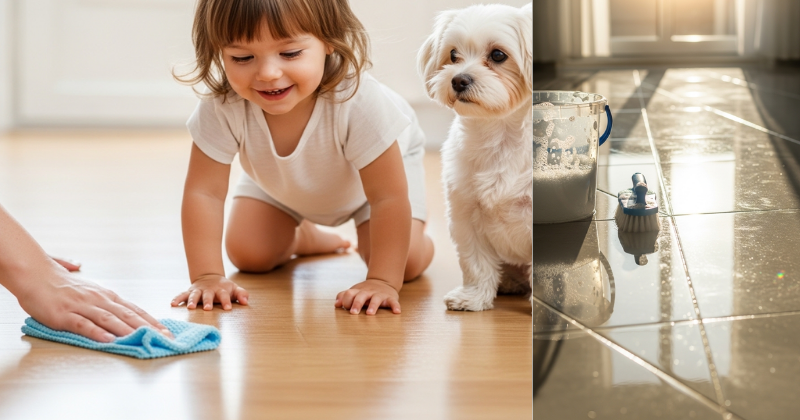
Every time you mop your floors with conventional cleaning products, you’re leaving a chemical residue film on every surface your toddler crawls across and your dog licks. According to the American Association of Poison Control Centers, household cleaning products represent one of the most common sources of childhood poisoning exposure — and pets, with their constant floor-level contact and grooming habits, face even greater cumulative chemical exposure than adults from residues on treated surfaces. The good news is that making a genuinely effective homemade floor cleaner that’s completely safe for kids and pets takes about two minutes, costs pennies per batch, and outperforms many commercial products for everyday cleaning. This complete guide gives you multiple proven recipes for every floor type, explains exactly why each ingredient is safe, and builds a complete system for keeping your floors spotless without compromising the safety of anyone in your household.
Why Commercial Floor Cleaners Raise Legitimate Safety Concerns
Before diving into recipes, understanding the specific concerns with conventional floor cleaners helps you appreciate why making your own is worth the minimal effort involved.
The Chemical Residue Problem
Commercial floor cleaners contain a range of synthetic compounds that don’t simply evaporate when floors dry — they leave residue that persists on surfaces until the next cleaning. Quaternary ammonium compounds (quats) — present in most “antibacterial” floor cleaners — have been linked in animal studies to reproductive toxicity and are known respiratory sensitizers. Glycol ethers, used as solvents in many commercial formulations, are classified by the EPA as hazardous air pollutants and can cause neurological effects with repeated exposure. Synthetic fragrances — often listed simply as “fragrance” on labels — can contain dozens of undisclosed compounds including phthalates, which function as endocrine disruptors.
Children and pets are disproportionately affected by floor-level chemical residues for several compounding reasons. Children spend significantly more time in direct floor contact during play and developmental exploration. Their body-to-surface-area ratio means they absorb proportionally more chemical exposure per unit of body weight. Pets groom themselves continuously, ingesting whatever exists on the floor surface through licked paws and coats. And the developing nervous and endocrine systems of both young children and young pets exhibit greater vulnerability to chemical disruption than mature adult systems.
What “Safe” Actually Means in This Context
When this guide describes ingredients as “safe for kids and pets,” the standard involves three specific criteria: acute oral toxicity classifications that pose no risk from the incidental ingestion that occurs with floor contact and grooming; absence of documented endocrine-disrupting, reproductive, or developmental toxicity concerns at household use concentrations; and complete biodegradability without persistence in home environments. The ingredients in these recipes meet all three criteria. None of them appear on EPA Safer Choice lists of concern, veterinary toxicology alerts, or pediatric poison control advisories at the concentrations used for floor cleaning.
The Core Ingredients: Safe, Effective, and Why They Work
White Vinegar: The pH-Neutral Acid Cleaner
White distilled vinegar (5% acetic acid) is the backbone of most homemade floor cleaners for good reason — it provides genuine cleaning efficacy through multiple mechanisms while meeting every safety criterion for household use around children and pets. Acetic acid at 5% concentration is classified by the EPA as a minimum-risk pesticide exempted from registration requirements based on its established safety profile. It is on the FDA’s GRAS (Generally Recognized As Safe) list. Veterinary toxicologists consider household vinegar essentially non-toxic for cats and dogs at typical home use concentrations.
Mechanistically, dilute acetic acid dissolves mineral deposits, soap scum, and food residues through mild acid-base chemistry. It reduces surface pH temporarily, creating conditions inhospitable to many common household bacteria and fungi without the systemic toxicity of synthetic antimicrobials. It completely biodegrades without leaving persistent chemical residue — once the floor dries, nothing remains beyond a mineral-free surface. The vinegar smell dissipates completely as it dries, leaving no lingering odor.
Castile Soap: Surfactant Action Without Synthetic Compounds
Dr. Bronner’s and similar pure castile soaps — made from saponified plant oils (typically coconut, olive, and hemp oils) — provide the surfactant cleaning action that lifts oils, fats, and adherent soils from floor surfaces. Unlike synthetic surfactants containing petrochemical derivatives and potentially endocrine-disrupting ethoxylates, castile soap’s cleaning compounds are derived entirely from food-grade plant oils through traditional saponification chemistry.
The surfactant molecules in castile soap (primarily sodium salts of fatty acids) are completely biodegradable, break down rapidly in water treatment systems, and leave no persistent residue at the concentrations used for floor cleaning. Important dosage note: castile soap requires careful dilution for floor cleaning — too much creates a soapy residue film that dulls floor finish and actually makes floors dirtier by attracting new soil. Just a few drops per gallon is sufficient and optimal.
Baking Soda: Gentle Abrasion and Odor Elimination
Sodium bicarbonate — baking soda — is so safe that it’s a primary component of pediatric oral rehydration preparations and is used therapeutically in veterinary medicine. Its role in floor cleaning formulations involves mild mechanical abrasion for embedded grime, pH buffering that supports surfactant effectiveness, and genuine odor elimination through neutralization of both acidic and basic odor-causing compounds rather than masking with fragrance.
Essential Oils: Natural Fragrance With Antimicrobial Benefit
Certain essential oils — specifically lavender, tea tree, eucalyptus, and lemon — provide genuine antimicrobial activity at appropriate concentrations alongside pleasant natural fragrance. However, essential oils require important species-specific safety considerations for pets. Tea tree oil (melaleuca) is toxic to cats and dogs and must be avoided in any formulation used in pet households. Eucalyptus oil is similarly problematic for cats specifically. Safe essential oil options for households with cats and dogs include properly diluted lavender oil (0.1-0.5% concentration in finished solution) and lemon or sweet orange essential oil at equivalent dilution.
For households with cats exclusively, avoiding all essential oils and relying on vinegar’s natural deodorizing properties is the simplest safest approach — cats are extremely sensitive to aromatic compounds due to their limited liver detoxification capacity for phenolic compounds.
The Complete Homemade Floor Cleaner Recipes
The Universal All-Purpose Safe Floor Cleaner (Works on Most Surfaces)
This is the daily-use formulation suitable for sealed hardwood, tile, vinyl, laminate, and most other common floor types. It cleans effectively without leaving residue and is completely safe for households with young children and pets.
Ingredients for one gallon:
- 1 gallon warm water
- ½ cup white distilled vinegar
- 1 teaspoon pure castile soap
- 10 drops lavender essential oil (optional, omit for cat-only households)
Preparation: Combine warm water and vinegar in your mop bucket first, then add castile soap and essential oil if using. Adding soap after water prevents excessive foaming that makes the mixture difficult to work with. Stir gently to combine — vigorous stirring creates suds that reduce cleaning efficiency. Use immediately or store in a sealed container for up to one week.
Application: Use with a well-wrung mop — the solution should go on damp, not wet. No rinsing required at this dilution.
The Hardwood-Safe Gentle Formula
Hardwood floors require extra caution because both excess moisture and acidic solutions can damage the wood finish over time. This formulation reduces vinegar concentration to a level that cleans effectively without pH-related finish degradation risk.
Ingredients for one gallon:
- 1 gallon warm water
- 2 tablespoons white distilled vinegar (reduced from the standard formulation)
- 1 teaspoon castile soap
- 5 drops lavender essential oil (optional)
Wring the mop until barely damp before each stroke and follow immediately with a dry microfiber buff for optimal results and minimal moisture exposure to wood.
The Tile and Grout Deep Clean Formula
Ceramic and porcelain tile tolerates more aggressive cleaning chemistry than hardwood, enabling a higher-efficacy formulation for kitchens and bathrooms where grease, hard water deposits, and bacterial growth are more significant concerns.
Ingredients for one gallon:
- 1 gallon warm water
- 1 cup white distilled vinegar
- 2 teaspoons castile soap
- 2 tablespoons baking soda (add last, after other ingredients are combined)
- 10 drops lemon essential oil (pet-safe at this dilution, omit for cat households)
Important mixing note: Add baking soda after combining all other ingredients — adding it to vinegar first creates a dramatic fizzing reaction that neutralizes both compounds before they can clean effectively. The slight fizzing that occurs when added to the complete mixture is controlled and productive.
The Pet Odor Elimination Formula
For households managing pet accidents, this specialized formulation neutralizes organic odors at the molecular level through enzyme-like action rather than masking them with fragrance.
Ingredients:
- 1 gallon warm water
- ¾ cup white distilled vinegar
- 1 teaspoon castile soap
- 3 tablespoons baking soda
- 2 tablespoons hydrogen peroxide (3% drugstore grade — safe for most sealed floors when diluted)
This formula’s combination of acetic acid (vinegar), alkaline buffer (baking soda), and oxidizing agent (hydrogen peroxide) addresses pet odor compounds through multiple simultaneous chemical mechanisms. Test on an inconspicuous area first for any floor type you haven’t previously used hydrogen peroxide on.
Advanced Tips for Maximum Cleaning Effectiveness
The Pre-Mopping Dry Clean Habit
The single most impactful improvement to any floor cleaning routine — regardless of which formula you use — is thorough dry cleaning before wet mopping. A quality microfiber dust mop removes the loose soil, pet hair, and debris that wet mopping would otherwise distribute across the floor surface rather than removing. Spending 3-5 minutes dry mopping before every wet mopping session produces visibly cleaner results and prevents the gritty residue that comes from mopping over undisturbed debris.
Concentration Calibration for Your Specific Water
Water hardness varies significantly by geography, and hard water (high mineral content) reduces the cleaning effectiveness of both vinegar and castile soap through mineral interference. If you live in a hard water area (check your municipal water report), increase vinegar concentration by 25-50% in your formulation, or substitute distilled water for tap water in your cleaning solution. The improvement in cleaning effectiveness and reduction in mineral spotting on tile and vinyl is immediately noticeable.
Essential Oil Safety Reference for Pet Households
The essential oil safety picture for pets is more nuanced than a simple safe/unsafe binary, and getting this right matters for genuinely pet-safe floor cleaner formulations. Dogs tolerate properly diluted lavender and citrus oils reasonably well in cleaned floor residues. Cats are significantly more sensitive due to their limited glucuronidation liver enzyme capacity and should not be exposed to tea tree, eucalyptus, clove, cinnamon, or thyme oils. For multi-species households with both cats and dogs, lavender at 0.1-0.2% concentration in the finished solution represents the safest aromatic option, or simply omit essential oils entirely — the formula cleans beautifully without them.
Troubleshooting Common Challenges
Floors Looking Streaky After Mopping
Streaking almost universally results from one of three causes. Too much castile soap leaves a film that catches light and appears streaky when dry — reduce to 1 teaspoon per gallon maximum. A wet (rather than damp) mop leaves solution pooling that dries unevenly — wring more thoroughly. Hard water minerals in tap water leave deposits — switch to distilled water. Addressing the actual cause resolves streaking permanently rather than requiring repeated rinsing that undermines the efficiency advantage of homemade formulas.
Persistent Pet Odors Despite Cleaning
If pet odors persist after cleaning, the source is biological material that has penetrated the floor surface into grout, subfloor, or between floorboards. Surface cleaning — regardless of formulation — cannot address subsurface contamination. For embedded odors, apply undiluted 3% hydrogen peroxide directly to the affected area, allow 10-minute contact time, then clean normally. For severe or repeated accident areas, enzymatic pet urine treatments specifically designed to break down urine proteins provide the subsurface treatment that cleaning solutions cannot reach.
Maximizing Long-Term Success With Natural Floor Cleaning
Building a Complete Natural Cleaning System
Homemade floor cleaner works most effectively as part of a coordinated natural cleaning approach throughout your home. Combining DIY floor cleaner with baking soda surface scrubbing, white vinegar glass and surface treatment, and castile soap for general cleaning creates a complete, consistent system from a small set of safe, inexpensive ingredients. You eliminate the cognitive complexity of managing multiple specialized products with different safety profiles, reduce storage demands, and create a genuinely toxin-free home environment for children and pets.
Batch-making your floor cleaner weekly in a sealed gallon jug eliminates the small friction of mixing before each cleaning session. Store it in a cool location away from direct sunlight — heat and UV exposure can degrade essential oil compounds over time. Label the container clearly with the contents and date, and replace weekly for optimal freshness.
Teaching Children About Natural Cleaning
One of the unexpected benefits of switching to homemade floor cleaner is the opportunity to involve children in household cleaning without safety concerns. Children can safely help mix these formulations (with supervision appropriate to their age), understand what each ingredient does and why it’s effective, and develop practical household skills without chemical exposure risk. This engagement builds both practical competence and healthy habits around home care that commercial cleaning products — with their “keep away from children” warnings — inherently preclude.
Conclusion
Making a homemade floor cleaner that’s genuinely safe for kids and pets requires nothing more than white vinegar, castile soap, baking soda, and optionally pet-appropriate essential oils — ingredients you likely already have, combined in under two minutes, at a cost of pennies per gallon. The result is floors that are truly clean — not chemically coated — providing a surface that toddlers can crawl across and pets can lick without cumulative chemical exposure concerns. Start with the universal all-purpose formula for your next mopping session and experience firsthand that safe, effective, and natural aren’t competing priorities — they’re completely compatible goals that this simple recipe achieves simultaneously, every single time.