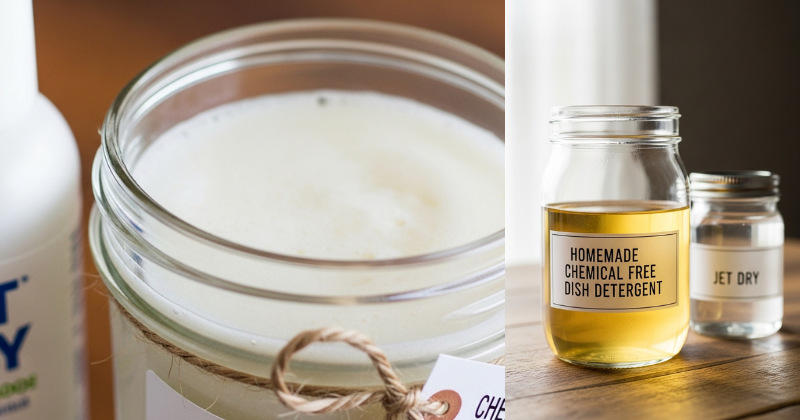
Every time your dishwasher runs a cycle, it rinses your dishes — and everything remaining on them — directly onto the surfaces your family eats from. Commercial dishwasher detergents contain a cocktail of synthetic compounds including chlorine bleach, phosphates, synthetic fragrances, artificial dyes, and polycarboxylates that don’t always rinse completely from dish surfaces. The residues left behind on plates, glasses, and cutlery enter your food and drink at every meal. Making your own chemical-free dish detergent and rinse aid isn’t a compromise — it’s an upgrade. These homemade formulas use ingredients whose complete chemical profiles you can look up, understand, and trust, and they clean dishes effectively through the same fundamental chemistry that commercial products employ, just without the synthetic additives. This complete guide gives you proven recipes for both dishwasher detergent and a natural jet dry rinse aid, explains the cleaning chemistry behind each ingredient, and troubleshoots every challenge you might encounter.
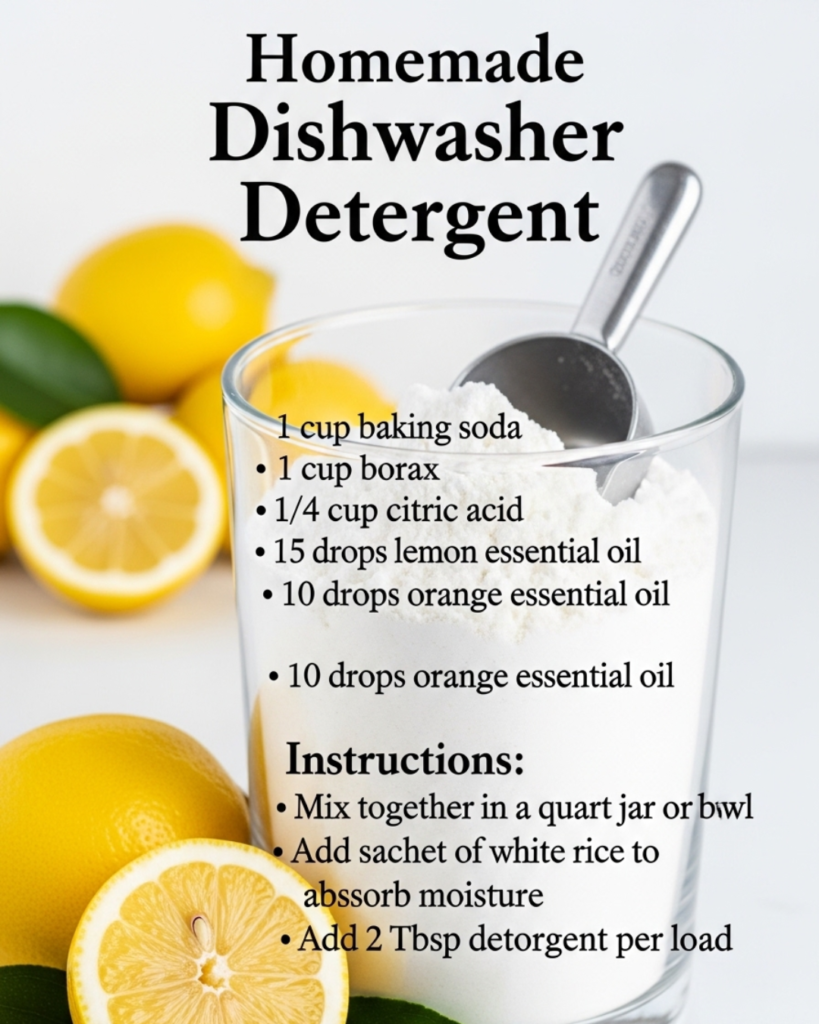
Understanding Dishwasher Chemistry: Why These Ingredients Work
Before mixing anything, understanding the cleaning chemistry involved transforms you from someone following a recipe into someone who genuinely understands what they’re making and can adapt it intelligently.
The Three Core Functions of Any Dishwasher Detergent
Every effective dishwasher detergent — commercial or homemade — must accomplish three simultaneous tasks. Alkalinity creation provides the pH environment (typically 9-11) that saponifies fats and denatures proteins, making them water-soluble and removable. Surfactant action lifts and suspends oil and food particles in the wash water, preventing redeposition on dish surfaces. Water softening prevents calcium and magnesium minerals in hard water from forming insoluble soap scum deposits on dishes and the machine interior. Commercial detergents achieve these functions through sodium hydroxide or sodium metasilicate (alkalinity), synthetic surfactants (cleaning action), and phosphates or EDTA (water softening). Your homemade formula achieves identical functions through washing soda, castile soap, and citric acid respectively — ingredients with completely transparent chemistries and dramatically better environmental profiles.
How Rinse Aids Actually Work
Jet dry and commercial rinse aids work through a deceptively simple mechanism that your homemade version replicates exactly. The rinse aid compartment dispenses its contents during the final rinse cycle, where it reduces the surface tension of the rinse water. Water naturally wants to bead up on hydrophobic surfaces (like glass and ceramics) — beads of water that evaporate leave behind mineral deposits as spots. Rinse aids contain surfactants that reduce water’s surface tension, causing it to “sheet” off dish surfaces in thin films that evaporate completely without leaving concentrated mineral deposits. White vinegar achieves this through identical physical chemistry — its acidity also simultaneously dissolves any remaining mineral deposits from the wash cycle, producing the spot-free, gleaming results that make rinse aids valuable.
The Complete Homemade Chemical-Free Dish Detergent Recipe
This formulation produces enough dishwasher detergent for approximately 30-40 wash cycles, prepared in under 10 minutes with ingredients available at any grocery or hardware store.
Powdered Detergent Formula (Recommended for Most Dishwashers)
The powder format is the most stable, longest-lasting, and most effective homemade dishwasher detergent configuration. Unlike liquid formulas that require complex preservation strategies, the powder remains stable for months in a sealed container.
Ingredients:
- 1 cup washing soda (sodium carbonate — the alkalinity and softening foundation)
- 1 cup baking soda (sodium bicarbonate — mild abrasion and additional alkalinity)
- 1/2 cup citric acid powder (water softening through calcium sequestration, rinse aid boost)
- 1/2 cup coarse kosher or sea salt (mechanical abrasion enhancement, water softening support)
- Optional: 20-30 drops of lemon or orange essential oil (degreasing terpenes + natural fragrance)
What each ingredient does at the molecular level: Washing soda (sodium carbonate) dissolves in hot water to produce a strongly alkaline solution (pH approximately 11.4) that saponifies triglycerides in food fats — converting them to water-soluble fatty acid soaps that rinse away cleanly. Baking soda provides gentle mechanical abrasive action through its slightly gritty texture while contributing moderate additional alkalinity. Citric acid functions as a chelating agent — its tricarboxylic structure binds calcium and magnesium ions in hard water, preventing them from interfering with soap’s cleaning action and preventing lime scale formation. Coarse salt provides additional mechanical scrubbing action and contributes sodium ions that support water softening dynamics.
Preparation: Combine washing soda and baking soda in a large bowl and mix thoroughly. Add salt and stir to distribute evenly. Add citric acid last and mix quickly — the citric acid will react gently with the carbonate compounds if moisture is present, so work quickly and store immediately in an airtight container to prevent moisture-triggered premature reaction. Add essential oils if using, stir immediately to distribute throughout the dry mixture, then transfer to your sealed storage container.
Usage: 1-2 tablespoons per dishwasher load in the detergent compartment. For heavily soiled loads or hard water areas, use 2 tablespoons and add 1/4 teaspoon of citric acid directly to the bottom of the dishwasher before running.
The Dishwasher Detergent Tabs Formula
Tabs offer the convenience of pre-measured portions and eliminate the mess of scooping powder for each load. They take about 30 minutes to make and last indefinitely when stored in an airtight container.
Ingredients:
- 1 cup washing soda
- 1/2 cup baking soda
- 1/4 cup citric acid
- 1/4 cup coarse salt
- 3-4 tablespoons water (add just enough to make the mixture hold together when pressed — not wet, barely damp)
- 15-20 drops lemon essential oil
Combine dry ingredients, add essential oil, then add water by the tablespoon while stirring constantly — the mixture will fizz gently as acid and base contact water. Work quickly and press firmly into silicone ice cube trays or soap molds. Allow to harden at room temperature for 24 hours minimum, then unmold and store in an airtight glass container. Use one tab per dishwasher load.
The Natural Jet Dry Rinse Aid: Three Options
Option 1: Pure White Vinegar (Simplest and Most Effective)
Undiluted white distilled vinegar (5% acetic acid) poured directly into the dishwasher’s rinse aid compartment provides spot-free, streak-free rinse performance that genuinely rivals commercial rinse aids. The acetic acid reduces water surface tension, causing sheeting rather than beading, while simultaneously dissolving any calcium carbonate deposits left from the wash cycle. Fill the rinse aid compartment completely with white vinegar and set the dispenser to its lowest or mid-range setting — vinegar is more fluid than commercial rinse aids and may over-dispense at maximum settings.
A concern sometimes raised is that vinegar might damage dishwasher rubber seals over time. This concern has merit in theory but requires clarification: the extremely dilute acetic acid concentration that reaches seals during the rinse cycle (the vinegar is diluted 10-20 fold by rinse water) poses negligible risk to quality silicone seals. Older rubber gaskets that have already begun to deteriorate may experience accelerated degradation — inspect your dishwasher’s seal condition and consider replacing aged gaskets if this is a concern before transitioning to vinegar rinse aid.
Option 2: Enhanced Citric Acid Rinse Aid
For hard water areas where vinegar alone doesn’t fully prevent mineral spotting, this enhanced rinse aid formula provides stronger chelating action through citric acid’s superior calcium-binding capacity compared to acetic acid.
Ingredients:
- 1 cup water
- 2 tablespoons citric acid powder
- 1 tablespoon white vinegar
- 5 drops lemon essential oil (optional)
Dissolve citric acid in water at room temperature — no heating required. Add vinegar and essential oil, stir to combine, and bottle in a clean glass bottle with a pour spout. Fill your dishwasher’s rinse aid compartment and set the dispenser to medium. This formula handles hard water deposits more aggressively than vinegar alone, producing brilliant spot-free results even in areas with very high mineral content water.
Option 3: The Deluxe Rinse Aid Formula With Glycerin
Adding a small amount of vegetable glycerin to the rinse aid improves sheeting action on certain dish materials — particularly plastics that commercial rinse aids are specifically formulated to address.
Ingredients:
- 1 cup white vinegar
- 1 tablespoon vegetable glycerin
- 1 tablespoon citric acid (dissolved in 2 tablespoons warm water before adding)
Combine all ingredients and bottle. The glycerin reduces surface tension further than vinegar alone, improving performance on plasticware and stainless steel items where sheeting action is most critical.
Advanced Strategies for Maximum Cleaning Performance
Hard Water Adaptation Strategies
Hard water is the single most common reason homemade dishwasher detergent underperforms expectations. Water hardness above 200 parts per million (moderately hard) requires specific adaptations to achieve commercial-equivalent results. Increase the citric acid component in your detergent recipe by 25-50% — this provides additional chelating capacity for the elevated calcium and magnesium ion concentration. Add 1/4 cup of oxygen bleach (sodium percarbonate — available as OxiClean powder) to the base recipe for enhanced mineral deposit prevention. Place a halved lemon in the top rack of each dishwasher load — the juice that releases during the wash cycle provides supplemental citric acid exactly where mineral deposits form most visibly.
For extremely hard water areas (above 400 ppm, common in the American Southwest, parts of Texas, and much of the UK), checking your water softener salt levels (if you have a whole-house softener) and using only distilled or softened water in your detergent formula preparation may be necessary for consistent performance.
Machine Maintenance That Amplifies Detergent Performance
The performance difference between a maintained and neglected dishwasher is substantial — and directly affects how well any detergent performs. A monthly deep cleaning cycle using 2 cups of white vinegar placed in a bowl on the top rack (run empty on the hottest cycle) dissolves accumulated mineral scale that reduces spray arm effectiveness and water heating efficiency. Following with an empty cycle using 1/2 cup of baking soda sprinkled on the dishwasher floor removes residual odors and polishes the interior. Clean spray arm holes with a toothpick monthly — clogged holes reduce water pressure and create cleaning inconsistency. A clean machine requires less detergent to achieve optimal results and performs consistently rather than erratically.
Temperature Optimization
Dishwasher water temperature directly determines how effectively washing soda and citric acid perform their functions. Washing soda achieves maximum alkalinity and grease-cutting performance at temperatures above 55°C (130°F). Many modern dishwashers default to energy-saving modes that heat water to only 45-50°C — insufficient for optimal homemade detergent performance. Activating your dishwasher’s “sanitize” or “high-temperature” wash option, or adjusting your water heater’s temperature setting to 60°C (140°F), meaningfully improves results with homemade formulas without requiring any recipe changes.
Troubleshooting Common Challenges
White Film or Hazy Residue on Dishes
White film after washing indicates insufficient alkalinity, insufficient water softening, or both — depending on whether the film wipes off easily (mineral deposits, addressed by more citric acid) or feels slightly tacky (soap film from insufficient rinsing, addressed by reducing detergent quantity or adding more rinse aid). Hard water mineral film responds to a 1/2 cup citric acid dissolved in a gallon of water — soaking affected items for 30 minutes dissolves existing deposits instantly. Preventing recurrence requires increasing citric acid in your detergent formula and ensuring the rinse aid compartment is consistently filled.
Dishes Not Getting Clean Enough
Inadequate cleaning typically reflects one of three variables: insufficient water temperature (see temperature section above), inadequate detergent quantity for soil load, or overloading that prevents adequate water spray coverage of all surfaces. Increase detergent to 2 tablespoons for heavily soiled loads, add 1/4 teaspoon of citric acid directly to the wash compartment for greasy loads, and ensure dishes are loaded with enough spacing for water spray access. Pre-rinsing excessively is counterproductive — a small amount of food soil actually helps the detergent perform better by activating enzymes in the wash process.
Glassware Developing Cloudiness Over Time
Cumulative glass cloudiness (etching) is irreversible when it results from alkaline erosion of glass surfaces — a risk with any alkaline cleaner used at high temperatures over many wash cycles, not unique to homemade formulas. Preventively reducing wash temperature, using the minimum effective detergent quantity, and ensuring adequate rinse aid prevents new etching from developing. For existing cloudiness that hasn’t yet crossed into permanent etching, soaking in white vinegar for 30 minutes can remove the mineral component of cloudiness, revealing whether the underlying glass remains clear.
Building Your Complete Chemical-Free Kitchen Cleaning System
Cost Analysis and Environmental Impact
The economic case for homemade chemical-free dish detergent is compelling at every usage level. A batch of homemade powder detergent costing approximately $3-4 in ingredients provides 30-40 washes — roughly $0.08-0.13 per load compared to $0.25-0.40 for commercial pods. Annual savings for a household running 5 washes weekly approach $50-80 from detergent alone. Adding rinse aid savings (white vinegar at $0.02 per fill versus $0.30+ for commercial rinse aids) increases annual savings further. Over five years, a household switching entirely to homemade dish cleaning products saves $300-400 — meaningful household budget impact from a change requiring 15 minutes of preparation monthly.
Integrating With a Complete Natural Home Cleaning Approach
Dishwasher detergent is frequently the first homemade cleaner that households adopt — and the success typically motivates expanding to hand dish soap (castile soap with a few drops of lemon essential oil), all-purpose kitchen cleaner (water, vinegar, and tea tree oil), and surface scrubs (baking soda with castile soap). The same core ingredients — washing soda, baking soda, castile soap, citric acid, and white vinegar — address virtually every kitchen and bathroom cleaning need. Purchasing these five ingredients in bulk provides an entire year’s supply of multiple cleaning products for less than the monthly cost of a single commercial cleaning product subscription.
Conclusion
Homemade chemical-free dish detergent and jet dry deliver clean, spot-free, gleaming dishes through the same fundamental chemistry as commercial products — without the synthetic preservatives, artificial fragrances, chlorine bleach, or polycarboxylates that commercial formulas routinely include. The washing soda provides alkalinity, citric acid softens water and chelates minerals, and white vinegar or citric acid rinse aid sheets water cleanly from surfaces without leaving residue. Prepare your first batch of powder detergent this weekend — the investment is under $10, the preparation takes 10 minutes, and the result is a genuinely effective, completely transparent cleaning product you can use with full confidence in every ingredient it contains.