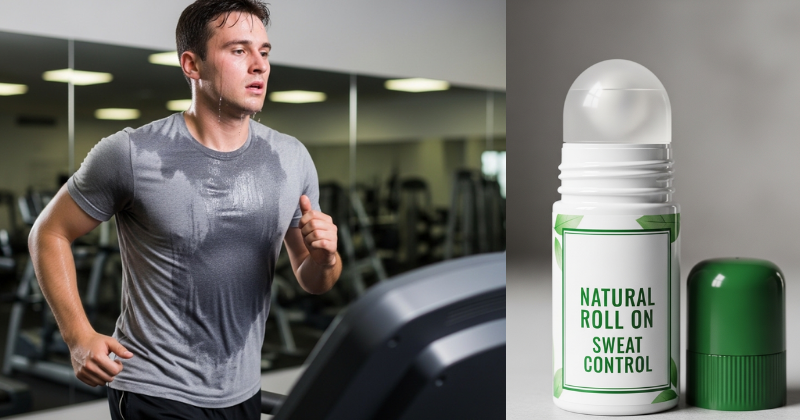
Commercial antiperspirants typically rely on aluminum-based compounds — aluminum chlorohydrate, aluminum zirconium, or aluminum chloride — that mechanically plug sweat gland ducts to reduce perspiration by 20-40% in clinical testing. While effective, aluminum salts raise concerns for some consumers regarding potential links to breast cancer and Alzheimer’s disease (though current research hasn’t definitively established these connections). This DIY sweat control roll-on delivers genuine perspiration reduction through natural astringent and antimicrobial compounds that address both the volume of sweat and the bacterial metabolism producing body odor, without relying on aluminum or synthetic additives. The formulation combines witch hazel’s tannin-based astringency, baking soda’s pH-modifying antimicrobial action, and essential oils with documented antibacterial activity against the Corynebacterium and Staphylococcus species responsible for axillary odor. You’ll create a roll-on preparation that genuinely reduces sweat and odor through evidence-based mechanisms — in a format you control completely.
The Physiology of Sweat and Body Odor: What You’re Actually Addressing
Understanding the biological processes generating sweat and odor helps you appreciate why this DIY formulation works and how its mechanisms differ from commercial products.
Eccrine vs. Apocrine Sweat Glands
The human body contains approximately 2-4 million sweat glands distributed across two types with distinct functions. Eccrine glands, distributed across the entire body surface and particularly dense on palms, soles, and forehead, produce hypotonic sweat (dilute salt water) for thermoregulation. This watery sweat is essentially odorless when secreted. Apocrine glands, concentrated in the axillae (armpits), groin, and areolae, produce a milky, protein-rich secretion containing lipids, steroids, and volatile compounds. Apocrine glands become active at puberty under hormonal influence and contribute to body odor through a mechanism that requires understanding: the apocrine secretion itself is initially odorless, but resident skin bacteria — primarily Corynebacterium species — metabolize the proteins and lipids in this secretion, producing the volatile short-chain fatty acids and sulfurous compounds that constitute body odor.
This distinction is critical: commercial antiperspirants target the glands themselves (blocking sweat secretion mechanically), while this DIY formulation targets both the environmental conditions favoring bacterial growth (through pH modification and antimicrobial compounds) and the volume of perspiration (through astringent action that temporarily constricts pores and sweat gland ducts).
Why Aluminum Works and What Alternatives Exist
Aluminum salts form temporary gel-like plugs within sweat gland ducts when they contact sweat’s moisture and slightly alkaline pH. These plugs partially obstruct sweat flow for 24-48 hours until natural skin cell turnover and sweating dislodge them. The effectiveness is dose-dependent — clinical-strength products containing 20-25% aluminum compounds reduce sweat more than over-the-counter products at 10-15% concentrations.
Natural alternatives don’t mechanically plug ducts but instead operate through: astringent tannins that temporarily tighten skin and reduce pore diameter (witch hazel, green tea extract); pH-modifying compounds that create less hospitable environments for odor-causing bacteria (baking soda elevates pH, inhibiting acid-preferring bacteria); antimicrobial essential oils that directly kill bacteria (tea tree, lavender, sage); and absorbent minerals that wick moisture (arrowroot powder, cornstarch). This DIY roll-on strategically combines these mechanisms.
Complete DIY Sweat Control Roll-On Recipe
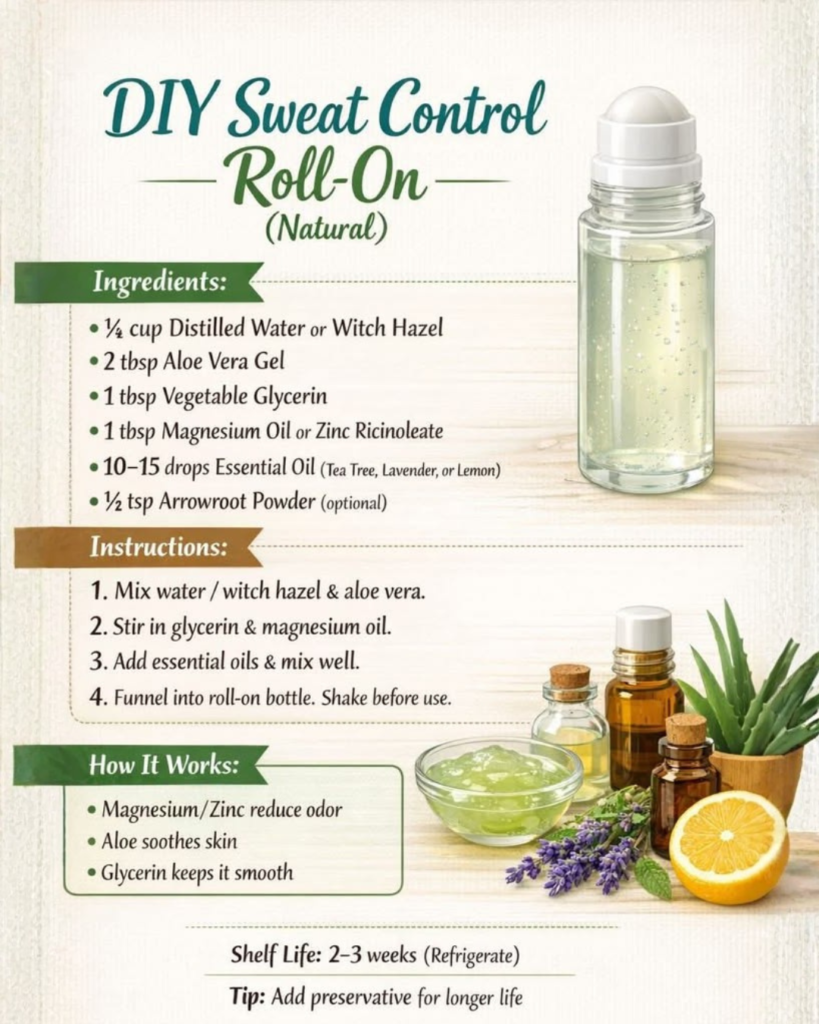
This formulation produces approximately 60ml of finished product — sufficient for 6-8 weeks of daily application — using readily available ingredients with documented antiperspirant or antimicrobial properties.
Core Ingredients and Their Functions
Base ingredients:
- 3 tablespoons (45ml) witch hazel extract (alcohol-based, not the alcohol-free hydrosol version)
- 1 tablespoon (15ml) vegetable glycerin
- 1 teaspoon (5g) baking soda
- 1 teaspoon (5g) arrowroot powder or cornstarch
- 10-12 drops tea tree essential oil (Melaleuca alternifolia)
- 8-10 drops lavender essential oil
- 5-6 drops sage essential oil (optional — enhances antimicrobial activity)
Equipment needed:
- Small bowl for mixing
- Whisk or fork for blending
- Empty roll-on bottle (60ml capacity, glass or plastic with rolling ball applicator)
- Funnel for transferring finished product
Ingredient selection rationale: Witch hazel provides tannins (particularly hamamelitannin) that produce astringent effects through protein precipitation in the superficial skin layers, temporarily tightening tissues and reducing pore diameter. Research documents that topical tannin application reduces transepidermal water loss and may modestly reduce sweat secretion through this mechanical tightening. Vegetable glycerin functions as a humectant that improves the formulation’s skin feel and prevents excessive drying from the alcohol in witch hazel and the alkalinity of baking soda. Baking soda (sodium bicarbonate) elevates local pH when dissolved in perspiration — while bacteria thrive in the slightly acidic environment of normal skin (pH 4.5-5.5), raising pH to 8-9 inhibits the Corynebacterium species most responsible for odor production. Arrowroot powder provides absorbency that wicks moisture from the skin surface, reducing the aqueous environment bacteria require. Tea tree oil’s terpinen-4-ol exhibits broad-spectrum antimicrobial activity with minimum inhibitory concentrations against Staphylococcus and Corynebacterium species documented at 0.5-2% in research — the 10-12 drops in this 60ml formulation provide approximately 1% concentration. Lavender oil contributes additional antimicrobial activity through linalool and linalyl acetate while providing pleasant fragrance that masks any residual body odor.
Step-by-Step Preparation Method
Step 1: Combine dry ingredients. In your small mixing bowl, add the baking soda and arrowroot powder. Whisk together thoroughly to ensure even distribution and break up any clumps — this step is critical because clumped powder creates an uneven, gritty finished product.
Step 2: Add liquid ingredients gradually. Add the witch hazel extract slowly to the dry ingredient mixture while whisking continuously. The powder will initially resist incorporating into the liquid — persistent whisking for 60-90 seconds creates a smooth slurry. Add the vegetable glycerin and whisk until fully integrated. The mixture should be milky-white and fluid, with no visible powder clumps or separation.
Step 3: Add essential oils and mix thoroughly. Add the tea tree, lavender, and optional sage essential oils. Whisk vigorously for another 30 seconds to distribute the oils evenly throughout the base — essential oils naturally want to separate and float, so thorough incorporation at this stage ensures consistent potency throughout the bottle’s use.
Step 4: Transfer to roll-on bottle. Using your funnel, pour the finished mixture into the roll-on bottle. Fill to approximately 90% capacity to leave space for the rolling ball mechanism to move freely. Insert the rolling ball applicator and cap tightly. Shake vigorously for 15-20 seconds to ensure final mixing — you’ll need to shake before each use as the powder components naturally settle over time.
Step 5: Label and store. Label with ingredients and preparation date. Store at room temperature away from direct sunlight. Properly prepared, this formulation remains stable for 3-4 months due to the antimicrobial properties of the alcohol in witch hazel and the essential oils. Discard if you notice off odors, color changes, or separation that doesn’t resolve with shaking.
Application Protocol for Optimal Effectiveness
The efficacy of any topical antiperspirant depends substantially on application timing and technique. Apply the DIY sweat control roll-on to completely clean, dry skin immediately after showering or bathing — when the skin is free of previous product buildup, bacteria, and residual perspiration. Shake the bottle vigorously for 5-10 seconds before each use to redistribute the powder components. Apply 2-3 strokes to each underarm, ensuring complete coverage. Allow 2-3 minutes of air-drying before dressing — the alcohol in witch hazel evaporates quickly, leaving the active powder components and oils on the skin surface. Reapply once daily for most individuals, twice daily during hot weather or for those with higher-than-average perspiration rates.
Advanced Formulation Variations for Specific Needs
The Maximum Strength Variation for Heavy Perspiration
For individuals with hyperhidrosis (excessive sweating affecting 2-3% of the population) or simply those with higher-than-average sweat production, enhancing the base formula provides measurably greater sweat reduction. Increase the arrowroot powder to 2 teaspoons (doubling the absorbent capacity), add 1/2 teaspoon of activated charcoal powder (provides additional moisture absorption and odor adsorption through its extensive porous surface area), and increase tea tree oil to 15 drops. This enhanced formula produces a slightly thicker consistency but substantially greater sweat-wicking and antimicrobial activity.
The Sensitive Skin Gentle Formula
For skin that reacts to baking soda (manifesting as redness, irritation, or rash from its alkaline pH), replacing the baking soda with additional arrowroot powder eliminates the pH-elevation mechanism while maintaining the moisture absorption and antimicrobial protection from essential oils. Reducing essential oil concentrations by 25-30% and adding 3-4 drops of chamomile essential oil (with anti-inflammatory bisabolol and chamazulene) creates a formulation appropriate for sensitive, easily irritated skin.
The Sport and Exercise Enhancement
For application before athletic activity when perspiration rates can increase 10-fold over resting rates, adding 1 teaspoon of colloidal oatmeal (finely ground oats) to the base formula provides additional skin-soothing beta-glucan polysaccharides and increased absorbency. Substituting 1 tablespoon of aloe vera gel for an equivalent volume of witch hazel adds cooling, anti-inflammatory properties while maintaining adequate alcohol content for preservation and astringency.
Troubleshooting Common DIY Roll-On Challenges
Powder Settling and Separation
The most common challenge with powder-containing roll-on formulations is settling — the arrowroot and baking soda naturally settle to the bottom of the bottle within hours of mixing, creating an ineffective watery top layer and a sludge-like bottom layer. This is a physical reality of suspensions rather than true solutions, and the solution is simple but essential: shake vigorously before every single use. The 5-10 seconds of shaking redistributes the powder throughout the liquid, ensuring consistent product delivery with each application. Some users add a small stainless steel ball bearing to the bottle (sterilized first) — the additional weight enhances mixing efficiency during shaking.
Skin Irritation or Rash Development
If redness, itching, or rash develops within the first week of use, three culprits are most likely. Baking soda’s alkaline pH irritates some individuals’ skin — the solution is switching to the baking-soda-free sensitive skin formula. Essential oil concentration may be too high for individual tolerance — reduce all essential oils by 50% for the next batch. The alcohol in witch hazel may be drying or irritating — substitute alcohol-free witch hazel hydrosol (though this reduces preservation and may require refrigeration to prevent microbial growth). Always perform a patch test on the inner forearm before first underarm application to identify sensitivities before full use.
Insufficient Sweat or Odor Control
If the DIY roll-on provides inadequate protection compared to previous commercial products, several factors warrant investigation. Application may be insufficient — ensure 2-3 complete strokes per underarm with full coverage. The formulation may need strengthening — try the maximum strength variation. Clothing choices matter substantially — tight, synthetic fabrics trap heat and moisture, overwhelming any antiperspirant’s capacity, while loose, natural fiber clothing supports the product’s effectiveness. Underlying medical conditions including hyperhidrosis, hormonal imbalances, or certain medications can produce perspiration rates that exceed what natural formulations can address — in these cases, medical consultation is appropriate to explore prescription-strength options or other interventions.
Comparing DIY vs. Commercial Antiperspirant Effectiveness
Setting realistic expectations requires honest assessment of what DIY formulations can and cannot achieve relative to commercial products.
Effectiveness Comparison
Clinical antiperspirants containing 20-25% aluminum compounds reduce sweat production by approximately 35-45% in gravimetric sweat measurement studies. Over-the-counter commercial antiperspirants at 10-15% aluminum concentrations reduce sweat by approximately 20-30%. This DIY formulation, operating through astringent, antimicrobial, and absorptive mechanisms rather than mechanical duct plugging, produces sweat reduction in the 10-20% range for most users — meaningful but generally less dramatic than aluminum-based products. However, the odor control from this DIY formulation often equals or exceeds commercial products because it directly targets the bacterial populations producing odor rather than merely reducing the substrate they metabolize.
For many individuals, the modest decrease in sweat reduction compared to aluminum products is an acceptable trade-off for eliminating aluminum exposure, gaining complete ingredient transparency, and achieving substantial cost savings (approximately $0.50-0.75 per bottle versus $4-8 for commercial products).
When Commercial Products Remain the Better Choice
For individuals with clinical hyperhidrosis, those working in extremely hot environments, or anyone for whom even moderate visible perspiration creates professional or social challenges, commercial clinical-strength antiperspirants may remain the most effective option despite their aluminum content. The DIY formulation serves beautifully for normal to moderately elevated perspiration but doesn’t replace medical-grade interventions for truly excessive sweating.
Building a Comprehensive Natural Sweat Management System
Complementary Lifestyle Strategies
Topical antiperspirant application achieves maximum results when paired with lifestyle practices that address sweating from multiple angles. Clothing selection dramatically influences perceived and actual sweat intensity — natural fibers (cotton, linen, bamboo) absorb moisture and promote evaporative cooling far better than synthetic fabrics. Layering allows garment removal as body temperature rises. Hydration counterintuitively reduces body odor intensity — well-hydrated individuals produce more dilute sweat with lower concentrations of odor-generating metabolites. Dietary factors influence body odor — strong-flavored foods (garlic, onions, curry, cumin) contain volatile compounds that excrete through sweat, while processed foods, alcohol, and excessive caffeine may increase perceived odor intensity. Stress management reduces anxiety-mediated apocrine sweating — the “stress sweat” produced by emotional rather than thermal stimulation.
Building a Rotation System for Optimal Results
Some users find that alternating between the DIY roll-on and occasional use of baking soda as a powder dusted directly onto the underarms produces superior results to either method alone. The direct baking soda application (ensuring complete dryness of the underarm first) provides maximum pH-modifying antimicrobial effect, while the roll-on provides the convenience and pleasant fragrance of a prepared product. A rotation schedule of 3-4 days roll-on followed by 1-2 days powder application maintains effectiveness while preventing the skin adaptation that can reduce perceived benefit over time.
Conclusion
This DIY sweat control roll-on delivers genuine perspiration reduction and odor elimination through natural astringent, antimicrobial, and absorptive mechanisms that address the biological processes underlying both sweat and body odor. Witch hazel tightens pores, baking soda inhibits odor-causing bacteria, arrowroot absorbs moisture, and essential oils provide broad-spectrum antimicrobial activity — all in a formulation you prepare in under 10 minutes with ingredients whose complete composition you understand. Prepare your first batch this week, commit to proper application technique, and allow 3-5 days of consistent use for your skin microbiome to adapt and for maximum benefit to manifest. The effectiveness won’t match clinical-strength aluminum products for sweat reduction, but the odor control often equals or exceeds commercial options, and you’ll achieve this with complete confidence in every ingredient you’re applying to your skin daily.