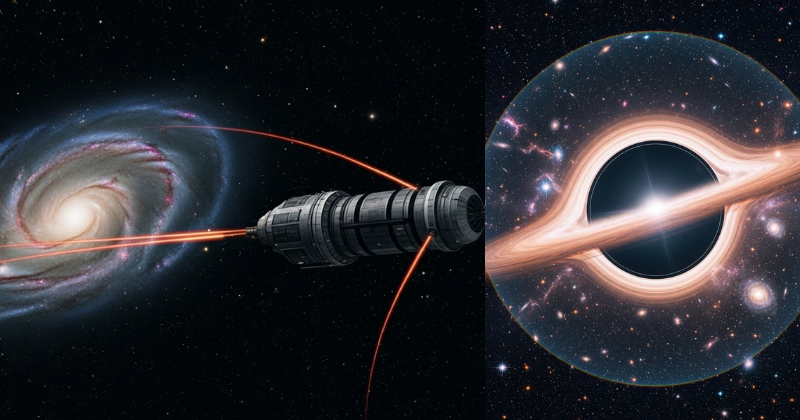
Astronomers are observing cosmic objects moving at extreme speeds that challenge classical physics, revealing how relativity, spacetime, and energy behave at their limits.
H1: Astronomers Have Observed Objects Moving So Fast They Bend Our Understanding of Physics
Across the universe, motion unfolds on scales and at speeds that defy everyday intuition. While cars, planets, and even stars move comfortably within classical mechanics, astronomers have identified objects whose velocities approach—or appear to approach—the ultimate cosmic speed limit: the speed of light. These observations are not mere curiosities. They expose the boundaries of physical law and force scientists to test, refine, and sometimes rethink foundational theories.
From jets launched by supermassive black holes to neutron stars flung across galaxies, these extreme movers reveal how energy, gravity, and spacetime interact under the most intense conditions nature can produce. This article explores what these objects are, how they reach such astonishing speeds, and why their motion bends—though does not break—our understanding of physics.
H2: What does it mean for an object to move “too fast” in the universe?
In physics, speed is never just speed. It is a relationship between distance, time, and the structure of spacetime itself.
According to Einstein’s theory of special relativity, nothing with mass can reach or exceed the speed of light in a vacuum. As an object accelerates toward this limit, its kinetic energy increases dramatically, its time slows relative to external observers, and its length contracts along the direction of motion.
When astronomers say an object moves “too fast,” they usually mean one of three things:
- It travels at a significant fraction of light speed.
- It appears to exceed light speed due to relativistic effects.
- Its speed cannot be easily explained by known astrophysical mechanisms.
Each case pushes physics into regimes where intuition fails and precision theory becomes essential.
H2: What are the fastest objects ever observed by astronomers?
The universe hosts a diverse cast of extreme-speed phenomena.
H3: Relativistic jets from black holes
Some of the fastest known structures are relativistic jets—narrow beams of plasma launched from the regions around supermassive black holes. These jets can extend for thousands of light-years and move at more than 99.9% of the speed of light.
Their motion is so extreme that small changes in angle can dramatically alter what observers see from Earth.
H3: Hypervelocity stars
Hypervelocity stars are stellar objects ejected from galaxies at speeds exceeding one million kilometers per hour. Many originate near galactic centers, where gravitational interactions with supermassive black holes act as cosmic slingshots.
These stars move fast enough to escape their home galaxies entirely.
H2: How can objects appear to move faster than light without breaking physics?
One of the most striking astronomical observations is apparent superluminal motion—objects that seem to travel faster than light.
This phenomenon does not violate relativity. Instead, it arises from geometry and light-travel-time effects.
H3: The relativistic illusion
When a jet moves nearly at light speed and almost directly toward Earth, light emitted later has less distance to travel than light emitted earlier. This compresses the apparent time between observations, making the motion seem faster than light.
The object itself remains subluminal, but perception bends reality.
H2: How does Einstein’s relativity explain these extreme speeds?
Relativity does not merely allow these observations—it predicts them.
At relativistic speeds:
- Time dilation slows processes within fast-moving objects.
- Length contraction alters spatial measurements.
- Mass-energy equivalence increases resistance to acceleration.
These effects become measurable in astronomical settings, allowing scientists to test relativity far beyond laboratory scales. Observations of fast-moving cosmic objects consistently confirm relativistic predictions, reinforcing Einstein’s framework even under extreme conditions.
H2: Which cosmic forces accelerate objects to such extraordinary velocities?
Extreme speed requires extreme energy, and only a few cosmic engines can provide it.
H3: Gravitational interactions
Close encounters with black holes or dense star clusters can transfer enormous gravitational energy, accelerating objects to relativistic speeds.
H3: Magnetic and plasma processes
In accretion disks around black holes and neutron stars, twisted magnetic fields channel energy into jets, converting rotational and gravitational energy into motion.
These mechanisms operate far beyond anything achievable by human technology.
H2: How do astronomers measure the speed of such distant, fast-moving objects?
Measuring extreme motion across vast cosmic distances is a technical triumph.
Astronomers use:
- Doppler shifts, where light changes wavelength due to motion.
- Very Long Baseline Interferometry (VLBI), which links radio telescopes across Earth to achieve extraordinary resolution.
- Timing analysis, comparing changes over years or decades.
These methods allow speed estimates with remarkable precision, even for objects billions of light-years away.
H2: Why do these observations challenge classical physics but not modern theory?
Classical Newtonian physics assumes time and space are absolute. At extreme speeds, this assumption fails.
Objects moving near light speed expose:
- The relativity of simultaneity
- Nonlinear energy–velocity relationships
- The dynamic nature of spacetime
Rather than breaking physics, these observations demonstrate where classical models stop applying and relativistic physics must take over.
H2: What do ultra-fast cosmic objects teach us about the universe itself?
These objects act as natural laboratories.
By studying them, scientists gain insight into:
- The behavior of matter under extreme energy densities
- The structure of spacetime near black holes
- The limits of particle acceleration
- The evolution of galaxies and cosmic jets
In many cases, the universe provides experiments no Earth-based facility could ever replicate.
Conclusion: When speed reveals the deepest truths of physics
Objects moving at extreme speeds do not undermine physics—they illuminate it. Each relativistic jet, hypervelocity star, and near-light-speed particle forces theory and observation into dialogue, sharpening our understanding of reality’s foundations.
Astronomers have not discovered motion that breaks physical law. Instead, they have uncovered motion that reveals how profoundly different the universe becomes at its limits. At these speeds, time stretches, space contracts, and intuition gives way to mathematics. In bending our understanding, these objects ultimately strengthen it, showing that the universe remains coherent—even at its most extreme.