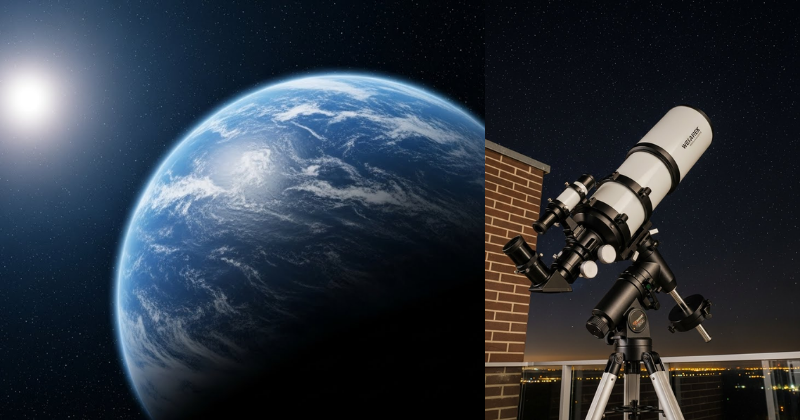
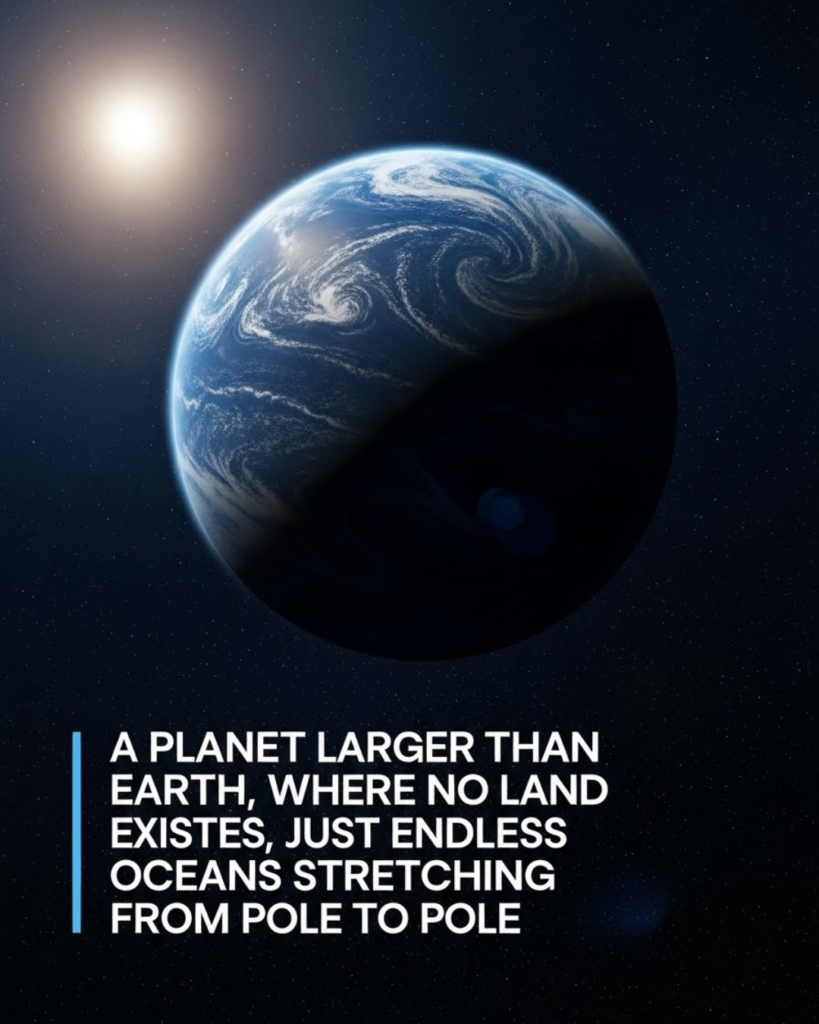
Astronomers have unveiled a mind-blowing new world: a planet larger than Earth where land doesn’t exist, just endless oceans stretching from pole to pole. This discovery challenges conventional planetary models, offering crucial insights into exoplanet formation and the potential for deep-sea habitability far beyond our solar system.
What is the Scientific Classification of this Water World Exoplanet?
The recently unveiled planet larger than Earth falls into the scientific category of a “Hycean” world or a “Water World.” This classification denotes a planet where water constitutes a significantly large fraction of the total mass, potentially forming oceans hundreds of kilometers deep.
- Mass and Radius: Preliminary data places this mind-blowing new world likely in the range of super-Earths to mini-Neptunes, typically possessing a mass between two and ten times that of Earth ($\sim 2 \text{-} 10 \text{ M}_\oplus$). Its radius suggests a low-density bulk composition consistent with a deep water layer enveloping a small, rocky core.
- The Hycean Hypothesis: Hycean worlds are believed to possess dense, hydrogen-rich atmospheres above their massive water layers. Unlike Earth, where water makes up less than $0.05\%$ of the mass, these exoplanets could be $50\%$ water by mass. This extreme composition is the reason land doesn’t exist on the surface.
- Observational Confirmation: The planet’s mass and radius were determined through a combination of transit photometry (measuring the dip in starlight as the planet passes) and radial velocity measurements (detecting the gravitational wobble of the host star).
How Does a Planet Larger Than Earth Form Without Land Masses?
The formation mechanism for a planet where land doesn’t exist, just endless oceans stretching from pole to pole is fundamentally different from the terrestrial formation process experienced by Earth, Mars, and Venus.
- Accretion in the Outer Disk: These water worlds are thought to have formed further out in the protoplanetary disk, beyond the “frost line,” where volatile compounds like water ice were abundant. The forming planet could rapidly accrete large amounts of ice and gas.
- Runaway Accretion: Once the initial core reached a critical mass (around $5 \text{ M}_\oplus$), its gravity became strong enough to rapidly pull in surrounding hydrogen and helium gas, contributing to a thick atmosphere and preventing the volatile water from escaping or being completely baked away by the host star.
- Internal Differentiation: The massive pressure exerted by the deep atmosphere and ocean prevents the rocky material from breaking the surface. The pressure at the core-water boundary is immense, likely forming exotic phases of water, such as ice VII or ice X, which act as a solid mantle beneath the liquid ocean.
What are the Estimated Characteristics of this Endless Ocean?
The endless oceans stretching from pole to pole on this planet larger than Earth would be unlike any ocean found in our solar system, characterized by extreme depth, pressure, and temperature gradients.
- Atmospheric Pressure: The hydrogen atmosphere could be $100$ to $1000$ times thicker and denser than Earth’s atmosphere. This heavy blanket significantly increases the pressure on the water layer below.
- The Critical Layer: Beneath the thick atmosphere, the water exists in a supercritical fluid phase—a state where distinct liquid and gas phases cease to exist. Below that supercritical layer lies the liquid ocean, potentially reaching depths of $100 \text{ to } 500 \text{ km}$.
- No Surface Ice Cap: Due to the dense, hydrogen-rich atmosphere acting as a powerful insulator and trapping heat, the surface temperature is likely much higher than freezing, despite the distant orbit, preventing the formation of global ice caps and ensuring the vast ocean remains liquid.
Which Methods Did Astronomers Use to Unveil This Mind-Blowing New World?
The successful unveiling of this mind-blowing new world relies on a sophisticated chain of detection and characterization techniques utilizing powerful space and ground-based telescopes.
- Primary Detection (TESS): The Transiting Exoplanet Survey Satellite (TESS) likely detected the planet initially through the transit method, identifying the periodic dip in the host star’s light. The transit data provides the orbital period and the precise radius of the planet.
- Confirmation (Radial Velocity): Follow-up observations from large ground-based telescopes (e.g., Keck, VLT) use the radial velocity method to measure the planet’s mass. Combining the mass and radius yields the density, which was crucial in determining the planet’s volatile-rich, water-dominated composition.
- Atmospheric Analysis (Spectroscopy): Future observations, particularly with the James Webb Space Telescope (JWST), will employ transmission spectroscopy during transit events. This method analyzes the light passing through the planet’s atmosphere to identify molecules like hydrogen, water vapor, and potentially biosignatures, confirming the planet’s Hycean nature.
Could Life Exist in a World Where Land Doesn’t Exist?
The possibility of life on a planet larger than Earth where land doesn’t exist presents a fascinating astrobiological question, challenging our reliance on Earth-like conditions for habitability.
- Habitable Zone: While the planet’s orbital distance is a factor, the massive insulating hydrogen atmosphere effectively widens the traditional habitable zone, meaning liquid water is stable even if the planet is farther from its star than Earth is from the Sun.
- The Subsurface Ocean: Life would most likely be found in the deep, pressurized liquid ocean beneath the thick atmosphere. Here, conditions are relatively stable, shielded from the host star’s dangerous ultraviolet and X-ray radiation.
- Energy Sources: Unlike surface life which uses sunlight, deep-sea life on this mind-blowing new world would rely on chemosynthesis, utilizing energy derived from hydrothermal vents at the rocky core, similar to organisms found near black smokers in Earth’s abyssal plains.
What Challenges Do Deep Oceans Pose for Planetary Habitability?
While the endless oceans stretching from pole to pole provide a vast reservoir for life, the extreme conditions impose severe limitations on biological complexity and evolution.
- Extreme Pressure: The immense pressure at great depths on a planet larger than Earth is a major obstacle. This pressure dictates the biochemistry of any life form, requiring unique adaptations for cellular structure and molecular stability.
- Lack of Geochemistry: The absence of continental landmasses eliminates the long-term carbon cycle feedback loop that regulates Earth’s climate and nutrient supply. There are no weathering processes to return essential minerals from surface rock into the ocean.
- Hydrogen Atmosphere Toxicity: The thick, hydrogen-rich atmosphere itself could be hostile to life as we know it, although life confined to the ocean depths would be partially insulated from direct atmospheric contact. The pressure, however, could drive chemical reactions within the atmosphere that could be detrimental to the upper ocean layers.
How Does This Discovery Influence Future Exoplanet Research Missions?
The characterization of this planet larger than Earth as a Hycean world significantly alters the search strategies for life beyond our solar system and informs the design of future space missions.
- Focus on Mini-Neptunes: Historically, mini-Neptunes (planets between Earth and Neptune in size) were often overlooked as potentially habitable because their thick atmospheres were thought to crush any life. This discovery suggests that a subset of these worlds are prime candidates for follow-up atmospheric analysis, expanding the target list dramatically.
- Atmospheric Biosignatures: Researchers are now refining models to predict what biosignatures (gases produced by life) might look like in a hydrogen-rich atmosphere. Detecting molecules like methane, ammonia, or sulfur compounds in specific proportions could be the key to confirming life on this mind-blowing new world.
- Future Instruments: The success in characterizing this planet highlights the need for dedicated instruments on future telescopes (beyond JWST) optimized for detecting water and hydrogen signatures on small, distant exoplanets.
Why is an Endless Ocean World so Significant to Planetary Models?
The existence of a planet larger than Earth with endless oceans stretching from pole to pole challenges the long-held assumption that a terrestrial-style land-and-sea arrangement is necessary for long-term planetary stability and life.
- Revisiting the “Habitable Zone”: This discovery forces scientists to reconsider the classical definition of the habitable zone, emphasizing the internal processes and atmospheric composition over simple orbital distance. The dense atmosphere provides sufficient insulation to keep the deep ocean liquid over vast timescales.
- Water Budget Extremes: The finding confirms that planetary formation can result in extremes of water content. This world represents the high end of the water budget spectrum, while arid super-Earths represent the low end. Understanding these extremes helps constrain models of water delivery in protoplanetary disks.
- The Uniqueness of Earth: By proving that stable, volatile-rich worlds like this one are possible, the unique geological and oceanographic conditions of Earth—specifically its exposed landmasses and plate tectonics—become even more remarkable in the context of the cosmos.
Conclusion
The unveiling of this mind-blowing new world: a planet larger than Earth where land doesn’t exist, just endless oceans stretching from pole to pole, marks a pivotal moment in exoplanetary science. The existence of such a massive water world, confirmed through combined transit and radial velocity data, reinforces the Hycean world hypothesis. While the extreme pressure and thick hydrogen atmosphere present unique challenges, the stability of the deep, global ocean offers a tantalizing new target in the search for extraterrestrial life. This discovery compels us to adjust our definitions of habitability and inspires the next generation of space telescopes to probe the atmospheres of these distant, aquatic realms.