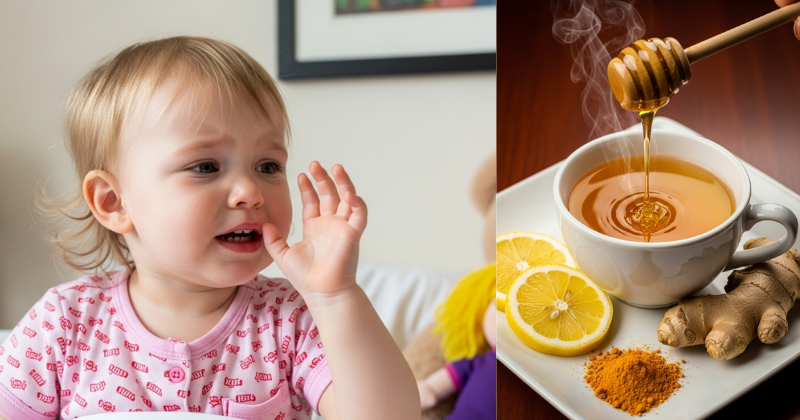
Tired of the nightly battle to get your child to take cough medicine? You can transform the dreaded dosage into a comforting, delicious ritual with a natural cough remedy that has kids asking for more! This simple, homemade syrup leverages the natural power of honey and therapeutic herbs, making it an achievable and soothing solution for dry, irritated throats. Learn how to craft this easy, effective, and cost-saving remedy today, empowering you to discover a supportive, non-judgmental approach to self-care during cold season.
Important Disclaimer: This article is for informational purposes only and should not replace professional advice. Consult healthcare providers for health-related topics, especially concerning children. Honey should never be given to infants under one year old due to the risk of botulism. Individual results may vary, and personal circumstances should always be considered when implementing any suggestions.

🍯 Foundation First: Why Honey Works Wonders
The core component of the best natural cough remedy that has kids asking for more! is honey. Honey is not just a sweet treat; it has well-established scientific backing as an effective cough suppressant, especially for children over the age of one.
H3: Building Confidence with Basic Concepts
Studies have shown that honey can be just as effective as common over-the-counter cough syrups in reducing nighttime coughing and improving sleep quality.
- Demulcent Action: Honey has a thick, sticky consistency that makes it an excellent demulcent. When swallowed, it coats the irritated mucous lining of the throat and upper respiratory tract. This protective layer reduces irritation, calming the nerve signals that trigger coughing.
- Antimicrobial Properties: Honey naturally contains enzymes that release small amounts of hydrogen peroxide, giving it mild antimicrobial and antibacterial properties that can help support the body during a cold.
- Encouraging Reassurance for Beginners: This remedy is built around simple, food-grade ingredients, making it an accessible and supportive way to address coughs.
H3: Key Components: Beyond the Honey Base
To elevate the honey base into a powerful cough remedy that has kids asking for more!, we introduce two potent, kid-friendly herbs: ginger and lemon.
| Ingredient | Wellness Role | Why Kids Love It |
| Raw Honey | Demulcent (soothes throat), mild cough suppressant. | Sweet, familiar taste, sticky texture. |
| Ginger Root | Anti-inflammatory, anti-nausea, expectorant (helps break up mucus). | Adds a warm, zesty zing. |
| Lemon Juice | Vitamin $\text{C}$ boost, cuts the sweetness, aids mucus thinning. | Bright, fresh flavor that kids often associate with relief. |
🥣 Section 2: Step-by-Step Process for the Soothing Syrup
Creating this effective and delicious cough remedy that has kids asking for more! is an achievable, step-by-step guidance project that requires minimal time and basic kitchen tools.
Core Methods: The Decoction and Infusion
Tool Requirements: Small saucepan, fine-mesh strainer or cheesecloth, clean glass jar with a tight-fitting lid, small measuring cups/spoons.
- Prep the Ginger (Actionable Language): Peel and thinly slice about $1/4$ cup of fresh ginger root. You want to maximize the surface area for extraction.
- The Decoction: Place the sliced ginger and 1 cup of water into the small saucepan. Bring the mixture to a boil, then reduce the heat immediately to a low simmer. Allow it to simmer gently for $15$ minutes. This process, called decoction, effectively draws out the active compounds from the harder ginger root.
- Strain and Cool: Remove the pan from the heat. Carefully strain the ginger pieces from the liquid, discarding the solids. Allow the ginger-infused water to cool until it is lukewarm (less than $100^\circ\text{F}$ or $38^\circ\text{C}$). Timing and Planning Considerations: Crucially, do not add honey to boiling or hot water, as high heat can destroy some of its beneficial enzymes and raw properties.
- The Honey Infusion: Pour the lukewarm ginger water and $1/2$ cup of honey into the clean glass jar. Add $2$ tablespoons of fresh lemon juice.
- Mix and Seal: Stir the mixture until the honey is fully dissolved into the liquid. Seal the jar tightly.
H4: Dosage and Storage Guidelines
- Dosage: For children over one year old, administer 1 teaspoon every 2-4 hours, as needed, particularly before bedtime. For adults and older children, a dosage of 1 tablespoon is recommended.
- Storage: Store the finished syrup in the refrigerator. It will last for up to 3 weeks.
💫 Section 3: Advanced Strategies: Flavor & Potency Boosts
Ready to customize your cough remedy that has kids asking for more!? These expert-level insights offer creative variations to target different types of coughs and enhance the flavor.
H3: Creative Solutions for Specific Coughs
You can customize your syrup with other supportive herbs based on whether the cough is dry or wet.
- For Dry, Hacking Coughs (Demulcent Boost): Incorporate $1$ teaspoon of dried Marshmallow Root or Slippery Elm Bark powder during the cooling stage (Step 3). These herbs are rich in mucilage, which provides extra coating and soothing power to the throat, offering multiple options to suit different preferences. (Internal Linking Opportunity: Learn more about demulcent herbs in our article, “Natural Soothing Herbs for Throat Health.”)
- For Wet, Congested Coughs (Expectorant Boost): Add 5 drops of food-grade Thyme Essential Oil (or a sprig of fresh Thyme to the decoction in Step 2). Thyme is a potent natural expectorant that helps thin and loosen mucus, making it easier to cough up.
H3: Customizing the Flavor for Picky Eaters
If your child is sensitive to the ginger’s mild spiciness, try masking it with cinnamon.
- Flavor Variation Pro Tip: Add 1 whole cinnamon stick to the water along with the ginger in the decoction stage (Step 2). Cinnamon provides warmth, sweetness, and anti-inflammatory properties without the “zing” of ginger. This modification is an alternative approach that maintains the remedy’s effectiveness while ensuring the child will actually take it, offering real-world scenarios for common parenting challenges.
⚠️ Section 4: Troubleshooting and Safety Concerns
Safety is paramount, especially when administering wellness remedies to children. This section provides necessary safety considerations and practical troubleshooting tips.
Featured Snippet Potential: “Is it safe to give honey to a toddler for a cough?”
Yes, it is generally safe and recommended to give honey to a child for a cough, but only if the child is over one year old. Honey is a proven natural demulcent that coats the throat and calms coughing. However, honey must never be given to infants under the age of one due to the risk of infant botulism. Always consult a pediatrician before administering any new remedy.
Practical Troubleshooting Tips (Wellness Focus)
- Problem: The syrup solidified or crystalized in the refrigerator.
- Obstacle: Honey naturally crystalizes over time, especially when diluted with water and refrigerated.
- Solution: Place the sealed glass jar in a bowl of warm water for 5-10 minutes. Stir until the crystals dissolve. Do not microwave or boil the syrup, as this high heat defeats the purpose of using raw honey.
- Problem: The child still refuses to take the syrup.
- Obstacle: Texture or taste aversion.
- Solution: Encouragement for setbacks: Present the cough remedy that has kids asking for more! not as “medicine” but as a “special warm drink topping.” Drizzle the teaspoon of syrup over a small spoonful of applesauce or mix it into a cup of non-caffeinated herbal tea (like chamomile or peppermint). This makes the content relatable and applicable to daily life.
- When to See a Doctor: If the cough persists for more than a week, is accompanied by a fever, difficulty breathing, or wheezing, stop the remedy and seek medical attention immediately.
📈 Section 5: Maximizing Results: Holistic Comfort
To truly maximize the results of your cough remedy that has kids asking for more!, focus on complementary strategies that support the body’s natural healing process.
- Hydration is Key: Encourage frequent intake of warm fluids like herbal teas or clear broth. Hydration thins mucus and keeps the throat moist, supporting the honey’s demulcent action.
- Emphasize Gradual Progress: Understand that natural remedies are part of a holistic approach. Use the syrup as needed, focusing on improving sleep quality and reducing irritation, rather than expecting an instant “cure.” This promotes a sustainable lifestyle change toward self-care.
- Inspiration for Continued Growth and Learning: Pair the syrup with a DIY chest rub made with a coconut oil base and diluted eucalyptus or peppermint essential oil (safe for older children). Applying this to the chest and feet before bedtime adds a decongestant component that works alongside the cough-calming syrup. (Internal Linking Opportunity: Find our best DIY Chest Rub recipe here.)
✅ Conclusion: Your Capability to Soothe and Heal
You now possess the simple yet powerful knowledge to create a cough remedy that has kids asking for more! You’ve mastered the core method of honey infusion and learned how to customize the flavor and potency for any cough type. This homemade approach brings immense satisfaction of completion and peace of mind.
Remember, you have the capability to provide comfort and effective relief to your family using natural, accessible ingredients.
Which key ingredient—adding Thyme for congestion or Marshmallow Root for a dry cough—will you use in your next batch of this delicious remedy?