Introduction (meta description 155–160 characters)
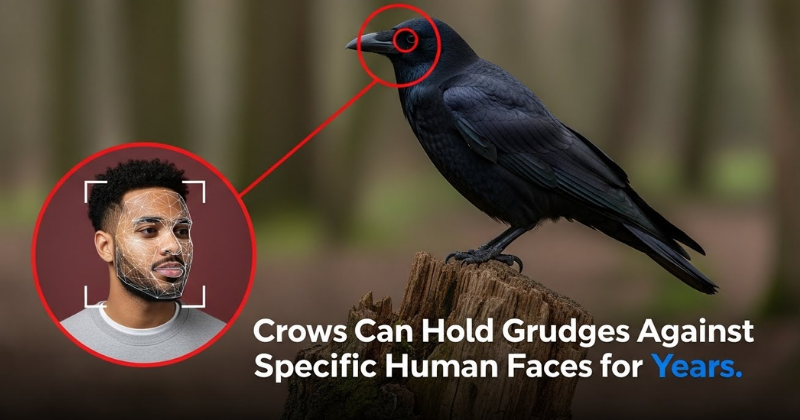
Research shows crows can recognize and remember human faces for years, holding grudges against specific individuals. Explore the science behind crow memory and social intelligence.
For decades, researchers have been fascinated by the intelligence of corvids—especially crows. The claim that crows can hold grudges against specific human faces for years is not folklore; it is grounded in rigorous scientific observation. Studies conducted across North America and Europe demonstrate that crows exhibit advanced facial recognition, long-term memory retention, social communication, and emotional responses linked to threat perception. This comprehensive article examines how crows identify people, why they hold grudges, and the lasting consequences for human–crow interactions. Drawing from field experiments, neurobiology, evolutionary ecology, and social learning theory, we explore evidence that crows not only remember individuals but share those memories socially, influencing group-level behavior across generations.

H2: What does scientific evidence show about crow memory for human faces?
Research strongly supports the idea that crows recognize and remember individual human faces. One landmark study at the University of Washington demonstrated that crows held lasting negative memory associations toward humans who threatened them during capture experiments. Researchers wearing a “dangerous mask” captured and banded wild crows. Years later, when walking through campus wearing the same mask—but without interacting with the birds—the crows mobbed the wearer aggressively, signaling distress and alarm.
This response persisted for at least five years in monitored populations. Even young birds that were not present for the original capture learned to associate the masked individual with danger through social learning. The experiment showed that:
- crows distinguish one human face from another
- they form long-term memories of perceived threats
- negative experiences create durable behavioral responses
These findings contradict assumptions that long-term facial recognition is uniquely human or primate-specific and position corvids among the most cognitively advanced non-human animals.
H2: How do crows recognize and remember specific human faces?
Crow facial recognition involves a combination of perceptual processing, memory encoding, and emotional tagging. Crows rely on:
H3: Visual acuity and perceptual sensitivity
Crows possess highly developed vision. Their acute pattern recognition allows them to differentiate subtleties in facial structure. Experimental evidence shows they respond to masks consistently even when clothing changes, indicating that facial features rather than body cues guide recognition.
H3: Neural mechanisms linked to avian cognition
Neuroimaging reveals that crows activate regions analogous to the mammalian amygdala when perceiving threats. The nidopallium caudolaterale, often compared to the prefrontal cortex in mammals, modulates problem-solving and memory consolidation. These structures allow:
- emotional tagging of threatening stimuli
- long-term memory formation
- associative learning between visual cues and experiences
H3: Long-term memory consolidation
Behavioral studies indicate memory retention spanning multiple years. Researchers documented persistent responses during seasonal migrations, suggesting stable memory traces resistant to extinction.
H2: Why do crows hold grudges against humans for years?
Holding grudges serves adaptive functions. In the wild, threats predict survival outcomes. Humans present unpredictable danger, whether via hunting, nest disturbance, or capture. When crows encode a negative interaction with a specific human face, they avoid repeating harmful contact.
Ecological advantages include:
- preventing predation or harm
- protecting nestlings and resources
- enhancing vigilance within the social group
Emotional responses, such as anger-like aggression, may emerge as cognitive proxies for danger avoidance. These reactions appear disproportionate because they are not tied to immediate threat but reflect lasting memory.
H2: Which factors influence long-term negative memory formation in crows?
The persistence of grudges varies depending on multiple environmental and social variables.
Key factors include:
- Intensity of the negative interaction
A traumatic or painful experience increases likelihood of long-term retention. - Social reinforcement
Alarm calls propagate information across the flock. Younger birds observing mobbing learn which faces to distrust. - Repetition
Multiple exposures strengthen neural associations through reinforcement. - Environmental stability
In urban environments where the same individuals appear frequently, recognition memory strengthens. - Seasonal context
During nesting, threat sensitivity rises, accelerating memory encoding.
H2: How do crows communicate grudges and threat responses to others?
Crows do not individually store grudges in isolation. Their social intelligence facilitates cultural transmission of knowledge. A crow mobbing a dangerous human emits alarm calls that attract other crows. Studies reveal that:
- neutral individuals join mobbing behavior
- recruits respond aggressively without direct experience
- memory of threat spreads across social networks
This demonstrates a form of social learning analogous to cultural transmission observed in primates and cetaceans. The facial recognition memory becomes a collective behavioral rule, allowing grudges to persist beyond the lifespan of the initial witnesses.
H2: What implications does crow facial recognition have for human–wildlife relationships?
Understanding crow cognition has practical and ethical ramifications. In cities, humans and crows interact frequently. Feeding, harassment, nest disturbance, and garbage exposure influence crow perception of humans. Negative encounters may lead to chronic mobbing, nest aggression, and avoidance behavior.
Urban planning and wildlife management programs increasingly recommend:
- minimizing nest disruption during breeding season
- educating the public about respectful coexistence
- using deterrence techniques that avoid harm to birds
Crow grudges demonstrate complex emotional memory. Treating wildlife interactions responsibly reduces conflict escalation.
H2: Where does crow intelligence rank among non-human animals?
Comparative cognition research positions corvids alongside apes, dolphins, and elephants. Their capabilities include:
- tool use and manufacture
- episodic-like memory
- strategic planning
- self-awareness indicators
- numerical discrimination
Long-term facial recognition represents another dimension of their sophisticated cognition. Their ability to retain grudges for years demonstrates emotional, social, and cognitive depth once thought unique to primates.
Corvid intelligence likely evolved through a combination of environmental pressures, flexible foraging strategies, and highly social behavior, reinforcing memory-driven cooperation and defense.
H2: Can humans change their relationship with crows after a grudge is formed?
Evidence suggests grudges can soften over time, but active behavioral shifts may be required.
Research shows crows modify negative responses when:
- threat exposure decreases
- humans provide food consistently
- other birds display relaxed behavior
- environmental stresses reduce
However, reversal is slow. Long-term memory persistence means that rehabilitation requires repeated positive experiences. Neutral attire may help because crows associate negative memory strongly with facial patterns. Mask experiments demonstrate how altering appearance can disrupt recognition.
Understanding crow cognition empowers humans to avoid escalating long-term conflict and instead build cooperative coexistence.
Conclusion
Scientific evidence confirms that crows can hold grudges against specific human faces for years. This behavior emerges from advanced facial recognition abilities, long-term memory mechanisms, emotional learning, and cultural communication within social groups. Field research, including mask-based experiments, demonstrates that crows encode negative experiences, recall them after long intervals, and transmit knowledge across generations. These sophisticated cognitive and emotional processes underscore the remarkable intelligence of corvids and challenge assumptions about human uniqueness in long-term social memory.
Crow grudges illuminate the delicate dynamics of human–wildlife relationships. Understanding the psychological foundations of crow behavior enables more respectful interactions and highlights the ethical responsibilities of living alongside highly intelligent species.