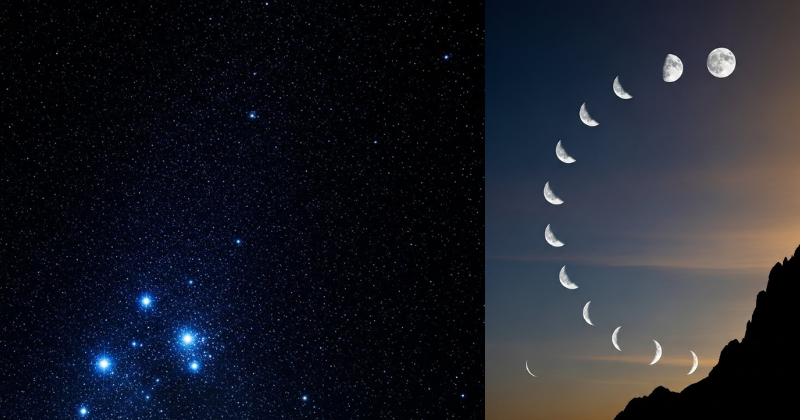
As the longest nights of the year settle in, December 2025 offers stargazers and amateur astronomers some of the most spectacular celestial events. We provide a detailed guide covering Dec 2025 everything you will see in the night sky this month, from planetary alignments and meteor showers to deep-sky objects visible under the crisp winter conditions.
What are the key planetary conjunctions visible in December 2025?
The celestial mechanics of December 2025 position several bright planets for remarkable conjunctions, providing excellent observation opportunities shortly after sunset. A conjunction is an event where two celestial bodies appear close together in the sky, a purely perspectival effect based on the observer’s viewpoint from Earth.
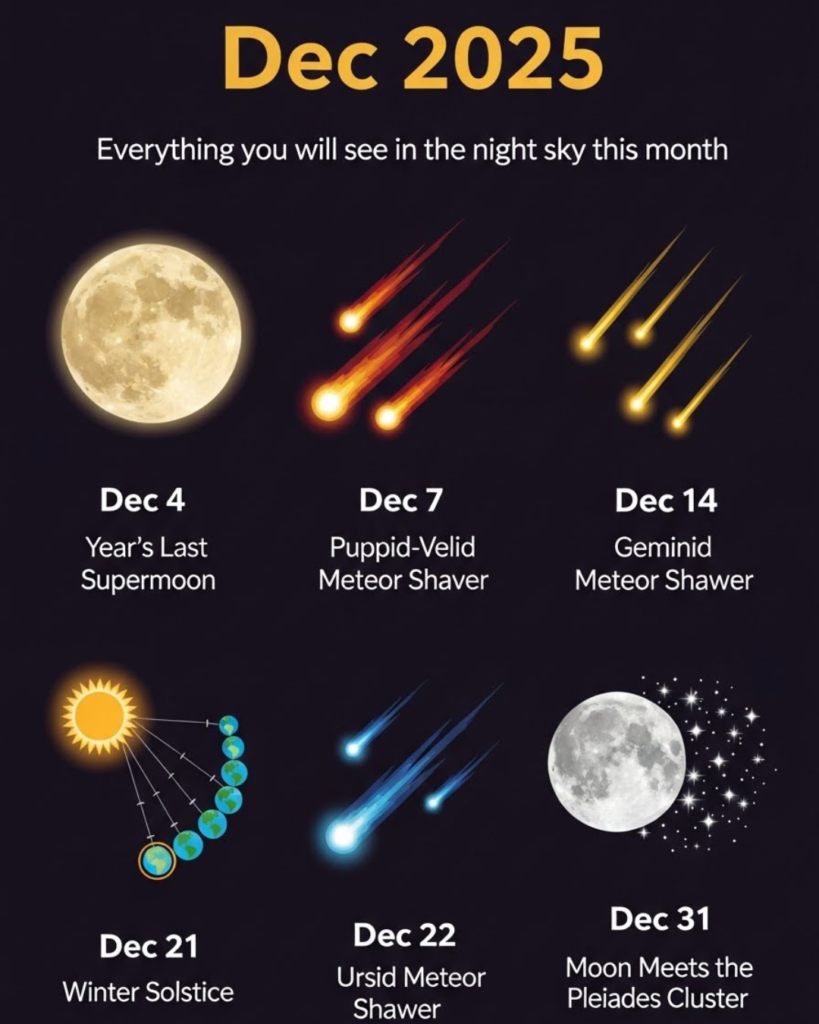
The most anticipated event involves the alignment of Venus and Saturn. Throughout early December, Venus, which reaches its peak brilliance in the western evening sky, will rapidly close the angular distance with Saturn. By December 10, 2025, the two planets will achieve their closest approach, separated by approximately $1.5$ degrees. While this is not a technically “tight” conjunction, the juxtaposition of Venus’s brilliant white magnitude (around $-4.2$) against Saturn’s subtle, golden hue (magnitude $+0.8$) offers a stunning visual contrast. Observing this event with binoculars ($7\times 50$ or $10\times 50$) will reveal Saturn’s slightly oblate disk, potentially hinting at the presence of its rings, despite the low magnification.
Following this, attention shifts to the early morning sky near the end of the month. Mars, now receding slightly from Earth but still visible around magnitude $+0.5$, will form a less striking, but equally significant, pairing with the waning crescent moon around December 27. This particular morning alignment serves as a helpful navigational beacon for locating Mars before sunrise.
How does the Geminid Meteor Shower perform in December 2025?
The Geminid Meteor Shower is consistently one of the most reliable and prolific annual displays, and December 2025 presents favorable conditions for observation. The Geminids peak around December 13–14, 2025. Unlike most meteor showers which originate from cometary debris, the Geminids are unique, associated with the debris trail of the asteroid 3200 Phaethon. This distinction results in slower, often bolder, and frequently multicolored meteors.
The anticipated Zenithal Hourly Rate (ZHR) for the Geminids in 2025 is expected to exceed 120 meteors per hour under ideal conditions. Crucially, the peak viewing period in 2025 occurs just three days after the New Moon phase. This minimal lunar interference means the skies will be optimally dark, maximizing the visibility of fainter meteors. Observers located in the Northern Hemisphere should focus their gaze toward the constellation Gemini, the shower’s radiant point, which rises in the late evening and reaches its zenith around 2 a.m. local time. Patience is paramount, as the high ZHR is an instantaneous, theoretical maximum; successful observation requires a dark, broad field of view and extended viewing time.
Which factors influence the visibility of the Ursid Meteor Shower?
The Ursid Meteor Shower, the final notable celestial event of the year, peaks annually around December 22–23. The Ursids are a less dramatic, but historically significant, shower originating from the debris of Comet 8P/Tuttle. The ZHR for the Ursids is typically low, averaging only 5–10 meteors per hour.
Visibility in December 2025 is significantly impacted by the lunar cycle. The peak of the Ursids falls close to the waxing gibbous phase, meaning the moon’s brightness will wash out many of the faint meteor trails. To mitigate this light pollution and maximize your chances of seeing these end-of-year streakers, observers should employ specific strategies:
H3: Optimizing Ursid Observation Techniques
- Moon Shielding: Position yourself so that the brightest part of the sky (where the Moon is located) is blocked from your direct line of sight by a building, tree line, or natural feature.
- Radiant Focus: Concentrate viewing efforts on the area immediately surrounding the radiant point, located in the constellation Ursa Minor (the Little Bear). While the meteors will appear to streak away from this point, the darkest region of the sky, opposite the Moon, often yields the best results.
- Timing: The pre-dawn hours of December 23, 2025, after the Moon has set or descended significantly, offer the best opportunity to observe the faint, slow-moving Ursid meteors against the backdrop of the deep, cold night sky.
What major deep-sky objects are best positioned for viewing in Dec 2025?
December is arguably the optimal month for observing a diverse range of nebulae, star clusters, and galaxies, particularly those associated with the winter constellations. The extended darkness and generally stable atmospheric conditions of the cold season enhance contrast and minimize scintillation.
The most spectacular target is the Orion Nebula (M42), located in the sword of the constellation Orion. M42 is an immense stellar nursery, approximately 1,344 light-years away, and is easily visible to the naked eye as a fuzzy patch. Through a small telescope ($6 \text{ inches}$ aperture or greater), the subtle gaseous structure and the Trapezium cluster (four hot, young stars) at its core become dramatically apparent.
Additionally, the Pleiades (M45), an open star cluster in Taurus, will be high in the sky. While visible year-round, the crisp December air makes the signature blue reflection nebulosity surrounding the brightest stars in the cluster particularly clear, making it a crucial component of Dec 2025 everything you will see in the night sky this month. Furthermore, the Triangulum Galaxy (M33), a relatively close spiral galaxy, is situated high enough to be located with large binoculars or a small telescope, offering an excellent alternative to the more distant Andromeda Galaxy (M31).
How does the Moon cycle affect visibility in December 2025?
The phase of the Moon is the single most dominant factor affecting deep-sky observation. The December 2025 lunar cycle presents a strategic schedule for viewing the fainter elements of the cosmos.
| Lunar Phase | Date (2025) | Observation Impact | Strategic Target |
| First Quarter | December 6 | Significant light pollution in early evening. | Planets (Venus/Saturn) and bright clusters. |
| Full Moon | December 14 | Maximum light pollution. Poor conditions for nebulae/galaxies. | Lunar viewing (craters and mare regions). |
| Last Quarter | December 22 | Darker skies in the pre-dawn hours. | Faint galaxies and the Ursid Meteor Shower. |
| New Moon | December 29 | Optimal dark-sky window throughout the night. | M33, M42, and other nebulae/galaxies. |
The crucial dark-sky window occurs during the week leading up to the New Moon, specifically from Christmas until the end of the year. This period offers prime viewing for extended duration, maximizing the detail visible in diffuse nebulae like the Rosette Nebula and the faint arms of M33.
Which factors make December a favorable month for astronomical photography?
The combination of factors present in December 2025 creates a highly favorable environment for astronomical photography, particularly for long-exposure deep-sky images.
H3: Scientific Advantages for Astrophotography
- Atmospheric Stability: The cold air characteristic of mid-winter holds less moisture than warmer air. Less atmospheric water vapor leads to reduced light scatter, resulting in cleaner images and better resolution, a measure known as “seeing” in scientific terms.
- Extended Dark Hours: The December solstice ensures the longest period of nighttime darkness, maximizing the available exposure time for deep-sky targets. This is especially beneficial for capturing the faint hydrogen-alpha emissions from large nebulae, which require hours of cumulative exposure.
- Target Accessibility: The core targets of the Northern Hemisphere winter sky (Orion, Taurus, Canis Major) feature high declinations, meaning they transit close to the zenith. Observing objects near the zenith minimizes the amount of atmosphere the light must travel through, reducing atmospheric dispersion and distortion.
What are the orbital positions of the superior planets in Dec 2025?
Understanding the orbital positions of the superior planets (those orbiting beyond Earth) is key to predicting their visibility and brightness.
- Jupiter: By December 2025, Jupiter will be well past its opposition (its closest point to Earth). It will be visible in the evening sky, setting a few hours after midnight. Although receding, its sheer size ensures it remains brilliant (magnitude $-2.2$) and its visibility in the early evening makes it an easy target for telescopic observation of its Galilean moons and cloud bands.
- Mars: Mars, having passed opposition earlier in the fall, is slowly dimming as Earth pulls ahead in its orbit. It remains a distinct, reddish target in the pre-dawn sky, positioned in the eastern constellation Virgo. While its disk size is diminishing, it remains bright enough (magnitude $+0.5$) to observe its general color and position with ease, forming a core element of Dec 2025 everything you will see in the night sky this month.
How do light pollution and viewing location impact celestial visibility?
Light pollution remains the single greatest impediment to successful astronomical observation, profoundly impacting the visibility of all celestial objects except the brightest planets and the Moon.
The Bortle Scale, ranging from Class 1 (Excellent dark-sky site) to Class 9 (Inner-city sky), provides a quantitative measure of sky darkness. Moving from a suburban Class 7 sky to a rural Class 4 sky can increase the number of visible stars from a few hundred to several thousand and is essential for observing faint targets like M33 and nebulosity within M42.
Viewing Location Strategies for December 2025:
- Meteor Showers: For high ZHR events like the Geminids, minimizing light pollution is critical. Traveling even 50 miles outside a major metropolitan area can significantly enhance the number of meteors observed.
- Deep-Sky Objects: For the observation of nebulae and galaxies, a Class 3 or 4 location is the minimum requirement for detecting structural detail, even with high-end equipment. The contrast afforded by a darker background is the primary mechanism by which these objects are resolved.
- Ambient Temperature: While the cold aids visibility, the observer’s comfort must be prioritized. Adequate thermal regulation is essential for maintaining focus and maximizing the duration of observation sessions, which often yields the most rewarding results.
In summary, December 2025 presents a rewarding calendar for stargazers. The month is bracketed by the striking Venus-Saturn conjunction and the optimal dark-sky window near the New Moon. The Geminid Meteor Shower provides a spectacular mid-month highlight, benefiting significantly from minimal lunar interference. Whether tracking the orbits of the superior planets or immersing yourself in the ethereal light of the Orion Nebula, the dark, stable skies of late December offer unparalleled opportunities to connect with the cosmos.