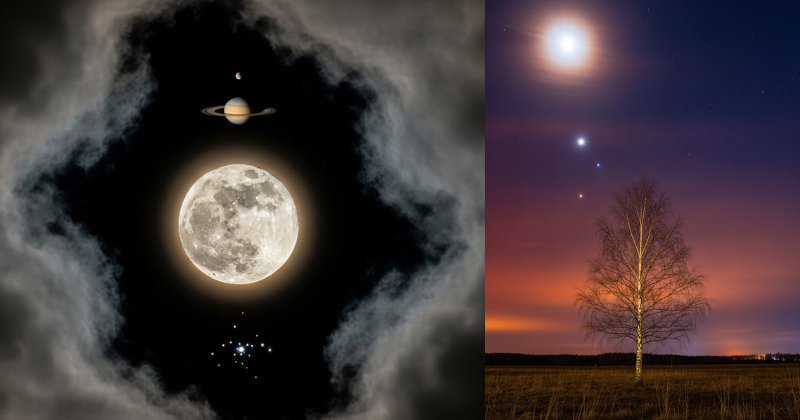
Witness the stunning December 7, 2025 Moon & Jupiter Conjunction. This event features a close celestial pairing, offering spectacular views and valuable insights into orbital mechanics and planetary visibility.
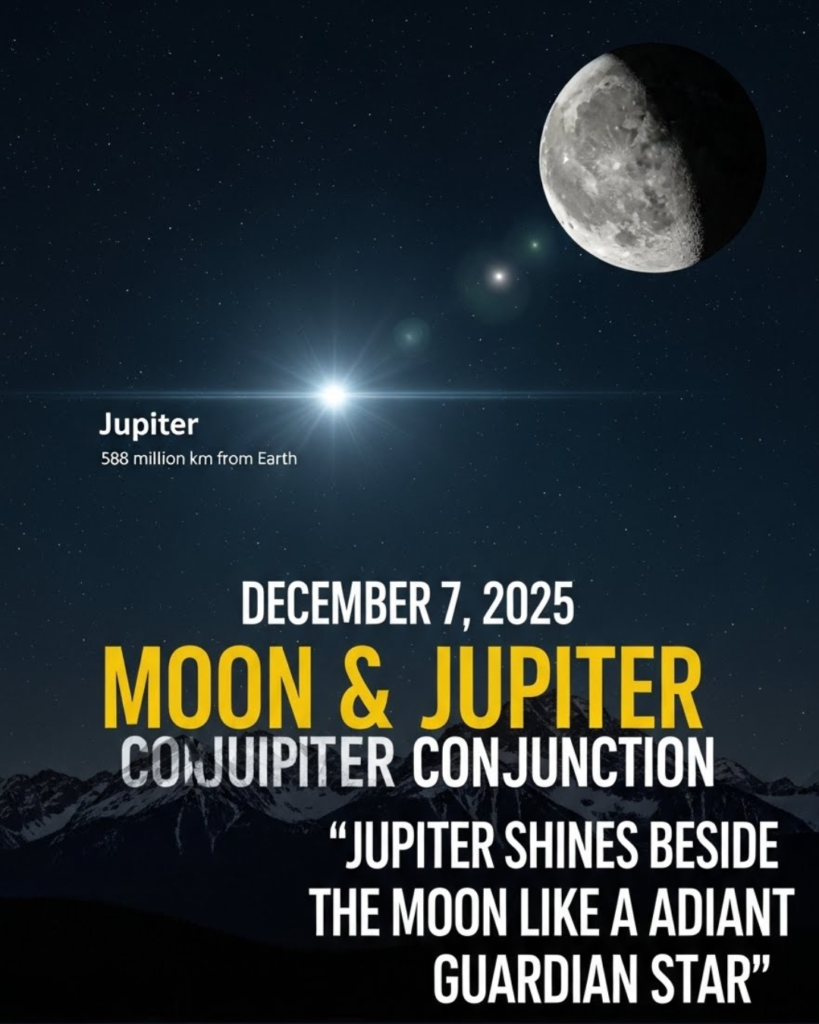
What Is a Conjunction and Why Is the Moon–Jupiter Pairing Significant?
A conjunction in astronomy refers to an event where two celestial objects appear close together in the sky as seen from Earth. This is a visual alignment, not a physical one—the objects remain vast distances apart in space.
The December 7, 2025 Moon & Jupiter Conjunction is particularly significant for several reasons:
- Jupiter’s Visibility: Jupiter, the largest planet in the solar system, is generally the fourth-brightest object in the sky (after the Sun, Moon, and Venus). Its brightness and size make it an ideal partner for a striking conjunction.
- The Moon as a Celestial Marker: The Moon’s rapid motion across the sky makes it a natural guide for locating planets, especially during favorable phases.
- Accessibility: This event requires no specialized equipment to view, making the December 7, 2025 Moon & Jupiter Conjunction widely observable.
The angular separation between the Moon and Jupiter during the peak of the event—typically measured in degrees or arcminutes—determines how dramatic the pairing appears. Smaller separations result in a tighter, more impressive grouping.
How Will the Moon Appear During the December 7, 2025 Conjunction?
The visual quality of the December 7, 2025 Moon & Jupiter Conjunction is closely tied to the Moon’s phase and position in its orbit.
On December 7, 2025, the Moon will be in a waxing crescent phase. This occurs just after the New Moon and before the First Quarter, when less than half of the Moon’s surface is illuminated.
- Visual Contrast: The thin crescent provides a strong contrast against Jupiter’s brilliant glow, enhancing the visual impact.
- Earthshine: Shortly after sunset, viewers may see the Moon’s dark side faintly illuminated by earthshine—sunlight reflected off Earth. This adds depth and beauty to the conjunction.
Which Constellation Will Host the December 7, 2025 Conjunction?
Understanding the celestial backdrop helps observers locate and contextualize the event.
- Zodiacal Band: Conjunctions involving the Moon and major planets occur within the Zodiacal band, which traces the ecliptic—the plane of the solar system.
- Specific Constellation: On December 7, 2025, the Moon and Jupiter will be positioned in Pisces (The Fishes). Because Pisces is relatively dim, the Moon and Jupiter will dominate that region of the sky.
- Orbital Mechanics:
- Jupiter takes about 11.86 years to orbit the Sun, moving slowly through each zodiac constellation.
- The Moon completes an orbit in 27.3 days, explaining why Moon–Jupiter conjunctions occur roughly once per month.
Where Will the Conjunction Be Visible and What Is the Optimal Viewing Time?
Visibility and viewing quality depend on the observer’s location and local time.
- Global Visibility: The conjunction will be visible worldwide, though the exact angular separation and altitude may vary.
- Optimal Timing:
- Best viewed in the evening sky, shortly after sunset.
- The waxing crescent Moon will set a few hours after the Sun, giving observers a clear early-evening viewing window.
- Ideal Location: Choose a spot with an unobstructed western or southwestern horizon and low light pollution.
Which Observational Tools Are Recommended for Viewing Jupiter’s Moons?
Although the December 7, 2025 Moon & Jupiter Conjunction is easily visible to the naked eye, simple tools can enhance the experience.
- Binoculars (Recommended):
- Models like 7×50 or 10×50 can reveal Jupiter’s four major Galilean moons—Io, Europa, Ganymede, and Callisto.
- They also provide a clearer view of the Moon’s surface features.
- Small Telescope:
- An aperture of 60 mm or more allows observers to see Jupiter’s bands and possibly the Great Red Spot, along with detailed lunar surface structure near the terminator.
- Naked Eye:
- The pairing will appear as a bright crescent Moon beside a striking, silver-white “star”—Jupiter.
How Do Celestial Coordinates Define the Conjunction’s Closeness?
Celestial coordinates provide precise measurements for defining the moment of conjunction.
- Right Ascension (RA):
Analogous to longitude, RA measures the east–west position of celestial bodies. A conjunction occurs when the two objects share the same RA. - Declination (Dec):
Analogous to latitude, Dec measures the angular distance north or south of the celestial equator. Differences in Dec determine angular separation. - Angular Separation:
On December 7, 2025, the separation will be measured in arcminutes (60 arcminutes = 1 degree). Fewer arcminutes mean a tighter visual grouping.
What Factors Affect Jupiter’s Brightness During the Conjunction?
Jupiter’s apparent magnitude—its brightness in our sky—during the event is influenced by:
- Opposition and Distance:
Jupiter is brightest near opposition, when Earth is directly between Jupiter and the Sun. Even if the conjunction occurs outside exact opposition, Jupiter remains bright depending on its relative distance to Earth. - Phase Angle:
Although Jupiter’s phases are subtle, small variations occur depending on the angle between the Sun, Jupiter, and Earth. - Magnitude:
Around the event date, Jupiter’s magnitude is projected to be about –2.0, making it easily visible even in urban areas.
How Does the Moon’s Orbit Influence Future Conjunctions?
The Moon’s orbit is tilted by about 5.1° relative to the ecliptic, affecting how close conjunctions appear in the sky.
- Orbital Nodes:
Conjunctions are tightest when they occur near the points where the Moon’s orbit crosses the ecliptic—the nodes. - Lunar Movement:
The Moon moves an angle equal to its own diameter in about one hour, meaning precise timing can lead to occultations, where the Moon passes in front of a planet. - Predictability:
Tracking the Moon’s inclined orbit enables astronomers to forecast impressive future conjunctions and potential occultations beyond the December 7, 2025 Moon & Jupiter Conjunction.
Conclusion
The December 7, 2025 Moon & Jupiter Conjunction offers a visually stunning and scientifically rich opportunity to observe the dynamics of our solar system. With a waxing crescent Moon closely paired with bright Jupiter in Pisces, this event beautifully demonstrates the elegance and predictability of celestial mechanics. Though conjunctions are optical alignments, they reflect precise orbital movements—an ongoing reminder of the harmony within our cosmic neighborhood.