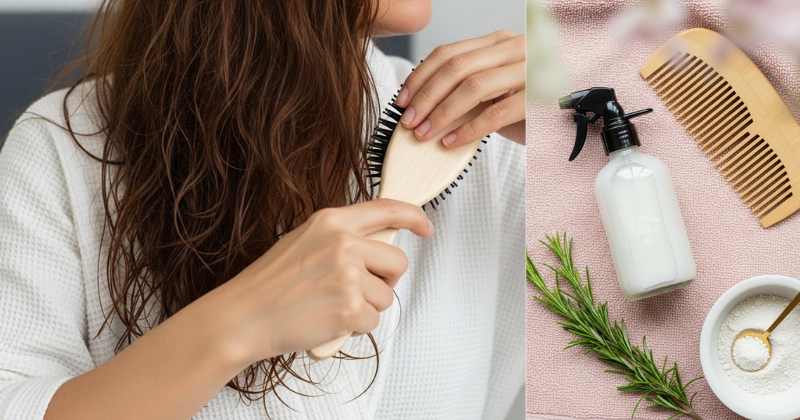
Tired of commercial detangling sprays packed with synthetic ingredients or DIY recipes that leave your hair smelling like a vinegar salad? You can transform your hair care routine with a natural solution! Learn how to make a DIY detangling spray made with essential oils & NO ACV! This guide provides achievable, step-by-step guidance to create a lightweight, effective, and beautifully scented mist that tackles knots effortlessly. By choosing nourishing ingredients and aromatic essential oils, you will discover the cost-saving benefits and the satisfaction of completion that comes with creating personalized, high-quality hair care products. Get ready to achieve smooth, tangle-free hair without the unwanted vinegar scent!
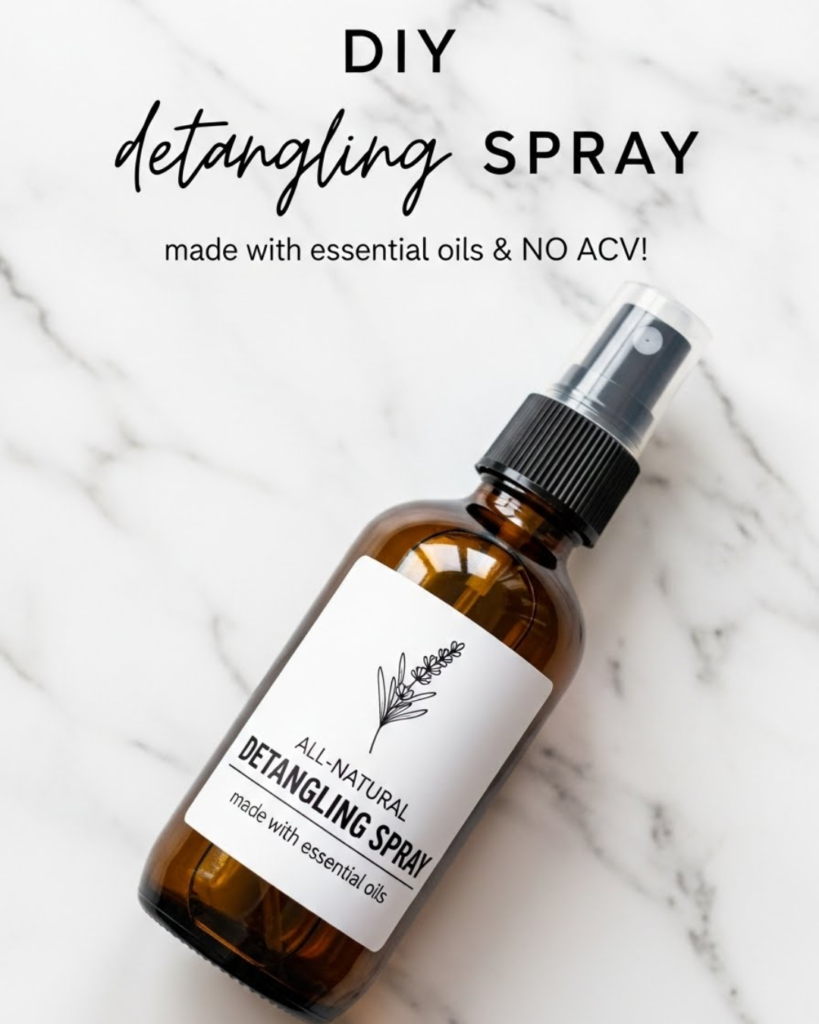
💧 Section 1: Foundation First: Understanding the ACV-Free Approach
Many natural hair detangling recipes rely on Apple Cider Vinegar (ACV) for its acidic properties, which help smooth the hair cuticle. However, the strong smell is a dealbreaker for many. To successfully create a DIY detangling spray made with essential oils & NO ACV, we must focus on ingredients that provide slip, moisture, and pH balance without the pungent aroma.
H3: Building Confidence with Basic Concepts: The Science of Slip
Detangling sprays work by providing “slip”—a lubricated surface that allows strands to slide past each other rather than catching and knotting.
- The Power of Glycols: We replace ACV’s cuticle-smoothing action with ingredients that provide deep hydration and exceptional lubrication. Vegetable glycerin or Aloe Vera gel are fantastic alternatives. Glycerin is a humectant, drawing moisture into the hair shaft, and Aloe Vera is a natural moisturizer and conditioner.
- Encouraging Reassurance for Beginners: Using these simple components allows you to build confidence with basic concepts of cosmetic formulation—focusing on replacing one chemical function (cuticle smoothing) with a natural, more pleasant alternative (hydration and lubrication).
H3: Addressing Common Concerns: Why Use Essential Oils in Detanglers?
Essential oils are not just for scent in this DIY detangling spray made with essential oils & NO ACV. They provide specific therapeutic benefits for scalp and hair health.
- Scientific Backing: Certain essential oils, like Rosemary, are known to stimulate blood flow to the scalp, promoting growth. Lavender offers calming properties and helps balance oil production. Tea Tree can help maintain a healthy, flake-free scalp. Diluted properly, these oils provide targeted care for your Wellness Topics goals.
- The Carrier Rule: Since essential oils do not mix with water, we must use a minimal amount of a light emulsifier or a dispersant (like polysorbate 20, or a tiny bit of solubilizer) to ensure the oils are evenly distributed, preventing oil slicks and potential skin irritation. We will use a small amount of liquid conditioner for this purpose.
🧴 Section 2: Step-by-Step Process: Core Methods and Recipe
This recipe is designed to be customizable and requires minimal specialized tools, focusing on achievable, step-by-step guidance.
Step 1: Gathering Tool Requirements and Ingredients (Actionable Language)
Ensure you have the following supplies before you begin to make a DIY detangling spray made with essential oils & NO ACV!
- Tool Requirements:
- One $8 \text{ ounce}$ clean spray bottle (preferably glass or PET plastic).
- Small funnel.
- Measuring cups and spoons.
- Core Ingredients:
- $6 \text{ ounces}$ Distilled Water (tap water minerals can cloud the mixture).
- $2 \text{ ounces}$ Aloe Vera Juice (not gel, for easy spraying) or $1 \text{ tablespoon}$ of vegetable glycerin.
- $1 \text{ tablespoon}$ of your favorite lightweight, natural, silicone-free liquid conditioner (this provides slip and acts as a mild emulsifier).
- $20 \text{-} 30 \text{ drops}$ of essential oils (see suggested blends below).
Step 2: The Mixing Process (Core Methods)
The order of mixing ensures the ingredients blend fully into a stable, effective solution.
- Combine Hydrating Base: Pour the distilled water and the Aloe Vera Juice (or glycerin) into the spray bottle using the funnel.
- Add Slip: Add the $1 \text{ tablespoon}$ of the liquid conditioner. This is key to making the detangling spray work and overcoming the need for ACV.
- Incorporate Essential Oils: Add the $20 \text{-} 30$ drops of essential oils. The small amount of conditioner helps hold the essential oils in a suspension.
- Final Shake: Cap the bottle tightly and shake vigorously for $30 \text{ seconds}$ to fully integrate the ingredients.
Step 3: Timing and Planning Considerations (Practical Tips and Shortcuts)
- Testing pH (Advanced Tip): While we bypass ACV, if you want to be precise, you can test the final pH with a litmus strip. Hair is happiest between $\text{pH } 4.5 \text{-} 5.5$. Aloe Vera juice is naturally in this range.
- Storage: Store your DIY detangling spray made with essential oils & NO ACV in a cool, dark place. Since this recipe contains water and no strong synthetic preservatives, plan to use the batch within $2 \text{-} 3 \text{ weeks}$ or store it in the refrigerator for longer shelf life (up to $2 \text{ months}$). Always label the bottle with the date.
🍋 Section 3: Advanced Strategies: Customizing Your Blend
The true customization of your DIY detangling spray made with essential oils & NO ACV comes from the oil blend, which allows you to tailor the spray to your specific hair type and scent preference.
H3: Creative Solutions: Tailoring Essential Oil Blends
Choose oils based on your hair goal to provide targeted support, turning a simple detangler into a treatment mist.
| Hair Goal | Essential Oil Blend | Quantity (Total 25 Drops) |
| Growth & Strength | Rosemary, Cedarwood, Peppermint | 10 R, 10 C, 5 P |
| Moisture & Shine | Lavender, Geranium, Sandalwood | 10 L, 10 G, 5 S |
| Oily Scalp & Balance | Tea Tree, Lemon, Clary Sage | 10 TT, 10 L, 5 CS |
- Encourage Experimentation: Start with the blends above and adjust the quantities based on scent preference. Just ensure you never exceed the safe dilution rate ($30 \text{ drops}$ per $8 \text{ ounces}$ of total liquid). This empowering approach helps you customize your approach to hair care.
H3: Pro Tips for Application and Effectiveness
To maximize the detangling power of your DIY detangling spray, follow these expert application steps.
- Saturate Sparingly: Focus the spray on the mid-lengths and ends of the hair, where tangles are most prevalent. If using it on dry hair, mist lightly to avoid weighing it down.
- Finger Detangling First: Before grabbing a brush, gently finger-comb your hair to loosen large knots. This prevents breakage.
- The Wet Brush Method: Use a dedicated detangling brush (like a Wet Brush) or a wide-tooth comb, starting at the bottom of your hair and working your way up to the roots. Never start combing at the root! This practice protects the delicate ends and prevents unnecessary damage.
❗ Section 4: Troubleshooting and Common Challenges
Even with a simple recipe, you may encounter issues like ingredient separation or product stickiness when you make a DIY detangling spray made with essential oils & NO ACV!
Featured Snippet Potential: “Why is my homemade detangling spray sticky or leaving residue?”
If your homemade detangling spray is sticky or leaving residue, it is usually because you added too much vegetable glycerin or liquid conditioner. Glycerin is a potent humectant, and excessive amounts can feel sticky, especially in humid weather. To fix this, simply pour out half of the current mixture and refill the bottle with plain distilled water to dilute the sticky components. For future batches, reduce the glycerin/conditioner by half a teaspoon and gradually increase it until you achieve the perfect slip without the residue.
Practical Troubleshooting Tips
- Problem: The spray separates quickly into layers.
- Obstacle: The essential oils are not fully integrated into the water base, and the conditioner wasn’t strong enough as a dispersant.
- Solution: Provide encouragement for setbacks: This is normal since we are using minimal emulsifiers! Always shake the bottle vigorously for $10 \text{ seconds}$ immediately before each use. Alternatively, you can add $1/2 \text{ teaspoon}$ of a clear carrier oil (like fractionated coconut oil) to help bind the essential oils together.
- Problem: The detangling spray is weighing down my fine hair.
- Obstacle: Too much of the heavy conditioner or glycerin was used.
- Solution: Offer Alternative Approaches: Reduce the conditioner to just $1 \text{ teaspoon}$ and skip the glycerin entirely. Replace the Aloe Vera juice with pure distilled water. Lighter hair types need maximum dilution to prevent residue.
- Problem: The essential oil scent is too weak or fades quickly.
- Obstacle: Citrus oils (like Lemon) are top notes and evaporate fast.
- Solution: Use more base note oils like Cedarwood, Vetiver, or Sandalwood, as these heavier molecules linger longer on the hair. You can also increase the total essential oil drops slightly (up to $30 \text{ drops}$) without exceeding the safe dilution limit.
🌟 Section 5: Maximizing Results: Next Level Hair Health
By mastering the creation of a DIY detangling spray made with essential oils & NO ACV, you can build upon this success to enhance your entire hair care routine.
- Show How to Build Upon Basic Success: Post-Sun Refresher. Use this spray during the summer months or after swimming. The Aloe Vera juice provides fantastic relief and hydration for hair dried out by sun or chlorine. You can even store it in the refrigerator for a cool, soothing application.
- Maintenance and Long-Term Considerations: Detangling and Protectant Spray. Use this spray not just for detangling but as a light thermal protectant before air drying or a quick heat style (though always pair with a professional heat shield for intense heat). The light coating helps seal the cuticle and adds natural shine—a fantastic General Lifestyle/Casual Tip.
- Suggest Complementary Strategies: Deep Conditioning with Leftovers. If you have leftover conditioner, use it to make a deep conditioning treatment. (Internal Linking Opportunity: Read our guide on “The Best Homemade Hair Masks for Dry, Damaged Hair.”) This inspires continued growth and learning in the realm of natural beauty.
✅ Conclusion: Your Capability to Craft Custom Hair Care
You have successfully learned how to make a DIY detangling spray made with essential oils & NO ACV, creating a personalized product that meets your needs for slip, scent, and natural ingredients. By replacing the harsh, smelly vinegar with nourishing alternatives like Aloe Vera and glycerin, you have transformed your detangling process from a chore into a luxurious self-care step. Embrace the empowerment of making your own beauty products! Your hair will thank you for the gentle, fragrant care.
Ready to start mixing? Which essential oil blend—Growth & Strength, or Moisture & Shine—will you choose for your first batch of this amazing DIY detangling spray?