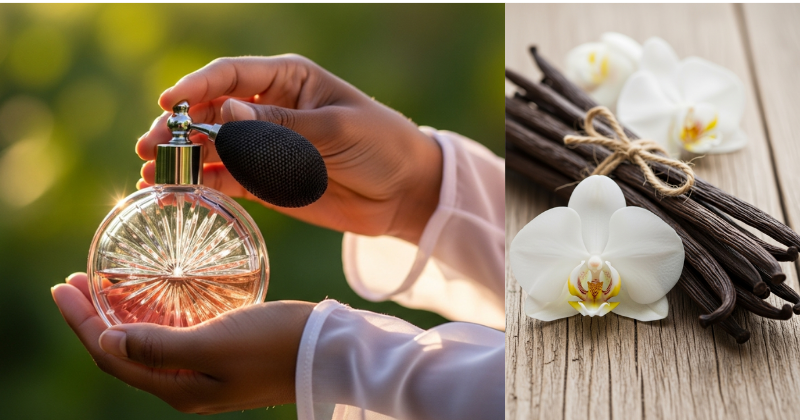
Are you searching for a cozy, sophisticated signature scent that is deeply comforting yet free from synthetic chemicals? Store-bought fragrances can be expensive and often contain ingredients that irritate sensitive skin. You can take control of your aroma by learning how to craft your own DIY HOMEMADE Warm Vanilla Woods Perfume. This guide will empower you to discover the art of natural perfumery, offering the achievable, step-by-step guidance needed to transform simple essential oils into a complex, long-lasting scent. Get ready to enjoy the cost-saving benefits and the satisfaction of completion that comes with creating a natural, personalized fragrance.
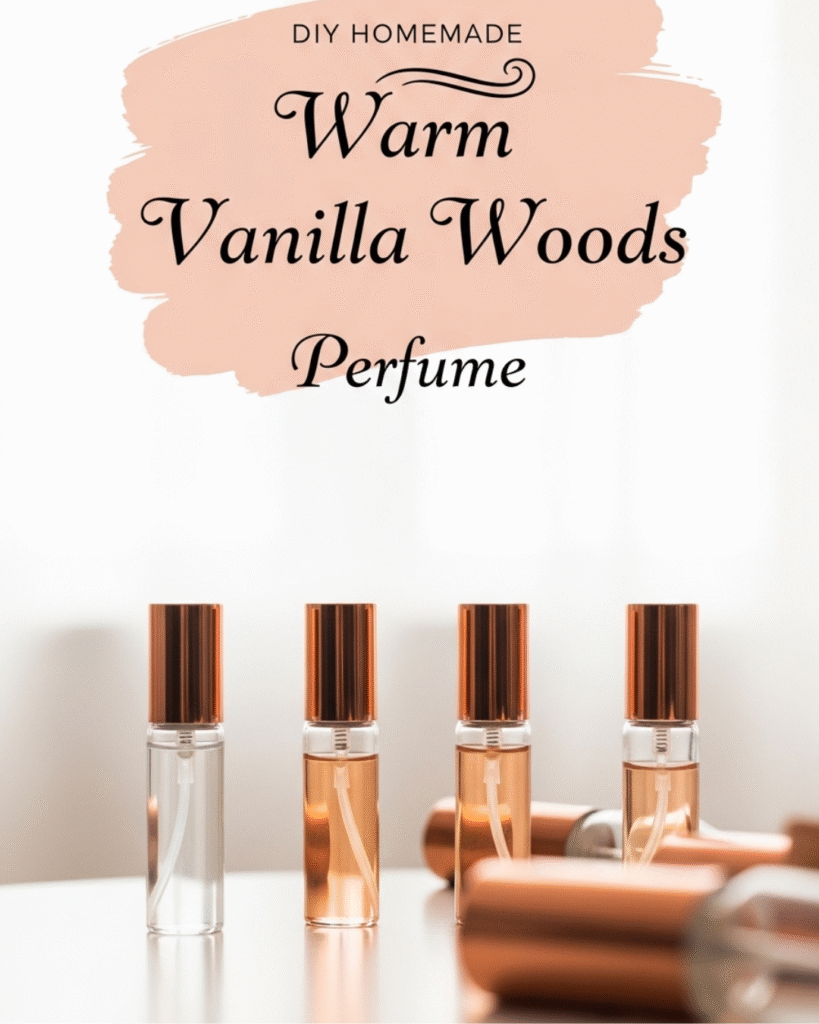
🔬 Foundation First: Understanding Perfume Notes
Creating a successful DIY HOMEMADE Warm Vanilla Woods Perfume relies on the classic structure of perfumery: the scent pyramid. By understanding and balancing these three fragrance notes, you can build a stable, long-lasting aroma.
H3: Building Confidence with Basic Concepts
Each note represents the rate at which an essential oil evaporates. The combination is what creates a balanced fragrance that evolves as you wear it.
| Perfume Note | Evaporation Rate | Role in the Scent | Scent Examples for “Warm Vanilla Woods” |
| Top Note | Fastest (First 5-15 mins) | The initial impression; light, uplifting. | Sweet Orange, Bergamot, Pink Peppercorn |
| Middle Note (Heart) | Medium (15 mins – 4 hours) | The core of the fragrance; balanced, soft. | Cinnamon, Clove, Nutmeg, Rose |
| Base Note | Slowest (Hours to days) | The anchoring scent; deep, rich, long-lasting. | Vanilla Absolute, Sandalwood, Cedarwood, Vetiver |
The ratio is crucial: for a $10 \text{ml}$ roll-on, you’ll generally use a total of 20-25 drops of essential oil, following a ratio of approximately $30\% \text{Top}: 50\% \text{Middle}: 20\% \text{Base}$.
H3: Addressing Common Concerns: Choosing Your Carrier
Before blending the oils, you need a carrier to dilute them safely. This addresses crucial safety considerations.
- The Alcohol Base (Traditional Spray Perfume): Use high-proof, unflavored alcohol (like $190$-proof grain alcohol or perfumer’s alcohol). Alcohol effectively disperses the essential oils and allows for maximum scent projection.
- The Oil Base (Roll-On Perfume): Use a light, non-greasy carrier oil like Fractionated Coconut Oil, Jojoba Oil, or Sweet Almond Oil. Roll-on perfumes sit closer to the skin and are excellent for sensitive skin. For this DIY HOMEMADE Warm Vanilla Woods Perfume, we will focus on the simpler, safer oil-based roll-on.
🪵 Section 2: Step-by-Step Process for Blending the Scent
This section breaks down the creation of your Warm Vanilla Woods blend into manageable, achievable steps.
Core Methods: The Roll-On Formula
Tool Requirements: 10 ml glass roller bottle, small funnel, and a glass measuring beaker or small bowl.
Ingredients List (for a 10 ml bottle):
| Component | Quantity | Role |
| Carrier Oil (Jojoba or FCO) | Fill to 10 ml line | Dilution and application base |
| Base Note (Woods/Vanilla) | 4 drops | Anchor and warmth |
| Middle Note (Spice) | 10 drops | Heart and complexity |
| Top Note (Citrus/Sparkle) | 6 drops | Initial lift and brightness |
Total Essential Oil Drops: 20 Drops
- Safety First Dilution Calculation: For a $10 \text{ml}$ roller bottle, 20 drops results in approximately a $1\%$ dilution rate. This is a very safe concentration for skin application.
- Add the Base Notes: Carefully drop the base notes (Vanilla, Sandalwood, Cedarwood) directly into the clean roller bottle. Base notes go first because they are the heaviest and hardest to evaporate.
- Example Recipe Drops: Vanilla Absolute (2 drops), Cedarwood (2 drops).
- Integrate the Middle Notes: Add the middle or heart notes (Spice/Herbals). This blend develops the “warm” aspect of the perfume.
- Example Recipe Drops: Cinnamon Bark (3 drops), Nutmeg (3 drops), Ylang Ylang (4 drops).
- Finish with Top Notes: Add the lightest, sparkliest notes last. These will lift the entire fragrance profile.
- Example Recipe Drops: Sweet Orange (4 drops), Pink Peppercorn (2 drops).
- Fill and Combine: Use the funnel to fill the rest of the $10 \text{ml}$ bottle with your chosen carrier oil. Secure the roller ball and lid tightly.
- The Time-Out (Timing and Planning Considerations): Shake the mixture gently to combine. Do not use immediately! Natural perfumes require a “curing” time. Store the sealed bottle in a cool, dark place for at least 1 week (2 weeks is better). This allows the oils to chemically bind with the carrier and “marry,” ensuring a deeper, richer, and longer-lasting final scent.
🎁 Section 3: Advanced Strategies and Variations
Once you master the basic formula, you can customize your DIY HOMEMADE Warm Vanilla Woods Perfume for complexity and personal preference.
H3: Customizing the Wood and Warmth
You can adjust the “Wood” and “Warm” components based on your desired scent intensity.
- Deeper Woods: Substitute traditional Cedarwood with Vetiver (1 drop max) for a smoky, earthy depth, or Patchouli (1 drop max) for a damp, rich forest scent. Remember to use these sparingly; they are extremely potent base notes.
- Spicier Warmth: Substitute Cinnamon with Cardamom for a more complex, bright warmth, or Ginger for a fresh, slightly hot spice note.
- Creative Solutions: For a creamier vanilla base, try adding 1 drop of Benzoin Resinoid, which acts as a fixative (see below) and provides a sticky, balsamic vanilla aroma.
H3: Pro Tips: Maximizing Longevity with Fixatives
Natural perfumes often struggle with longevity compared to synthetic fragrances. Fixatives are natural components that slow down the evaporation rate of the other oils.
- Use Naturally Slow Evaporators: Base notes like Sandalwood, Vetiver, and true Vanilla Absolute are natural fixatives.
- The Alcohol Method Shortcut: If you are determined to use an alcohol base for a stronger projection, soak a few small pieces of Orris Root Powder (a traditional fixative) in the carrier alcohol for 2-4 weeks before adding the essential oils. This provides depth and stability. (Internal Linking Opportunity: For detailed instructions on making an alcohol tincture, see our article, “DIY Herbal Tinctures for Wellness.”)
🛠️ Section 4: Troubleshooting and Common Challenges
Natural perfumery involves trial and error. Don’t be discouraged by initial setbacks! Here are solutions to common blending issues.
Featured Snippet Potential: “Why does my homemade vanilla perfume smell too weak or only lasts an hour?”
Your homemade vanilla perfume smells too weak and doesn’t last because the essential oils haven’t cured long enough, or you are missing a strong base note fixative. The fragrance must cure for at least one week (ideally two or more) in a cool, dark place to allow the scent molecules to fully integrate. To improve longevity, ensure your formula contains potent base notes like Sandalwood, Vetiver, or Vanilla Absolute, which naturally slow the evaporation rate.
Practical Troubleshooting Tips (DIY Focus)
- Problem: The scent is too sharp or “citrusy.”
- Obstacle: Too many top notes, or the blend needs time for the base notes to rise.
- Solution: Set the blend aside for two weeks and test again. If the sharpness persists, add 1-2 more drops of your heaviest base note (like Cedarwood) to anchor the fragrance. This is an alternative approach to rebalancing.
- Problem: The oil feels greasy or sticky on the skin.
- Obstacle: Using too heavy a carrier oil (like pure Olive Oil) or using the perfume immediately before it has integrated.
- Solution: Switch to a lighter, less viscous carrier like Fractionated Coconut Oil (FCO) or Jojoba Oil. Only apply small amounts to pulse points (wrists, behind ears).
- Problem: Scents are fading quickly.
- Solution: Preventive Measure: Apply the perfume to freshly moisturized skin (using an unscented lotion). Moist skin holds fragrance molecules much longer than dry skin, providing a great way to build upon basic success.
💖 Section 5: Maximizing Results: Application and Long-Term Care
Your DIY HOMEMADE Warm Vanilla Woods Perfume is a high-quality product that deserves careful application and maintenance and long-term considerations.
- The Pulse Point Strategy: Apply your roll-on perfume to pulse points where the skin is thinnest and warmth is generated (wrists, neck, behind the ears, inner elbows). The heat helps diffuse the fragrance throughout the day.
- Storage Longevity: Light, heat, and air are the enemies of natural perfume. Always store your roller bottle in a cool, dark place (a drawer or cabinet) and ensure the cap is tightly sealed to inspire continued growth and learning in fragrance preservation. Properly stored, your oil-based perfume can last up to a year.
- Complementary Strategies (Layering): Extend the scent by layering. Use a complimentary unscented body wash and follow up with a light layer of unscented body oil or lotion before applying the perfume. This creates a base that locks in the scent. (Internal Linking Opportunity: Read our guide on “How to Choose Non-Toxic Skincare” for layering options.)
✅ Conclusion: Your Capability to Create
You have successfully walked through the complex yet rewarding process of crafting a DIY HOMEMADE Warm Vanilla Woods Perfume. By mastering the art of the scent pyramid and the science of curing, you have taken a powerful step toward a more natural, personalized beauty routine.
Embrace the empowering message that you have the capability to succeed and create something beautiful and unique. Enjoy the comforting, sophisticated aroma that is authentically you.
Which customization—adding a hint of smoky Vetiver or spicy Cardamom—will you use to make your next batch of Warm Vanilla Woods truly your own?