
Introduction (meta description 155–160 characters)
Scientists have detected a mysterious seismic pulse repeating every 26 seconds deep under the ocean. Explore what drives Earth’s rhythmic “heartbeat” and the debate behind its unknown cause.
For nearly six decades, seismic monitoring stations around the world have recorded a rhythmic pulse emanating from the Earth approximately every 26 seconds. Often described metaphorically as the planet’s “heartbeat,” this repeating microseismic signal appears to originate from the deep ocean and transmits through Earth’s crust with astonishing regularity. Yet despite decades of study, researchers still cannot fully explain what drives the phenomenon. Its consistency, persistence, and global detectability have inspired scientific curiosity, engineering concern, and public fascination. This article provides a detailed, evidence-based overview of the mysterious 26-second signal: how it was discovered, how scientists monitor it, proposed explanations, unresolved questions, and what ongoing research may reveal about hidden dynamics within Earth and the oceans.
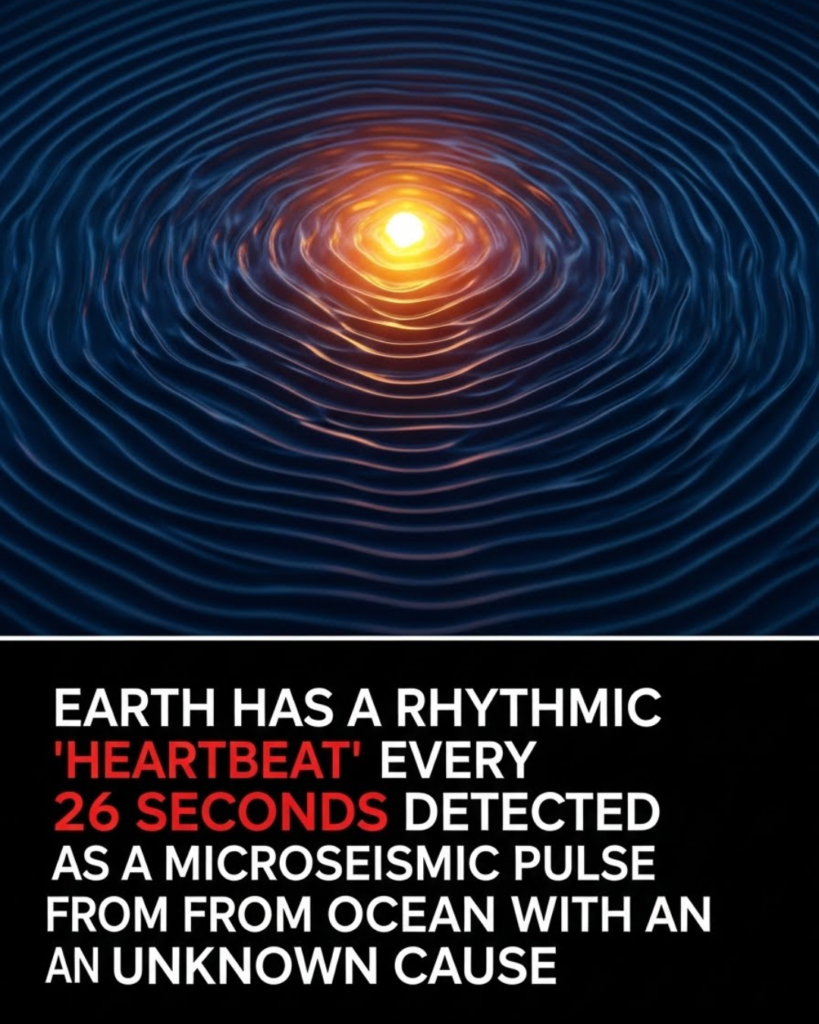
EARTH HAS A RHYTHMIC “HEARTBEAT” EVERY 26 SECONDS DETECTED AS A MICROSEISMIC PULSE FROM THE OCEAN WITH AN UNKNOWN CAUSE
What exactly is the 26-second microseismic pulse?
The 26-second pulse is a low-frequency seismic signal observed in global seismometer records since at least the early 1960s. It is classified as an ultra-low-frequency microseism rather than a tectonic tremor because it repeats at regular intervals rather than occurring randomly or as part of earthquake sequences.
Key characteristics include:
- a repetition interval of approximately 26 seconds
- global detectability across distant monitoring networks
- consistent timing independent of seasons or atmospheric patterns
- association with deep-ocean seismic noise
The pulse’s precision distinguishes it from typical ocean-wave microseisms, which vary with weather and storm conditions. The persistence of the 26-second interval—even during calm conditions—suggests a stable physical driver deep within Earth or the ocean environment.
H2: How did scientists first detect the rhythmic seismic pulse?
Seismologists studying background seismic noise noticed unusual regularity in recordings from ocean-adjacent instruments in the mid-20th century. The earliest systematic documentation emerged from Lamont-Doherty Geological Observatory researchers analyzing microseismic patterns during the Cold War era. As global seismic networks expanded through international monitoring treaties, repeated observations confirmed that the signal was not an equipment artifact.
Advances in digital seismology during the 1980s and 1990s allowed researchers to isolate the pulse more clearly from background noise. Time-series analysis, cross-correlation techniques, and spectral filtering revealed the signal in stations across continents, suggesting a global propagation source.
The widespread presence of the pulse sparked debate about geophysical origins. Its regularity initially sparked speculative theories about tectonic oscillations, ocean resonance, or magma-driven periodicity. Modern monitoring has reinforced the pulse’s persistence, making it one of the longest-recorded unexplained seismic signals.
H2: Where does the 26-second “heartbeat” originate within the Earth system?
Most research suggests the pulse originates in the southeastern Atlantic Ocean near the Gulf of Guinea. Seismic triangulation points to a region along the continental shelf where strong interaction between ocean waves and the seafloor topography occurs.
Researchers propose that the source region includes:
- a submarine continental slope
- sediment-laden seafloor with variable density layers
- steep gradients amplifying wave-driven energy
- interaction between ocean swells and coastal morphology
Although the region appears to be the primary source, the specific mechanism remains uncertain. The pulse’s propagation through Earth’s crust allows detection thousands of kilometers away, indicating highly efficient coupling between ocean energy and seismic waves.
H2: Which theories explain the cause of the rhythmic microseismic pulse?
Scientists have proposed several mechanisms to explain the 26-second periodicity, though none has been conclusively confirmed.
H3: Ocean wave resonance
Deep ocean swells may create standing waves that resonate at a natural frequency near 26 seconds. This resonance could repeatedly transfer energy into the crust as pressure pulses.
H3: Seafloor “pounding” or pressure forcing
Wave interaction along steep underwater slopes can generate periodic pressure pulses transmitted into the lithosphere.
H3: Volcanic or magmatic oscillation
Some researchers suggest fluid movement within Earth’s crust beneath the ocean basin could create periodic seismic pulses reminiscent of harmonic tremor.
H3: Coupled ocean–solid Earth oscillation
One hypothesis proposes feedback loops between ocean waves, seafloor topography, and lithospheric elasticity producing self-sustaining oscillations.
Despite decades of study, competing theories remain unresolved due to measurement complexity and the pulse’s subtle low amplitude.
H2: How do scientists monitor and analyze Earth’s rhythmic heartbeat in real time?
Seismologists detect the pulse using seismic arrays distributed across continents and ocean bottoms. Data collection relies on:
- broadband, high-sensitivity sensors
- hydroacoustic monitoring instruments
- interferometric synthetic aperture processing
- digital signal filtering to isolate ultra-low frequencies
H3: Time-series analysis techniques
Researchers apply stacking and cross-correlation to identify repeating patterns obscured by noise. Long-term monitoring over decades validates the pulse’s regularity.
H3: Global seismic network contributions
Stations in North America, Europe, Africa, and Asia detect the pulse independent of weather, confirming its persistent nature. Ocean-bottom seismometers near the Gulf of Guinea record the strongest signals, providing clues about geographical origin.
H2: Why is the origin of this 26-second pulse still unknown?
The mystery persists for several reasons:
- subtle amplitude limits resolution of source processes
- ocean-bottom instrumentation coverage is sparse
- complex ocean–crust interactions involve nonlinear physics
- competing explanations remain plausible
Moreover, the pulse’s consistency—despite variable ocean conditions—hints at deeper coupling mechanisms not yet understood. Traditional seismic monitoring tools were developed to detect discrete earthquakes rather than persistent rhythmic signals, creating technological challenges in studying ultra-low-frequency microseisms.
H2: What are the scientific implications of Earth’s mysterious seismic heartbeat?
The existence of a persistent periodic microseism has major implications for understanding Earth systems.
Potential insights include:
- improved modeling of ocean–solid Earth coupling
- better prediction of seafloor instability and coastal hazards
- enhanced interpretation of background seismic noise
- clues about lithospheric mechanical properties
The pulse suggests that Earth undergoes periodic energy transfers sensitive to ocean circulation and seafloor structure. Understanding its cause could reshape current models of microseismic generation and reveal feedback loops previously unknown.
H2: What research questions remain unanswered?
Scientists continue investigating open questions, including:
- What determines the precise 26-second interval?
- Why is the signal so persistent across decades?
- Do similar periodicities exist in other basins but remain undetected?
- Could subtle internal Earth processes amplify ocean forcing?
- Are long-term climate and sea-level changes affecting pulse strength?
Answering these questions requires coordinated marine geophysics efforts, expanded seabed monitoring, and improved computational modeling.
H2: Where is research on Earth’s heartbeat headed in the future?
Emerging technologies promise deeper insights. Ocean-bottom networks equipped with machine-learning algorithms may detect weak periodic signals buried beneath noise. High-resolution bathymetry and seafloor deformation sensors will allow researchers to investigate potential resonance structures.
Future missions may integrate:
- autonomous underwater vehicles
- pressure sensor arrays
- multiphysics modeling approaches
By mapping dynamic ocean–crust coupling more precisely, research teams hope to identify whether the pulse arises from hydrodynamic forcing, crustal oscillation, or unknown geophysical processes.
Conclusion
The 26-second seismic “heartbeat” of Earth remains one of geophysics’ most enduring mysteries. First detected over half a century ago, this rhythmic microseism pulses with astonishing regularity, transmitting through Earth’s crust and detectable around the world. While current research points toward an ocean source near the Gulf of Guinea, the specific mechanism behind the periodicity remains unknown. Proposed explanations include resonant ocean waves, seafloor pressure forcing, volcanic oscillation, and coupled crust–ocean feedback systems, yet definitive proof remains elusive.
Understanding this phenomenon could yield breakthroughs in seismic noise interpretation, ocean–Earth coupling theory, coastal hazard prediction, and deep-Earth material behavior. As technology advances, researchers continue unraveling the mysterious heartbeat of our planet, transforming this enduring enigma into an opportunity for scientific discovery.