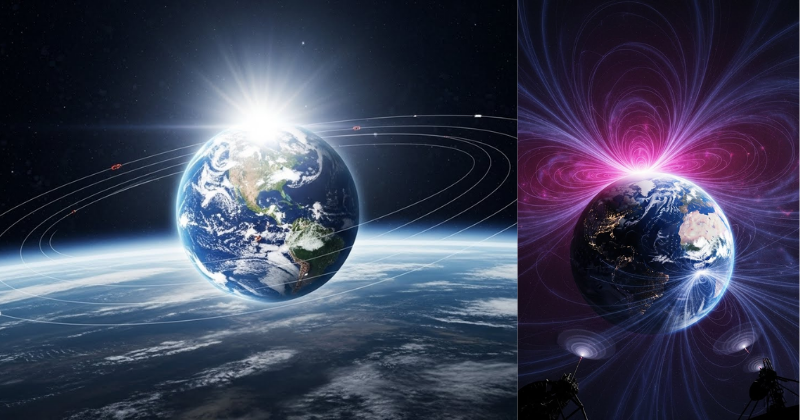
Earth is constantly bathed in invisible magnetic storms from the Sun, and scientists can detect these space weather events days before impact using advanced satellites and physics-based models.
H1: Earth Is Surrounded by Invisible Magnetic Storms — Here’s How Scientists Detect Them Before They Hit
Far beyond the blue sky and drifting clouds, Earth exists in a dynamic electromagnetic environment shaped by the Sun. Invisible magnetic storms—powerful disturbances in Earth’s magnetic field—continuously sweep through near-Earth space. Most pass unnoticed. Others disrupt satellites, radio communications, GPS accuracy, and even power grids.
What makes these storms remarkable is not only their scale, but humanity’s growing ability to detect them before they arrive. Through decades of space physics research, scientists have learned to monitor the Sun, model plasma flows, and read subtle magnetic signals that warn of incoming geomagnetic storms.
This article explains what magnetic storms really are, where they come from, how they interact with Earth, and—most importantly—how scientists detect and forecast them before they hit. The goal is clarity without oversimplification, revealing the hidden dynamics shaping our planet’s space environment.
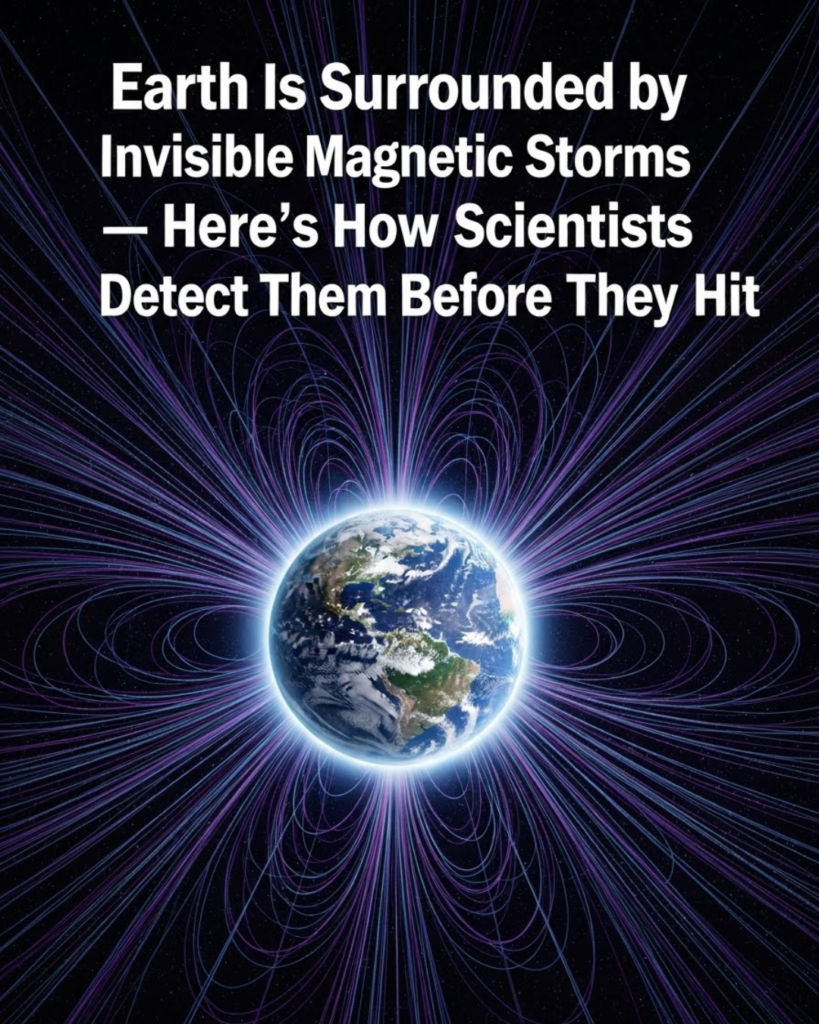
H2: What are invisible magnetic storms surrounding Earth?
Magnetic storms, more precisely called geomagnetic storms, are temporary but intense disturbances in Earth’s magnetosphere—the magnetic bubble that surrounds and protects the planet.
These storms are invisible to human senses, yet their effects are measurable across space and ground-based systems. They occur when charged particles from the Sun interact strongly with Earth’s magnetic field, transferring energy, momentum, and electric currents into near-Earth space.
A geomagnetic storm is not a single event but a sequence of processes that can last from hours to several days. During strong storms, Earth’s magnetic field can fluctuate by hundreds of nanoteslas, a change large enough to induce electrical currents in long conductors such as power lines and pipelines.
H2: Where do magnetic storms originate in the solar system?
The ultimate source of Earth’s magnetic storms is the Sun, a magnetically active star that constantly emits energy and charged particles.
H3: Solar wind as the background driver
The Sun continuously releases a stream of charged particles known as the solar wind. This plasma flows outward at speeds of 300–800 kilometers per second, carrying the Sun’s magnetic field with it.
Under normal conditions, Earth’s magnetosphere deflects most of this flow, maintaining relative stability.
H3: Coronal mass ejections and solar flares
The most disruptive magnetic storms are triggered by coronal mass ejections (CMEs)—massive eruptions that launch billions of tons of magnetized plasma into space. When a CME is directed toward Earth, it can compress the magnetosphere dramatically.
Solar flares, while intense bursts of radiation, often accompany CMEs and can enhance space weather effects by ionizing Earth’s upper atmosphere.
H2: How does Earth’s magnetosphere interact with incoming solar energy?
Earth’s magnetosphere acts as both a shield and an energy transfer system. Its response depends critically on the orientation of the incoming solar magnetic field.
When the solar magnetic field points southward, opposite to Earth’s northward field, a process called magnetic reconnection occurs. This allows solar energy to directly enter the magnetosphere.
The result is:
- Enhanced electric currents in space
- Energized particles trapped in radiation belts
- Disturbances that propagate down to Earth’s upper atmosphere
This interaction is why not all solar storms cause geomagnetic storms—orientation matters as much as strength.
H2: How do scientists detect magnetic storms before they reach Earth?
Early detection relies on a global network of space-based observatories positioned between Earth and the Sun.
H3: Solar monitoring satellites
Spacecraft such as solar observatories continuously image the Sun, tracking sunspots, flares, and coronal mass ejections. When a CME erupts, scientists can estimate its speed, direction, and potential arrival time at Earth.
These observations provide an initial warning window of 1–3 days.
H3: Lagrange point monitoring
Critical spacecraft are stationed at the L1 Lagrange point, about 1.5 million kilometers from Earth. From this position, satellites directly sample the solar wind before it reaches Earth, measuring:
- Particle density and speed
- Magnetic field strength and orientation
These measurements provide final confirmation and short-term alerts, often 30–60 minutes before impact.
H2: What instruments measure magnetic storms as they unfold?
Once solar energy reaches Earth, scientists rely on both space-based and ground-based instruments to track storm evolution.
H3: Magnetometers in space and on Earth
Highly sensitive magnetometers detect tiny changes in magnetic fields. Space-based instruments observe large-scale magnetospheric dynamics, while ground-based networks monitor disturbances at Earth’s surface.
H3: Auroral and ionospheric monitoring
Magnetic storms energize particles that collide with atmospheric gases, producing auroras. Imaging systems and radar arrays track these emissions, offering visual confirmation of storm intensity and location.
Together, these measurements allow scientists to map the storm in real time.
H2: Which factors determine how severe a magnetic storm becomes?
Not every solar event leads to major consequences. Storm severity depends on several interacting variables.
H3: Magnetic field orientation
A strong CME with an unfavorable magnetic orientation may produce minimal effects, while a moderate CME with optimal alignment can cause a major storm.
H3: Speed and density of solar plasma
Faster, denser plasma transfers more energy into the magnetosphere, increasing storm intensity.
H3: Pre-existing magnetospheric conditions
If Earth’s magnetosphere is already disturbed, it becomes more susceptible to further energy input.
H2: How do magnetic storms affect modern technology and infrastructure?
Invisible magnetic storms have very real consequences in a technology-dependent world.
They can:
- Disrupt satellite electronics and shorten satellite lifespans
- Degrade GPS accuracy and radio communications
- Induce currents in power grids, leading to transformer damage
- Increase atmospheric drag on low-Earth-orbit satellites
Understanding and forecasting these storms is now a matter of infrastructure resilience, not scientific curiosity.
H2: How accurate are modern magnetic storm forecasts?
Forecasting magnetic storms is a complex challenge involving plasma physics, magnetohydrodynamic modeling, and real-time data assimilation.
Current models can reliably predict:
- CME arrival times within several hours
- Likelihood of geomagnetic storm conditions
- Potential severity ranges
However, precise intensity forecasts remain difficult due to the chaotic nature of magnetic reconnection and solar plasma dynamics. Research continues to improve prediction accuracy using machine learning and high-resolution simulations.
Conclusion: Reading the invisible storms that surround our planet
Earth is not isolated in space. It is immersed in a constantly shifting electromagnetic environment shaped by solar activity and cosmic plasma flows. Invisible magnetic storms are a natural consequence of this relationship.
Through decades of scientific effort, researchers have learned to detect these storms before they arrive—watching the Sun, sampling the solar wind, and interpreting magnetic signals that once went unnoticed. While forecasting remains imperfect, early detection already protects satellites, power systems, and global communications.
Understanding these storms reveals a deeper truth: Earth’s safety depends not on isolation, but on awareness of the invisible forces constantly passing through our cosmic neighborhood.