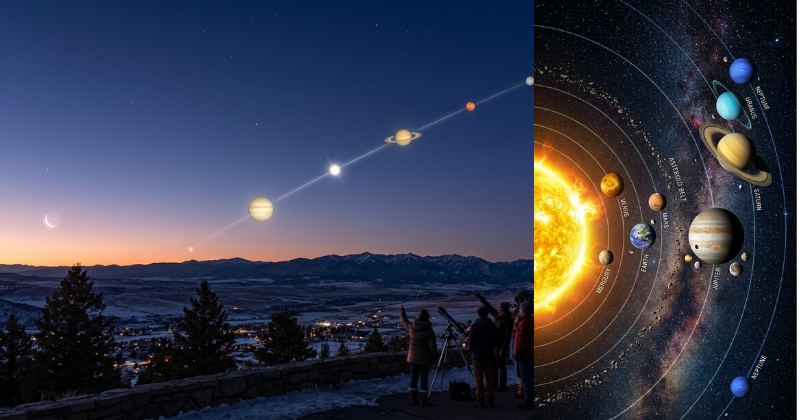
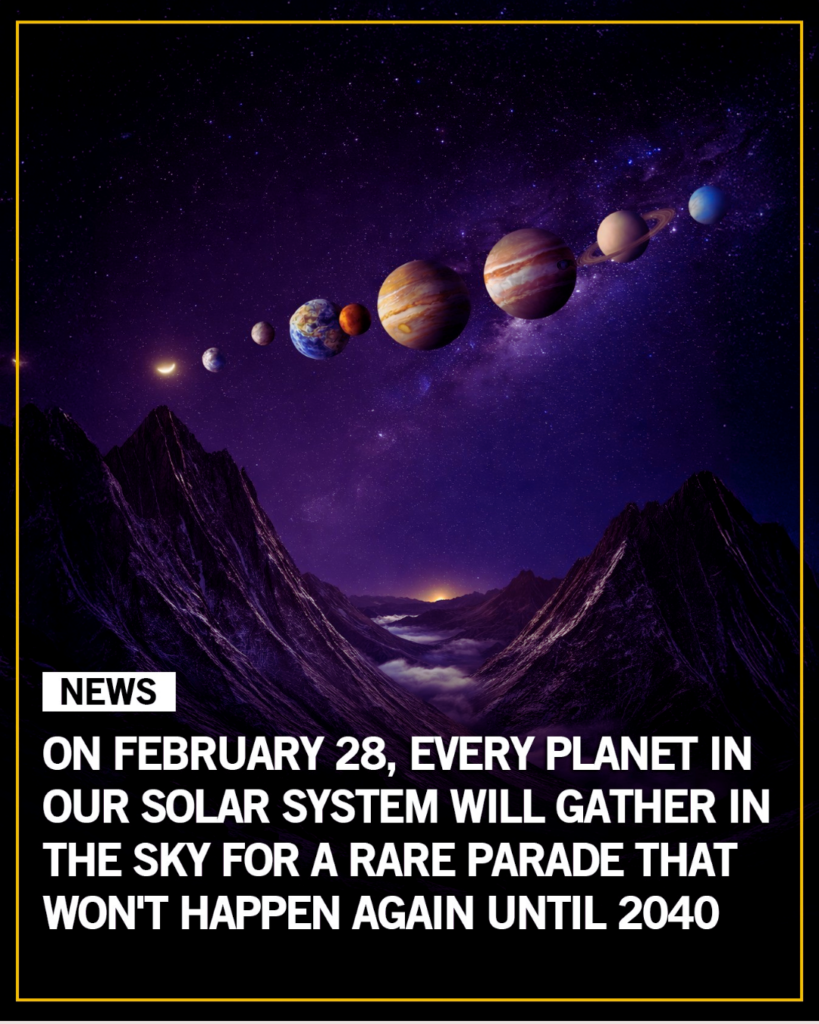
On February 28, a remarkable astronomical alignment positions all eight planets of our solar system within observable range during a single night — an event popularly termed a “planetary parade” that captures public imagination while raising questions about its actual rarity, observational requirements, and the orbital mechanics producing such configurations. This planetary visibility event does not represent a true linear alignment in three-dimensional space (a geometric impossibility given the planets’ varying orbital inclinations and heliocentric distances) but rather a perspective phenomenon where Earth’s position relative to the other planets creates simultaneous visibility windows across the evening and pre-dawn sky. Understanding this event requires examining the distinction between visual clustering and physical alignment, the observational strategies maximizing detection of all planets including the challenging inner worlds and distant ice giants, and the orbital period relationships determining how frequently such configurations recur across human timescales.
What Constitutes a Planetary Parade and How Does It Differ From True Alignment?
The terminology surrounding multi-planet visibility events often conflates distinct astronomical phenomena, necessitating precise definition of what observers will actually witness on February 28.
The Perspective Versus Position Distinction
A planetary parade describes a configuration where multiple planets achieve visibility during a single observational session — not because they occupy similar positions in space, but because Earth’s location in its orbit, combined with each planet’s individual position, creates visibility windows that overlap temporally. On February 28, Mercury and Venus appear in the western evening sky after sunset (positioned between Earth and the Sun in their orbits), Mars, Jupiter, and Saturn dominate the evening and midnight sky (positioned at various points beyond Earth’s orbit), while Uranus and Neptune require telescopic aid but occupy positions within the night sky hemisphere, and critically, observers in specific locations might detect Mars and outer planets in evening hours while Mercury and Venus set in the west.
This differs fundamentally from a syzygy — a true linear alignment where planets position along a straight line in three-dimensional space. True planetary syzygies involving all eight planets are effectively impossible due to the planets’ orbital inclinations ranging from 0° (by definition for Earth’s ecliptic reference plane) to 7° for Mercury and 3.4° for Venus, with the outer planets showing smaller but still significant inclinations. Even when planets share similar celestial longitudes (positions along the ecliptic), their varying distances from the ecliptic plane and different heliocentric distances mean they occupy vastly different three-dimensional coordinates.
The Angular Separation Reality
On February 28, the planets span approximately 180 degrees of celestial longitude — literally half the sky. Mercury and Venus cluster within 30-40 degrees of the Sun’s position below the western horizon during evening observations, Mars positions approximately 90-120 degrees from the Sun (near opposition or post-opposition), Jupiter and Saturn occupy intermediate positions, while Uranus and Neptune, though technically “visible” with optical aid, require precise ephemeris data for location. This 180-degree span means observers must survey from western to eastern horizons to capture all planets, with the naked-eye planets distributed across this vast arc rather than clustered in a compact grouping.
The popular imagination often envisions planetary parades as tight celestial processions with planets appearing as a visible chain or line. The reality involves planets scattered across the sky, many separated by angular distances exceeding 30-40 degrees — comparable to the span between your extended fist held at arm’s length and a point three fist-widths away.
How Frequently Do All Eight Planets Become Simultaneously Visible?
Determining the rarity of complete planetary visibility requires analyzing the synodic periods governing when each planet returns to similar configurations relative to Earth and assessing the cumulative probability of favorable visibility for all eight simultaneously.
Synodic Period Constraints and Visibility Windows
Each planet’s synodic period — the interval between successive similar geometric configurations with Earth — determines how often it achieves optimal visibility. Mercury’s 116-day synodic period means it cycles through evening visibility, conjunction, and morning visibility approximately three times annually, but each visibility window lasts only 2-3 weeks due to its proximity to the Sun. Venus’ 584-day synodic period produces evening or morning apparitions lasting several months, but it spends significant periods too close to the Sun for observation during inferior and superior conjunction.
For the outer planets, visibility depends on opposition timing and the planets’ angular separation from the Sun. Mars reaches opposition every 780 days (26 months), cycling from evening visibility through conjunction to morning visibility over this period. Jupiter (399-day synodic period) and Saturn (378-day synodic period) spend roughly 5-6 months around opposition in optimal evening visibility, then transition through conjunction when they’re invisible in solar glare, before emerging in morning skies.
Uranus (370-day synodic period) and Neptune (368-day synodic period) require telescopic observation but follow similar patterns, spending months around opposition when they’re visible throughout the night, then periods near conjunction when they’re lost in twilight.
The Probabilistic Analysis
For all eight planets to achieve simultaneous visibility requires: (1) Mercury or Venus in evening or morning visibility windows, (2) the opposite inner planet also in a visibility window (simultaneously having Mercury in evening sky and Venus in morning sky, or vice versa, occurs only when they’re on opposite sides of Earth), (3) at least several outer planets positioned more than 30-40 degrees from the Sun’s location. The cumulative probability of these conditions aligning produces events occurring perhaps 2-4 times annually when all eight planets are theoretically detectable during a single 24-hour period, though optimal observation typically requires either observing both evening and morning twilight or accepting that some planets require telescopic aid for detection.
The February 28 event represents a favorable configuration rather than an exceptionally rare one — similar visibility opportunities occurred in 2022, 2020, and will recur in 2027 and 2029 based on orbital mechanics. The perception of rarity often stems from limited public awareness during previous occurrences rather than genuine astronomical infrequency.
What Observational Strategies Maximize Planet Detection During the Parade?
Successfully observing all eight planets during the February 28 event requires strategic planning accounting for each planet’s brightness, position, and the observational windows when atmospheric and lighting conditions permit detection.
The Inner Planet Challenge: Mercury and Venus
Mercury and Venus present the greatest observational challenge despite being among the brightest planets, because their proximity to the Sun restricts visibility to twilight periods when sky background brightness remains substantial. On February 28, both inner planets appear in the western evening sky, with Venus dominating at magnitude -4.0 (appearing as the brilliant “Evening Star”) positioned approximately 30-40 degrees above the western horizon at sunset for mid-latitude Northern Hemisphere observers. Mercury, significantly fainter at magnitude +0.5 to -0.5 (varying with phase and distance), hugs closer to the horizon, requiring observers to scan within 10-15 degrees of the western horizon during the 30-45 minute window after sunset when the sky has darkened sufficiently for Mercury to contrast against the twilight but before it sets below the horizon.
Optimal Mercury observation requires unobstructed western horizons — observers in urban environments with buildings or trees blocking low-altitude views may find Mercury impossible to detect. Binoculars (7×50 or 10×50) substantially improve Mercury detection by concentrating its light and reducing the contrast challenge against twilight, though naked-eye observation remains possible under ideal conditions. Observers should locate brilliant Venus first (unmistakable as the brightest point-source object in the evening sky) and scan the area closer to the horizon and slightly south of Venus’ position to detect Mercury’s fainter gleam.
The Outer Planet Telescopic Requirements
While Mars, Jupiter, and Saturn achieve easy naked-eye visibility (Jupiter at magnitude -2.0, Saturn at +0.8, and Mars between -1.0 and +1.5 depending on its orbital position), Uranus and Neptune require optical aid. Uranus, at magnitude +5.8, theoretically achieves naked-eye visibility under dark-sky conditions (Bortle Class 3 or better) but appears as an extremely faint “star” indistinguishable from background stars without optical aid or prior knowledge of its position. Binoculars reveal Uranus readily, showing it as a distinctly non-stellar disk when examining carefully, while telescopes at 100-150x magnification display its blue-green coloration and disk shape unambiguously.
Neptune, at magnitude +7.9, remains beyond naked-eye detection under all conditions, requiring binoculars at minimum for detection and modest telescopes (80-100mm aperture) at 50-100x for comfortable observation. Locating Neptune requires accurate ephemeris data (available from astronomy applications and websites) showing its position relative to brighter reference stars. On February 28, Neptune positions in Pisces (specific coordinates vary by year but typically RA ~23h 40m, Dec ~ -3° for this timeframe), requiring observers to star-hop from brighter stars to Neptune’s faint point of light.
The Complete Observation Protocol
The optimal strategy for observing all eight planets on February 28 involves a sequenced approach:
Phase 1 (Sunset to 90 minutes post-sunset): Begin observations immediately after sunset, scanning the western horizon for Mercury using Venus as a reference beacon. Venus will be immediately obvious; Mercury requires careful scanning of the area 10-20 degrees above the horizon and slightly south of Venus. This window closes as Mercury sets 60-90 minutes after sunset.
Phase 2 (Evening, 90 minutes to 3 hours post-sunset): Shift attention to the southern and southeastern sky where Jupiter, Saturn, and Mars position (specific locations depend on the year’s particular planetary configuration). Jupiter’s brilliance makes it trivial to locate; Saturn appears as a steady, yellowish “star” of first magnitude; Mars shows distinctly ruddy coloration. Use binoculars or telescope to locate Uranus, positioned in Aries or Taurus (depending on year) among background stars, identifiable by its non-stellar disk when examined carefully.
Phase 3 (Evening, 2-4 hours post-sunset): Locate Neptune using star charts and finder scopes, requiring patient star-hopping from brighter reference stars to Neptune’s faint position in Pisces.
This complete protocol, from initial Mercury observation through final Neptune detection, spans approximately 3-4 hours and requires multiple optical instruments (naked eye for bright planets, binoculars for Mercury and Uranus, telescope for Neptune) plus accurate positional data and dark-adapted vision for faint planet detection.
Which Orbital Mechanics Principles Govern Planetary Visibility Patterns?
Understanding why planetary visibility events occur requires examining the fundamental orbital mechanics determining each planet’s position relative to Earth and the Sun across time.
Kepler’s Laws and Synodic Period Derivation
Johannes Kepler’s three laws of planetary motion, formulated in the early 17th century and later explained by Newton’s gravitational theory, govern planetary orbital behavior. The third law — the relationship between orbital period and semi-major axis (P² ∝ a³) — establishes that planets closer to the Sun complete orbits more rapidly than distant planets. Mercury orbits in 88 days, Venus in 225 days, Earth in 365.25 days, Mars in 687 days, Jupiter in 11.86 years, Saturn in 29.46 years, Uranus in 84.01 years, and Neptune in 164.79 years.
The synodic period (S) relates to the sidereal periods (P) of Earth and another planet through the equation: 1/S = |1/P_Earth – 1/P_planet|. For planets orbiting faster than Earth (Mercury, Venus), the synodic period represents how long until the planet “laps” Earth and returns to similar geometry. For outer planets orbiting slower than Earth, the synodic period represents how long until Earth “laps” the outer planet, returning to similar configurations. These synodic periods — ranging from 116 days for Mercury to 378 days for Saturn — determine the frequency of optimal visibility windows.
Opposition and Conjunction Dynamics
Outer planets achieve optimal visibility near opposition — the configuration where Earth positions directly between the planet and Sun, placing the planet in the midnight sky at peak altitude. At opposition, outer planets: (1) achieve maximum brightness (closest approach to Earth), (2) rise at sunset and set at sunrise (all-night visibility), (3) show maximum apparent angular diameter (optimal for telescopic observation). The months surrounding opposition provide evening visibility that gradually shifts earlier as Earth’s continued orbital motion carries it away from the opposition geometry.
Inner planets (Mercury and Venus) never reach opposition (Earth never positions between them and the Sun due to their orbital arrangement) but instead cycle through inferior conjunction (between Earth and Sun, morning visibility transitions to evening visibility) and superior conjunction (beyond Sun from Earth’s perspective, invisible in solar glare). Maximum visibility occurs at greatest elongation — the configurations when Mercury or Venus achieves maximum angular separation from the Sun as viewed from Earth, positioning them highest above the horizon during twilight.
The Ecliptic Plane and Seasonal Visibility Variations
All planets orbit within approximately 7 degrees of the ecliptic plane — the Earth-Sun orbital plane projected onto the celestial sphere. The ecliptic’s inclination relative to Earth’s celestial equator (23.5°, reflecting Earth’s axial tilt) means the ecliptic arc across the sky varies seasonally. In Northern Hemisphere spring, the ecliptic angles steeply upward from the western horizon during evening observations, providing excellent viewing geometry for planets near the western evening sky. In autumn, the ecliptic intersects the horizon at shallow angles, making twilight planet observation more challenging.
February observations in the Northern Hemisphere occur during late winter when the ecliptic maintains moderate angles — not optimal (as in spring) but substantially better than autumn geometry. This seasonal factor significantly influences Mercury and Venus visibility; the same orbital configuration produces dramatically different observational conditions depending on season and observer latitude.
How Do Amateur and Professional Astronomers Document Planetary Configurations?
The February 28 event provides opportunities for both amateur astrophotography and professional astronomical research, with different methodologies and objectives characterizing each approach.
Wide-Field Astrophotography Techniques
Capturing multiple planets in single frames requires wide-field optical systems spanning 50-180 degrees field of view — impossible with telescopes but achievable with camera lenses and specialized fisheye or ultra-wide lenses. DSLR or mirrorless cameras equipped with 14-35mm lenses (full-frame equivalent) can frame substantial portions of the planetary parade, though capturing all eight planets requires either: (1) ultra-wide lenses (10-14mm) with associated distortion, (2) panoramic stitching of multiple frames, or (3) acceptance that some planets fall outside the field of view.
The exposure challenge involves balancing detection of faint planets (requiring longer exposures) against overexposure of brilliant Venus and Jupiter (saturating detector wells in seconds). Optimal strategies employ: (1) HDR techniques combining multiple exposures at varying durations (1-4 seconds at ISO 1600-3200 for faint planets, 0.25-1 second for bright planets, merged in post-processing), (2) moderate apertures (f/2.8-f/5.6) balancing light gathering and depth of field, and (3) twilight timing when residual sky glow prevents complete darkness, reducing dynamic range between bright and faint objects.
Time-Lapse Documentation of Planetary Motion
The planets’ differential motions relative to background stars — most dramatic for Mercury and Venus over days to weeks — enable time-lapse documentation revealing orbital dynamics visually. Photographers capturing the same sky region over multiple nights observe planets shifting position while stars remain fixed (aside from Earth’s precessional motion, negligible over short timescales). Mercury moves most rapidly, shifting several degrees per night near greatest elongation; outer planets move imperceptibly night-to-night but show measurable displacement across weeks.
Professional Photometric and Astrometric Programs
Professional observatories utilize planetary visibility events for systematic photometric monitoring (measuring brightness variations) and astrometric measurements (determining precise positions). While bright planets receive continuous professional attention, events bringing multiple planets into favorable viewing geometry enable efficient multi-target observation sessions. Photometric data contribute to understanding rotational periods, atmospheric phenomena (storms, clouds), and long-term brightness variations potentially indicating seasonal changes. Astrometric measurements refine orbital elements, improving ephemeris accuracy for future predictions.
What Historical Significance Do Multi-Planet Visibility Events Hold?
Human observation and interpretation of planetary configurations spans millennia, with multi-planet groupings holding astronomical, astrological, and cultural significance across civilizations.
Ancient Astronomical Records and Interpretations
Ancient Babylonian astronomers systematically recorded planetary positions on clay tablets dating to 1600 BCE and earlier, documenting conjunctions and relative positions with remarkable precision. These observations served both predictive astronomy (calculating future positions) and astrological interpretation, with planetary configurations believed to presage terrestrial events. The MUL.APIN tablets, comprehensive Babylonian astronomical compendium texts, include detailed planetary period relationships enabling prediction of visibility windows.
Greek astronomers including Ptolemy (2nd century CE) developed geometric models explaining planetary motions through epicycles and deferents — complex combinations of circular motions reproducing observed planetary paths against background stars. While physically incorrect (superseded by heliocentric models), Ptolemaic astronomy achieved impressive predictive accuracy for planetary positions, enabling anticipation of multi-planet visibility events.
The Copernican Revolution and Heliocentric Understanding
Nicolaus Copernicus’ 1543 heliocentric model — positioning the Sun rather than Earth at the solar system’s center — transformed understanding of planetary configurations. What appeared as complex retrograde motions and unpredictable relative positions in geocentric models emerged as natural consequences of viewing other planets’ orbital motion from Earth’s moving vantage point. The heliocentric framework explained why inner planets (Mercury, Venus) never stray far from the Sun in Earth’s sky (they orbit inside Earth’s orbit), why outer planets exhibit retrograde motion near opposition (Earth overtaking them in faster interior orbit), and why certain planetary configurations recur with predictable periods (based on synodic period relationships).
Modern Public Engagement and Astronomical Literacy
Contemporary planetary visibility events, including the February 28 parade, serve valuable public outreach functions, drawing attention to solar system architecture and inspiring interest in observational astronomy. Astronomy organizations, planetariums, and science communication platforms leverage such events to explain orbital mechanics, demonstrate prediction accuracy of modern ephemeris calculations, and encourage direct sky observation connecting people to celestial phenomena their ancestors observed for millennia. The educational value extends beyond the specific event — explaining why planets appear in particular positions, how ancient astronomers tracked their motions without modern technology, and how current understanding derives from centuries of observation and theoretical development.
What Follow-Up Observations Can Build Upon the February 28 Event?
Observing the planetary parade provides foundation for continued planetary monitoring revealing orbital dynamics through direct observation across subsequent weeks and months.
Tracking Planetary Motion Against Background Stars
Following the planets’ positions relative to background stars over days and weeks makes abstract orbital concepts tangible. Mercury’s rapid motion becomes obvious as it shifts several degrees nightly near greatest elongation before reversing direction (relative to background stars) and plunging back toward the Sun. Venus’ slower but still substantial motion carries it gradually higher above the western horizon (or lower, depending on its position in the synodic cycle) across weeks. Mars’ motion against background stars accelerates or decelerates depending on its position relative to opposition, with retrograde motion periods (apparent backward motion) providing visible evidence of Earth overtaking Mars in faster interior orbit.
Systematic photography from consistent locations enables creation of time-lapse sequences or static composites showing planetary paths across the stellar background — powerful visualizations of orbital mechanics that abstract diagrams struggle to convey.
Monitoring Planetary Brightness Variations
Planetary brightness varies significantly across synodic cycles, with changes reflecting distance variations and phase effects (for inner planets). Venus exhibits dramatic brightness variation from magnitude -4.7 near maximum elongation to invisibility at conjunction, with the brightness changes accompanied by phase variations observable through small telescopes (Venus displays crescent, quarter, and gibbous phases like the Moon). Mars’ brightness varies even more dramatically, from magnitude -2.9 at favorable close oppositions to magnitude +1.8 near conjunction — a 100-fold intensity change reflecting its variable distance (from 0.37 AU at closest approach to 2.67 AU when beyond Sun from Earth).
Regular magnitude estimates (comparing planetary brightness to nearby stars of known magnitude) train visual photometry skills while documenting the brightness evolution arising from orbital geometry.
How Does Light Pollution Impact Planetary Parade Observation?
Urban light pollution affects planetary visibility differentially, with impacts ranging from negligible for bright planets to prohibitive for faint telescopic worlds.
The Magnitude Threshold and Bortle Scale Context
The Bortle Dark-Sky Scale quantifies light pollution through limiting magnitude — the faintest stars visible to dark-adapted eyes. Class 1 (pristine dark sky) achieves magnitude 7.6-8.0; Class 4-5 (suburban transition) reaches magnitude 5.0-6.0; Class 8-9 (inner city) barely achieves magnitude 3.5-4.0. Venus (magnitude -4.0), Jupiter (-2.0), Mars (-1.0 to +1.5), and Saturn (+0.8) remain easily visible from even Class 9 locations — light pollution scarcely affects observation of these brilliant objects. Mercury (+0.5 to -0.5) remains detectable from urban sites though contrast against twilight glow decreases in light-polluted skies.
Uranus (magnitude +5.8) becomes challenging from Class 7-8 locations where limiting magnitude approaches Uranus’ brightness; observers in these environments benefit from binocular aid concentrating Uranus’ light. Neptune (magnitude +7.9) becomes effectively impossible from Class 8-9 locations, requiring observers to travel to Class 4-6 sites for reasonable detection probability.
Strategies for Urban Observers
Urban and suburban observers can successfully view the six bright planets (Mercury through Saturn) despite light pollution, though Neptune and Uranus may require travel to darker sites. Timing observations during astronomical twilight (for evening planets) minimizes light pollution impact relative to fully dark conditions, as the residual natural sky glow from the Sun below the horizon competes less with artificial light pollution than full darkness would. Using building shadows or positioning to minimize direct views of streetlights and building illumination improves local sky darkness even within light-polluted regions.
What Future Planetary Visibility Events Merit Attention?
The February 28 event represents one of many favorable planetary configurations occurring across 2026 and subsequent years, with some configurations offering superior viewing conditions or including additional celestial phenomena.
Near-Term Notable Configurations
Based on orbital mechanics calculations, several upcoming events offer excellent planetary visibility: May 2026 features a tight grouping of Jupiter, Saturn, and Mars in the eastern pre-dawn sky, with the three bright planets within a 15-degree arc creating striking visual impact in wide-field photographs. October 2027 brings another all-planet visibility window with particularly favorable Mercury viewing geometry during autumn evening twilight for Southern Hemisphere observers. March 2029 positions all bright planets in evening visibility simultaneously — a configuration offering advantages over February 28’s split between evening and twilight observations.
The 2040s: Exceptional Outer Planet Groupings
The 2040s feature gradually tightening groupings of Jupiter, Saturn, Uranus, and Neptune as these slower outer planets converge in heliocentric longitude. The configuration culminates in 2041 when all four occupy a ~30-degree arc — still not a true alignment but offering unprecedented opportunity to observe multiple outer planets within single low-magnification telescopic fields. Such outer planet groupings occur only once per 80-160 years (depending on specific planet combinations) due to the long orbital periods, making the 2041 configuration genuinely exceptional.
Conclusion
The February 28 planetary parade represents a perspective phenomenon where all eight solar system planets achieve simultaneous visibility through favorable orbital geometry positioning them in accessible regions of the evening and twilight sky. While popularly described as rare, similar configurations recur every 2-4 years when synodic period relationships align favorably; the perception of rarity stems partly from limited awareness of previous occurrences. Successful observation requires strategic sequencing from evening twilight (for Mercury and Venus) through evening hours (for Mars, Jupiter, Saturn) and systematic telescopic surveys (for Uranus and Neptune), spanning 3-4 hours of observational time. The event’s scientific value lies not in inherent physical significance (the planets’ three-dimensional positions remain widely separated despite visual clustering) but in educational opportunities demonstrating orbital mechanics principles, inspiring continued sky observation revealing planetary motions across subsequent weeks, and connecting contemporary observers to millennia of planetary astronomy. Future visibility events occur regularly, with the 2041 outer planet grouping representing the next genuinely exceptional configuration offering observational opportunities unavailable across human lifetimes.