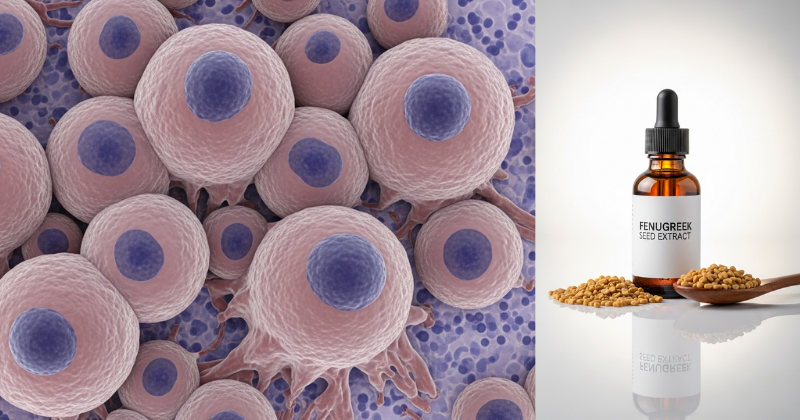
Recent laboratory studies reveal fenugreek seed extract slowed the growth of prostate, breast, and pancreatic cancer cells, inducing significant cell death within 72 hours.
What is the scientific mechanism behind fenugreek seed extract and cancer cell inhibition?
The therapeutic potential of Trigonella foenum-graecum, commonly known as fenugreek, lies in its complex phytochemical profile. At the molecular level, fenugreek seed extract contains a diverse array of bioactive compounds, including alkaloids (trigonelline), saponins (diosgenin), and various flavonoids. The primary mechanism by which fenugreek seed extract slowed the growth of prostate, breast, and pancreatic cancer cells involves the disruption of the cell cycle and the induction of programmed cell death, or apoptosis.
In healthy tissue, cell division is a tightly regulated process. However, cancer cells bypass these checkpoints, leading to uncontrolled proliferation. Research indicates that fenugreek extract interferes with these signaling pathways, specifically targeting the $G_1/S$ phase transition. By arresting the cycle at this stage, the extract prevents the replication of damaged DNA. Furthermore, the extract has been shown to modulate the expression of BCL-2 family proteins—the “gatekeepers” of cell survival—effectively tilting the balance toward pro-apoptotic signals that command the cancer cell to self-destruct.
How does fenugreek seed extract impact prostate cancer cell progression?
Prostate cancer cells are often driven by androgen signaling, making them a specific target for dietary phytochemicals that can modulate hormone-related pathways. In controlled in vitro environments, researchers observed that treatment with fenugreek derivatives led to a marked reduction in cell viability. The extract appears to downregulate the expression of the androgen receptor (AR) and prostate-specific antigen (PSA), which are critical markers for the progression of this specific malignancy.
The timeline of this intervention is particularly notable. Within a 72-hour window, the morphological integrity of the prostate cancer cells begins to degrade. The cells exhibit shrinkage and chromatin condensation—hallmarks of a losing battle against the extract’s bioactive components. This rapid response highlights the potency of compounds like diosgenin, a steroid saponin found in fenugreek, which mimics the structure of human hormones and can competitively inhibit the growth-promoting signals that prostate tumors rely on.
Which factors allow fenugreek to target breast cancer cells effectively?
Breast cancer is a heterogeneous disease, often categorized by the presence or absence of estrogen receptors (ER). Scientific inquiry has shown that fenugreek seed extract slowed the growth of prostate, breast, and pancreatic cancer cells regardless of the ER status, though its effects on ER-positive lines are particularly profound. The extract acts as a selective estrogen receptor modulator (SERM) in some contexts, binding to receptors and blocking the proliferative effects of endogenous estrogen.
Beyond hormonal modulation, fenugreek induces oxidative stress within the breast cancer cell environment. While antioxidants are generally considered protective, in the specific context of a tumor, the extract can trigger a localized “oxidative burst.” This increase in reactive oxygen species (ROS) damages the mitochondrial membrane of the breast cancer cells. Once the mitochondria are compromised, they release Cytochrome C into the cytosol, a definitive “death signal” that ensures the cell cannot recover or continue to divide.
Why is the effect on pancreatic cancer cells considered a significant breakthrough?
Pancreatic cancer is notoriously resilient to conventional therapies due to its dense stroma and the rapid mutation rate of its cells. The observation that fenugreek seed extract caused many of them to stop multiplying and die within about 72 hours offers a compelling area for supplemental research. Pancreatic ductal adenocarcinoma cells are often characterized by mutations in the KRAS gene, which keeps the “growth switch” permanently in the “on” position.
Fenugreek extract appears to penetrate this resistance by inhibiting the AKT/mTOR pathway, a central regulator of metabolism and growth. By “starving” the cell of its growth signals, the extract forces the pancreatic cancer cells into a state of autophagy, where the cell begins to digest its own components to survive, eventually leading to autophagic cell death. Because pancreatic cancer is often diagnosed at late stages, finding a natural extract that shows efficacy within a short 72-hour window in a lab setting provides a vital blueprint for developing future integrated treatments.
What happens to cancer cells during the critical 72-hour window?
The 72-hour mark is a recurring milestone in cytotoxic studies involving fenugreek. This duration is significant because it covers multiple rounds of the cell cycle, allowing the extract to intercept cells at various stages of development. During the first 24 hours, the extract typically initiates “growth arrest,” where the expansion of the tumor mass ceases.
By 48 hours, the biochemical cascade of apoptosis is in full swing. Enzymes known as caspases are activated; these act as “molecular scissors,” dismantling the structural proteins of the cell from the inside out. By the time the 72-hour threshold is reached, a significant percentage of the original cell population exhibits fragmented DNA and loss of membrane integrity. This rapid timeline is a testament to the extract’s ability to not just discourage growth, but to actively eliminate the existing malignant population.
How does diosgenin contribute to the extract’s anti-cancer properties?
Diosgenin is arguably the most researched compound within the fenugreek seed. It is a naturally occurring steroid saponin that serves as a precursor for various synthetic hormones. In oncological research, diosgenin has demonstrated an uncanny ability to suppress the activation of NF-kappaB (Nuclear Factor kappa B). NF-kappaB is a protein complex that controls DNA transcription and is frequently overactive in cancer, providing the cells with a “shield” against the immune system and chemotherapy.
By inhibiting NF-kappaB, diosgenin effectively strips the cancer cells of their defenses. This makes the prostate, breast, and pancreatic cancer cells more susceptible to both the other compounds within the fenugreek extract and the body’s natural regulatory mechanisms. Furthermore, diosgenin has been shown to inhibit angiogenesis—the process by which tumors grow their own blood vessels—thereby cutting off the nutrient supply required for the tumor to expand beyond a microscopic size.
Which extraction methods yield the most potent anti-cancer compounds?
Not all fenugreek preparations are created equal. The efficacy of the extract depends heavily on the solvent used during the processing of the seeds. Research indicates that ethanolic and methanolic extracts tend to harbor a higher concentration of the non-polar saponins and flavonoids responsible for the anti-tumor effects compared to simple aqueous (water) extracts.
The process of cold-pressing or CO2 extraction is often preferred in modern scientific settings to preserve the heat-sensitive volatile oils and alkaloids. These concentrated extracts ensure that the bioactive “synergy” of the seed remains intact. It is this synergy—the combined action of trigonelline, diosgenin, and luteolin—that allows the extract to perform more effectively than any of these compounds in isolation. This holistic chemical profile is what ensures fenugreek seed extract slowed the growth of prostate, breast, and pancreatic cancer cells so efficiently in laboratory models.
How do these laboratory findings translate to human health and future research?
While the in vitro (test tube) results are remarkably promising, translating these findings to human clinical applications requires rigorous validation. The current evidence provides a “proof of concept” that fenugreek contains molecules capable of selectively targeting malignant cells while leaving healthy cells relatively unharmed. This selectivity is the “Holy Grail” of oncology.
The next phase of research involves in vivo studies and clinical trials to determine the optimal dosage, bioavailability, and safety profile in humans. One challenge is ensuring that the bioactive compounds reach the site of the tumor in sufficient concentrations after being metabolized by the liver. Researchers are currently exploring nano-encapsulation techniques to deliver fenugreek seed extract directly to cancer cells, potentially revolutionizing how we utilize this ancient spice in a modern medicinal context.
Summary of Evidence
The scientific consensus emerging from these studies underscores a powerful narrative: fenugreek seed extract slowed the growth of prostate, breast, and pancreatic cancer cells and caused many of them to stop multiplying and die within about 72 hours. Through the modulation of the cell cycle, the inhibition of growth-promoting proteins, and the induction of apoptosis via diosgenin and other saponins, fenugreek represents a significant area of interest for integrative oncology.
- Prostate Cancer: Downregulation of AR and PSA markers.
- Breast Cancer: Induction of mitochondrial oxidative stress and estrogen modulation.
- Pancreatic Cancer: Interruption of the AKT/mTOR pathway and KRAS signaling.
- Timeline: Significant cellular degradation and death observed at the 72-hour mark.
Medical Disclaimer: This article is for informational purposes only and based on laboratory research. It does not constitute medical advice. Fenugreek can interact with blood-thinning medications and hormone-sensitive conditions. Always consult with an oncologist or healthcare professional before introducing supplements into a cancer treatment plan.