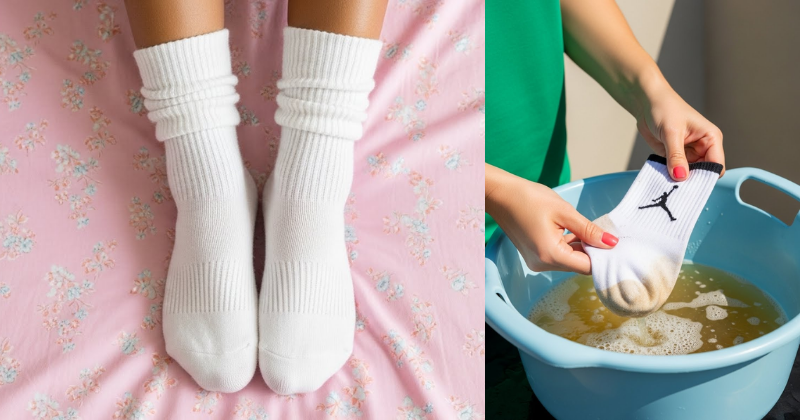
Do you despair every time your favorite white socks emerge from the laundry looking dull, dingy, or just plain grey? It’s a common frustration, but you don’t have to surrender to the yellowing fate! This Home Tips & DIY guide unlocks the most effective Home Remedies for Keeping White Socks Clean, providing achievable, step-by-step guidance that uses simple, affordable household products. You’ll learn how to transform those tired fibers back to brilliant white, proving you have the capability to succeed in achieving crisp, clean laundry without relying on harsh chemicals. Get ready to discover the secrets to lasting whiteness!
🔬 Section 1: Foundation First: Understanding Whiteness Loss
Before tackling the issue with Home Remedies for Keeping White Socks Clean, it’s crucial to understand why white fabrics lose their luster. It’s often not just dirt, but a combination of factors that cause that undesirable dinginess.
H3: Building Confidence with Basic Concepts: The Enemies of White
White fabric loses its brilliance primarily due to three factors that beginners often overlook. Building confidence with basic concepts starts here:
- Soil and Dirt Redeposition: During the wash cycle, dirt and oils lifted from clothes are suspended in the water. If there isn’t enough detergent or the water is too dirty, these particles settle back onto the fibers, dulling the whiteness.
- Hard Water Minerals: Minerals like calcium and magnesium, present in hard water, react with detergent, creating soap scum that adheres to the fabric. This residue attracts dirt and creates a yellowish or grayish film over time.
- Incomplete Rinsing: Laundry detergent residue left in the fibers also attracts dirt and can cause stiffness and discoloration.
H3: Addressing Common Concerns: Why Bleach Isn’t Always the Answer
Many people jump straight to chlorine bleach, but this can actually be counterproductive for keeping white socks clean in the long run.
- Fabric Damage: Chlorine bleach is powerful, but it degrades the cotton and elastic fibers in socks over time, leading to premature thinning and holes.
- Yellowing: When used on synthetics (like nylon or spandex often found in sports socks) or when mixed with hard water, chlorine bleach can actually cause an oxidation reaction that results in a permanent yellow tint. Encouraging reassurance for beginners: There are gentler, more effective alternatives!
🍋 Section 2: Step-by-Step Process: Core Brightening Methods
These Home Remedies for Keeping White Socks Clean are your go-to defense against dullness, focusing on pre-treating and deep soaking to lift entrenched grime.
Step 1: The Power of Pre-Soaking (Actionable Language)
For extremely soiled or dingy white socks, a proper pre-soak is the most important step in the entire process.
- The Lemon & Hot Water Soak: Fill a bucket or basin with very hot water. Add $1/2 \text{ cup}$ of fresh lemon juice and $1/2 \text{ cup}$ of salt. Lemon juice acts as a natural bleach due to its citric acid content, and the salt helps lift grime.
- Soak Time: Submerge your socks completely. Let them soak for a minimum of $2 \text{ hours}$, or ideally, overnight. The extended soaking time allows the acid to break down the embedded dirt and mineral buildup.
- The Vinegar Rinse: After soaking, wring out the socks and put them directly into the washing machine. Add $1/2 \text{ cup}$ of white vinegar (a natural fabric softener and descaler) to the rinse cycle to neutralize odors and mineral deposits.
Step 2: The Baking Soda & Hydrogen Peroxide Booster
This is a fantastic, non-chlorine alternative for boosting your regular wash cycle.
- Tool Requirements: You’ll need $1/2 \text{ cup}$ of Baking Soda (Sodium Bicarbonate) and $1/4 \text{ cup}$ of standard $3\%$ Hydrogen Peroxide.
- Core Methods: Add the baking soda and the hydrogen peroxide directly into the drum with your white socks before starting the cycle. The peroxide is a gentle oxygen bleach, and the baking soda boosts the performance of your regular detergent by balancing the water pH.
- Washing Temperature: Always use the hottest water setting recommended for your socks’ fabric type (usually warm or hot). Heat is essential for dissolving and mobilizing oils and grime.
Step 3: Timing and Planning Considerations
Practical tips and shortcuts dictate that you should treat stains immediately and wash white socks frequently.
- Wash Separately: Never wash white socks with any colored laundry. Even light colors can bleed micro-dyes that accumulate over time, leading to gradual graying.
- Immediate Treatment: Don’t let soiled socks sit in the hamper for days. The longer dirt, mud, or sweat residues sit, the harder they bond with the fibers. Pre-treat any major stains before putting them in the hamper.
☀️ Section 3: Advanced Strategies: Sun Power and Kitchen Remedies
These expert-level insights offer creative solutions for tough stains and leverage the power of natural elements for ultimate brightening.
H3: Sharing Expert-Level Insights: Harnessing Solar Bleaching
Sunlight is nature’s most effective and gentle whitener—a method used for centuries.
- Creative Solutions: After washing, line dry your white socks outside in direct sunlight. Ultraviolet (UV) radiation breaks down the chemical bonds of stains and dinginess without damaging the fabric fibers like chemical bleach. This is a brilliant, free, and non-toxic way to keep them crisp.
- The Science: This process is called photobleaching. Even on a cold, sunny day, the UV rays work their magic, offering a customization approach to whiten that uses zero chemicals.
H3: Pro Tips for Customizing Your Approach
You can use common household items as powerful spot treatments and boosters.
- Aspirin Soak: Dissolve $4 \text{ to } 5$ uncoated white aspirin tablets in a gallon of hot water. Soak your socks for several hours. The salicylic acid in aspirin is excellent for breaking down organic and perspiration stains that cause yellowing.
- Borax Boost: Add $1/2 \text{ cup}$ of Borax along with your detergent in the wash cycle. Borax is a natural mineral compound that softens hard water and boosts cleaning power, aiding in the complete removal of soil.
🛠️ Section 4: Troubleshooting: Dealing with Set-In Stains and Yellowing
Even with the best maintenance, some common issues can persist. Don’t be discouraged! These solutions offer alternative approaches for the toughest challenges.
Featured Snippet Potential: “What is the best home remedy for yellowed white socks?”
The best home remedy for seriously yellowed white socks is a deep overnight soak using a combination of powdered dishwasher detergent (containing oxygen bleach and strong enzymes) and hot water. Use $1 \text{ tablespoon}$ of detergent per gallon of water. This strong enzyme bath breaks down the protein and grease stains that cause persistent yellowing. After soaking, wash the socks immediately on the hottest setting allowed by the fabric.
Practical Troubleshooting Tips
- Problem: Tough Mud or Grass Stains.
- Obstacle: These stains contain chlorophyll and protein, requiring enzymatic action.
- Solution: Alternative Approaches: Pre-treat the stained area directly with a paste made from laundry detergent and water, scrubbing gently with an old toothbrush. Then, soak them in the aspirin solution (as described above) before washing.
- Problem: Persistent Yellowing/Graying (Bleach Residue).
- Obstacle: Mineral buildup and prior use of chlorine bleach have permanently discolored the fabric.
- Solution: Perform a stripping cycle. Wash the socks on the hottest setting with only a cup of Borax and a few squirts of dish soap. Follow this with a wash using only white vinegar to neutralize all residues. This provides encouragement for setbacks by offering a complete reset.
- Problem: Socks feel stiff and still smell faintly sour.
- Obstacle: Detergent and mineral residue build-up is trapping odors.
- Solution: Run a hot wash cycle with no detergent—only $1 \text{ cup}$ of white vinegar added to the drum. Vinegar is acidic and effectively dissolves alkaline soap residue and minerals, acting as a natural preventive measure against residue build-up.
🚀 Section 5: Maximizing Results: Next Level Clean Sock Habits
True success in keeping white socks clean is achieved through proactive habits and maintenance and long-term considerations that build upon your new cleaning knowledge.
- Show How to Build Upon Basic Success: Microfiber Cloth Soak. For a brilliant whitening boost, drop a clean, white microfiber towel into the wash with your socks. Microfiber is highly effective at trapping stray dirt particles in the water, preventing them from redepositing onto your socks.
- Suggest Complementary Strategies: Deep Clean Your Washer. If your socks are coming out dingy, the problem might be your washing machine! Run a hot, empty cycle using commercial washer cleaner or $2 \text{ cups}$ of white vinegar. A clean machine ensures clean water, which is fundamental to successful whitening. (Internal Linking Opportunity: Check out our guide on “The Ultimate Guide to Cleaning Your Front-Load Washing Machine.”)
- Storage Strategy: Store white socks separately from colored or patterned socks, even in the drawer. While less common, dyes can sometimes transfer in humid conditions over time. This minor step helps inspire continued growth and learning in laundry best practices.
✅ Conclusion: Your Capability to Achieve Lasting Whiteness
You have successfully unlocked the most effective Home Remedies for Keeping White Socks Clean. By shifting your focus from harsh bleaches to gentle, powerful soaks using lemon, vinegar, and baking soda, you are embracing cost-saving benefits and achieving superior results. Remember, the journey to brilliant white socks is won in the pre-treatment and the soak, not just the wash cycle. You have the capability to achieve that crisp, like-new whiteness every time!
Ready to start soaking? Which of these natural boosters will you try on your next load of white laundry?