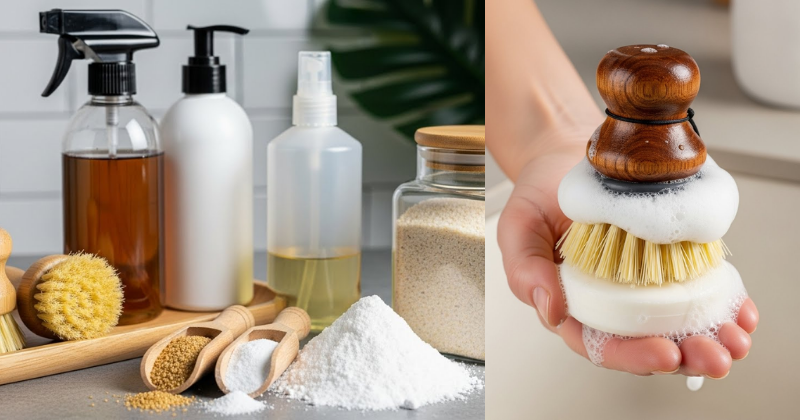
Tired of harsh chemicals, expensive brand-name detergents, and that frustrating cloudy residue on your glassware? If you’re seeking a powerful yet gentle alternative for your sink, learning how to make Homemade NATURAL DISH SOAP is an achievable Home Tips & DIY project that will transform your cleaning routine. This recipe not only tackles the toughest messes—from greasy oven trays to dried-on oatmeal—but also rinses clean, leaving no cloudy residue. Get ready to discover the simple, cost-saving benefits of crafting your own cleaning supplies, embrace sustainable lifestyle changes, and enjoy the satisfaction of completion that comes with crystal-clear dishes and a chemical-free home.

🫧 Section 1: Foundation First: The Problem with Commercial Soap
Before diving into the recipe for Homemade NATURAL DISH SOAP, it’s helpful to build confidence with basic concepts about what causes cloudy dishes and how natural ingredients counteract these issues.
H3: Building Confidence with Basic Concepts: Why Cloudy Residue Happens
That cloudy, white film on your glassware is usually not soap itself, but a combination of two things:
- Hard Water Minerals: High concentrations of calcium and magnesium in tap water react with commercial surfactants (cleaning agents) and leave behind scale, or limescale.
- Excess Additives: Many commercial dish soaps contain synthetic thickeners, dyes, and excessive foaming agents that contribute to a sticky film, especially if not rinsed meticulously.
Our Homemade NATURAL DISH SOAP recipe bypasses these issues by using ingredients that are naturally chelating (binding to minerals) and biodegradable, ensuring a clean rinse.
H3: Addressing Common Concerns: Safety and Ingredients
The ingredients used in this Home Tips & DIY recipe are non-toxic, making it a great choice for sustainable lifestyle changes.
| Ingredient | Role | Safety Consideration |
| Castile Soap | Main surfactant (cleaner) | Use unscented for sensitive skin. |
| Washing Soda | Booster (cuts grease) | Safety Tip: Handle with gloves if skin is sensitive; store away from children. |
| Essential Oils | Natural scent and antibacterial boost | Ensure they are pure grade; avoid ingesting. |
- Encouraging Reassurance for Beginners: This recipe does not use Lye. We are using pre-made Castile soap, making this a safe, easy DIY project.
🍋 Section 2: Core Methods: The Homemade NATURAL DISH SOAP Recipe
Follow this step-by-step guidance to create your concentrated, powerful dish soap solution designed to tackle the toughest messes without any cloudy residue.
Tools and Ingredients
| Tool Requirement | Quantity | Ingredient | Notes |
| Large Bowl or Bucket | 1 cup | Liquid Unscented Castile Soap | The base cleaner. |
| Whisk or Immersion Blender | 1/4 cup | Super Washing Soda (Sodium Carbonate) | Crucial for cutting grease and eliminating cloudy residue. |
| Storage Container (Pump Bottle) | 1/4 cup | Hot Distilled Water | Avoids introducing hard water minerals. |
| — | 1 tbsp | Vegetable Glycerin | Optional, but improves consistency and moisturizes hands. |
| — | 20-30 drops | Lemon, Orange, or Tea Tree Essential Oil | For scent and natural antimicrobial properties. |
Step-by-Step Process (Core Methods)
- Dissolve the Soda (Actionable Language): In your large bowl or bucket, slowly whisk the Washing Soda into the hot distilled water until it is completely dissolved. If the water isn’t hot enough, the soda may clump at the bottom, which will lead to residue later!
- Combine the Base: Gently pour the Castile Soap into the soda mixture. Practical Tip: Pour slowly to minimize foaming. Whisk gently, just enough to combine everything.
- Add Glycerin and Oils: Stir in the Vegetable Glycerin and the essential oils. The Glycerin helps thicken the mixture slightly and stabilizes the oils.
- Cool and Store (Timing and Planning Considerations): Allow the mixture to cool completely. The finished Homemade NATURAL DISH SOAP will thicken slightly as it cools. Pour it into your final storage container.
Practical Tips and Shortcuts
- For Pump Bottles: If your soap is too thick for your pump, simply thin it out with a little more warm distilled water until you achieve the desired consistency.
- Safety Precaution: Never mix this dish soap recipe with bleach, as the combination of ingredients could be hazardous.
✨ Section 3: Advanced Strategies: Maximize Cleaning Power
The real advantage of this Homemade NATURAL DISH SOAP is its customizable power. These expert-level insights show you how to customize the approach for the absolute toughest messes.
H3: Creative Solutions: Eliminating Cloudy Residue from Hard Water
The key to preventing the cloudy residue caused by hard water is to add a chelating agent to the rinse cycle.
- The Rinse Aid Secret: Keep a separate spray bottle filled with pure distilled white vinegar next to your sink. After washing your dishes with the Natural Dish Soap, give them a quick spritz with the vinegar solution before the final rinse.
- Creative Solution: The vinegar’s acetic acid neutralizes the mineral content left by the water and the soap, ensuring a completely streak-free, crystal-clear shine. It’s a simple, DIY secret that instantly solves the hard water problem. Don’t worry, the vinegar smell dissipates completely upon drying!
H3: Ways to Customize Approach: Tackling Tough Grease and Stains
When your soap needs extra boosting power for things like baked-on grease or sticky barbecue residue, you can easily adapt the recipe.
- The Grease Cutter: When making the recipe, consider adding $1 \text{ tbsp}$ of rubbing alcohol (isopropyl) or plain vodka to the mixture. Alcohol helps the soap emulsify fats and oils, making it significantly more effective against grease.
- Customizing the Scent: While lemon oil is popular, you can swap it for $15 \text{ drops}$ of Rosemary and $15 \text{ drops}$ of Peppermint essential oils. Both have excellent scientific backing as antimicrobial agents, making your Homemade NATURAL DISH SOAP not just clean, but ultra-sanitizing. This allows you to customize approach based on preference and specific cleaning needs.
🛑 Section 4: Troubleshooting and Common Challenges
Making Homemade NATURAL DISH SOAP is simple, but slight variations in ingredients can cause common issues. Here is the practical troubleshooting tips to fix them.
Featured Snippet Potential: “Why is my homemade dish soap separating or clumping after I mix it?”
Your homemade dish soap is separating because the Washing Soda and the Castile Soap have different densities and need a natural emulsifier to stay fully combined. To fix separation, simply give the bottle a good shake before each use (this is a common feature of natural soaps). If clumping occurs, it usually means the Washing Soda did not fully dissolve in the hot water initially. To fix clumping, pour the soap back into the mixing bowl, add $1/4 \text{ cup}$ more hot distilled water, and use an immersion blender or electric mixer for 30 seconds to fully integrate the ingredients.
Practical Troubleshooting Tips (Home Tips & DIY Focus)
- Problem: The soap is not foaming much, even though it cleans.
- Obstacle: Natural soaps, especially those without synthetic surfactants, create less foam. This is not a cleanliness issue.
- Solution: Encouragement for Setbacks: Reassure yourself that foam does not equal clean! If you miss the bubbles, add an extra $1 \text{ tbsp}$ of Castile soap to your recipe, which will provide a bit more lather. This alternative approach caters to the psychological need for bubbles.
- Problem: The soap leaves a slightly greasy feeling on hands.
- Obstacle: Too much vegetable glycerin was used in the recipe, or the Castile soap itself has added oils.
- Solution: Reduce the glycerin to $1/2 \text{ tbsp}$ in your next batch. For the current batch, use the preventive measure of adding a few shakes of pure baking soda directly to your sponge when washing, as the soda cuts through lingering oiliness.
- Problem: My stainless steel sinks look dull after using the soap.
- Obstacle: The dullness is likely from mineral deposits left by hard water reacting with the soap/soda.
- Solution: Use the Vinegar Spray Rinse method from Section 3 on your sink after you finish doing the dishes. This will polish the stainless steel and keep it streak-free, allowing you to achieve a sparkling sink finish.
📈 Section 5: Maximizing Results: Next Level Natural Cleaning
You’ve mastered how to make Homemade NATURAL DISH SOAP. Now, let’s explore maintenance and long-term considerations that help you maintain a fully sustainable lifestyle change.
- Show How to Build Upon Basic Success: Create a Solid Dish Soap Bar. By melting down grated Castile soap and adding more Washing Soda and a small amount of liquid, you can pour the mixture into a mold to create a dense, highly concentrated cleaning bar perfect for scrubbing pots and pans. This allows you to eliminate plastic bottles entirely. (Internal Linking Opportunity: Check out our guide on “Zero-Waste Solid Cleaning Bars.”)
- Maintenance and Long-Term Considerations: Purchase your ingredients in bulk. Buying Castile soap by the gallon, and washing soda and essential oils in larger quantities, drastically increases the cost-saving benefits of this DIY practice, making your switch to natural cleaning economically viable long-term.
- Suggest Complementary Strategies: Use the leftover essential oils to make an all-purpose counter spray. Mix $1 \text{ cup}$ white vinegar, $1 \text{ cup}$ water, and $10 \text{ drops}$ essential oils. This provides a uniform, achievable cleaning aesthetic and smell across your entire kitchen.
✅ Conclusion: Your Capability to Master Natural Cleaning
You have now unlocked the simple, powerful formula for Homemade NATURAL DISH SOAP. By following this step-by-step guidance, you can effectively clean the toughest messes while ensuring your dishes are left with no cloudy residue. This practice is not just about cleaning; it’s about making mindful, sustainable lifestyle changes that protect your health and your budget.
Embrace the clarity and cleanliness you have achieved. Your capability to succeed in maintaining a natural home environment is truly empowering!
Will you try the Lemon and Tea Tree oil blend in your first batch, or are you ready to tackle that sink full of greasy pots and pans with your new natural formula?