
Meta description (155–160 characters):
Scientists have captured a verified photograph of another solar system across space. Learn how the image was obtained, what it reveals, and why it matters.
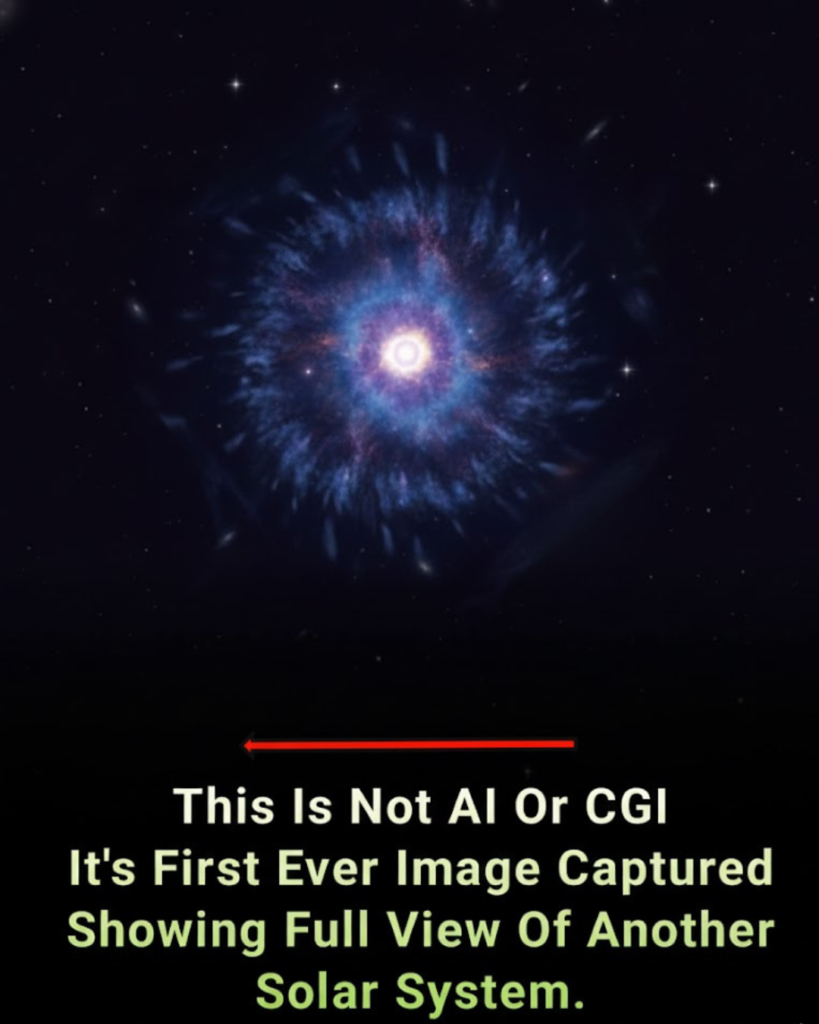
Humanity has dreamed of glimpsing worlds beyond our own for centuries. Until recently, our understanding of distant planetary systems relied on indirect clues—stellar wobble, dimming light curves, and gravitational perturbations. Today, however, astronomy has crossed a remarkable threshold. For the first time in history, scientists have captured direct images of another solar system across the vacuum of space. This achievement signals a profound shift not only in observational astronomy but in our understanding of planetary formation and the cosmic environment surrounding distant stars.
Direct imaging of extrasolar systems remains extremely rare and technically challenging. Yet the development of adaptive optics, coronagraph technology, and advanced spectral processing now allows astronomers to separate the faint light of exoplanets from the overwhelming glare of their host stars. The result is stunning: real visual evidence of planets orbiting suns far beyond our neighborhood. This article provides a comprehensive explanation of how such a photograph is possible, what scientific insights it reveals, and why this milestone expands the horizon of exploration for future generations.
What Does It Mean to Capture a Real Photograph of Another Solar System?
The concept of photographing an entire solar system across interstellar distances stretches imagination. For context, the closest star system, Alpha Centauri, lies more than four light-years away—about 25 trillion miles. Light leaving that system today would reach us years later.
A real photograph in this context means direct visual imaging of a star and its orbiting bodies as distinct sources of light. Unlike indirect detection methods, which infer exoplanets by analyzing stellar brightness or motion, direct imaging allows scientists to see the planet as a separate object on screen.
This feat requires separating extremely faint planetary light from the bright noise of the parent star. Stars shine billions of times more brightly than their planets, making the illumination contrast staggering. Successfully isolating planetary light proves that those distant worlds physically exist and occupy defined orbital positions.
How Do Astronomers Obtain These Photographs Across Interstellar Space?
Capturing a photograph of another solar system demands cutting-edge optical and computational tools. Astronomers employ several techniques to remove interfering light and resolve extremely distant objects.
Coronagraphy and starlight suppression
A coronagraph blocks the star’s direct light within the telescope, similar to how a hand blocks sunlight to help us see distant objects. By masking the stellar glare, faint planetary light becomes visible in telescope exposures.
Adaptive optics
Earth’s atmosphere distorts incoming light waves. Adaptive optics compensate for these distortions in real time, adjusting mirror shape hundreds of times per second to sharpen images.
Long exposure stacking
Multiple exposures are combined and filtered with advanced algorithms to reveal faint objects orbiting their stars. The stacking technique reduces noise while strengthening the true signal.
Infrared imaging
Planets reflect little starlight, but they emit heat. By observing in infrared wavelengths, astronomers can detect thermal signatures of gas giants orbiting distant suns.
Using these methods, researchers can produce images showing multiple planets in motion around a star—revealing actual orbital patterns over time.
Which Confirmed Images of Other Solar Systems Exist Today?
A small number of extrasolar systems have been directly imaged with sufficiently high resolution to reveal planets as visible points. Notable examples include:
HR 8799 System
One of the first multi-planet extrasolar systems imaged directly, showing four massive gas giants. The sequence of images across several years reveals orbital motion.
Beta Pictoris
This system includes a gas giant planet and a warped debris disk. It provides insight into early-stage planetary formation.
PDS 70
A young system where scientists observed a protoplanet growing within a circumstellar disk. This breakthrough gave visual confirmation of active planet formation.
These images demonstrate that planetary systems form and evolve beyond our solar system following similar—but not identical—patterns. Direct evidence now exists in astronomical archives, public databases, and scientific journals.
Why Is This Scientific Milestone Important?
Documenting a real photograph of another solar system holds immense scientific implications. It advances planetary science, cosmology, and future exploration missions.
Improved understanding of planetary origins
Seeing orbital patterns directly helps researchers test predictions in computer simulations of solar system formation, including accretion behavior and disk evolution.
Identifying habitable environments
Photographs allow astronomers to characterize planet sizes, distances from parent stars, atmospheric composition, and thermal signatures. These observations help narrow the search for water-rich and potentially habitable worlds.
Public engagement and scientific inspiration
Visual confirmation has unmatched emotional and educational impact. A direct image captures imagination in a way numerical data alone cannot.
How Do Scientists Analyze These Photographs After Capture?
Once an image is recorded, researchers extract measurable data to interpret planetary characteristics.
Photometric analysis
Brightness measurements help determine size, mass, reflectivity, and atmospheric composition.
Spectroscopy
Separating wavelengths reveals chemical fingerprints. Spectral data may show methane, carbon monoxide, or water vapor in exoplanet atmospheres.
Orbital calculations
By comparing images over time, astronomers track motion and derive orbital periods, eccentricity, and inclinations.
Debris disk evaluation
In young systems, dust structures indicate gravitational interactions and planet development over millions of years.
What Challenges Still Limit Direct Imaging of Solar Systems?
Despite new successes, multiple barriers constrain image resolution and scale.
Brightness contrast
For Earth-sized planets, contrast ratios may reach one part in ten billion relative to their parent stars.
Distance constraints
Current instruments succeed mainly with nearby systems, often within 150 light-years of Earth.
Atmospheric interference
Even with adaptive optics, Earth’s atmosphere imposes wavefront distortions. Space-based telescopes alleviate—but do not eliminate—these challenges.
New mission concepts aim to overcome these limits, including starshade spacecraft and ultra-large segmented telescopes designed for fine optical suppression.
Which Future Technologies Could Transform Exoplanet Photography?
Several emerging techniques promise major advances in imaging solar systems directly.
Space-based coronagraphs
NASA’s Roman Space Telescope will include advanced starlight suppression technology enabling finer resolution.
Interferometry
Multiple telescopes linked together create synthetic apertures capable of resolving extremely small angular separations.
Hybrid computational optics
Machine learning approaches can predict interference patterns and remove noise from images before analysis.
Gigantic primary mirrors
Proposed observatories like LUVOIR could capture visible-light images of Earth-sized exoplanets.
These innovations suggest that photographs of rocky, potentially habitable planets may soon move from theory to reality.
Conclusion
The statement that “it is a real photograph of another solar system captured across the vacuum of space” represents a profound scientific achievement. Direct imaging of other planetary systems provides unambiguous visual confirmation of exoplanets and deepens our knowledge of how solar systems form, evolve, and coexist across the galaxy.
Through coronagraphic masking, adaptive optics, spectroscopy, and long-exposure stacking, astronomers are overcoming barriers imposed by distance, brightness contrast, and atmospheric distortion. The resulting imagery is both scientifically invaluable and deeply inspiring, revealing worlds orbiting suns many trillions of miles away.
As technology advances, what was once impossible will soon become ordinary. In the coming decades, humanity may witness photographs not only of distant gas giants but of Earth-like planets with oceans, continents, and atmospheres. Each image brings us closer to answering profound questions about origins, habitability, and whether life exists beyond Earth.