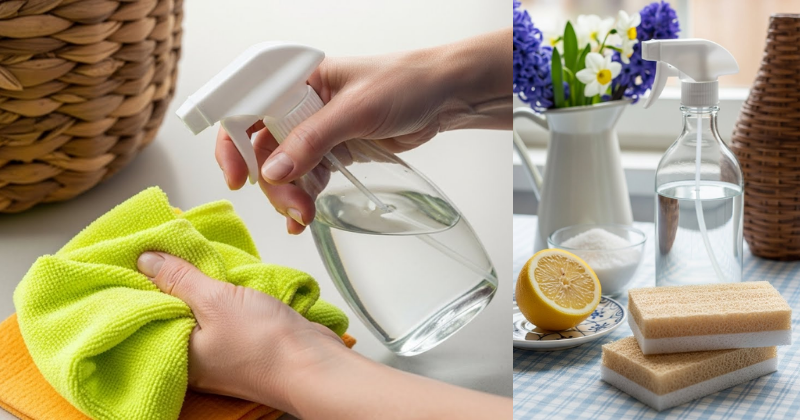
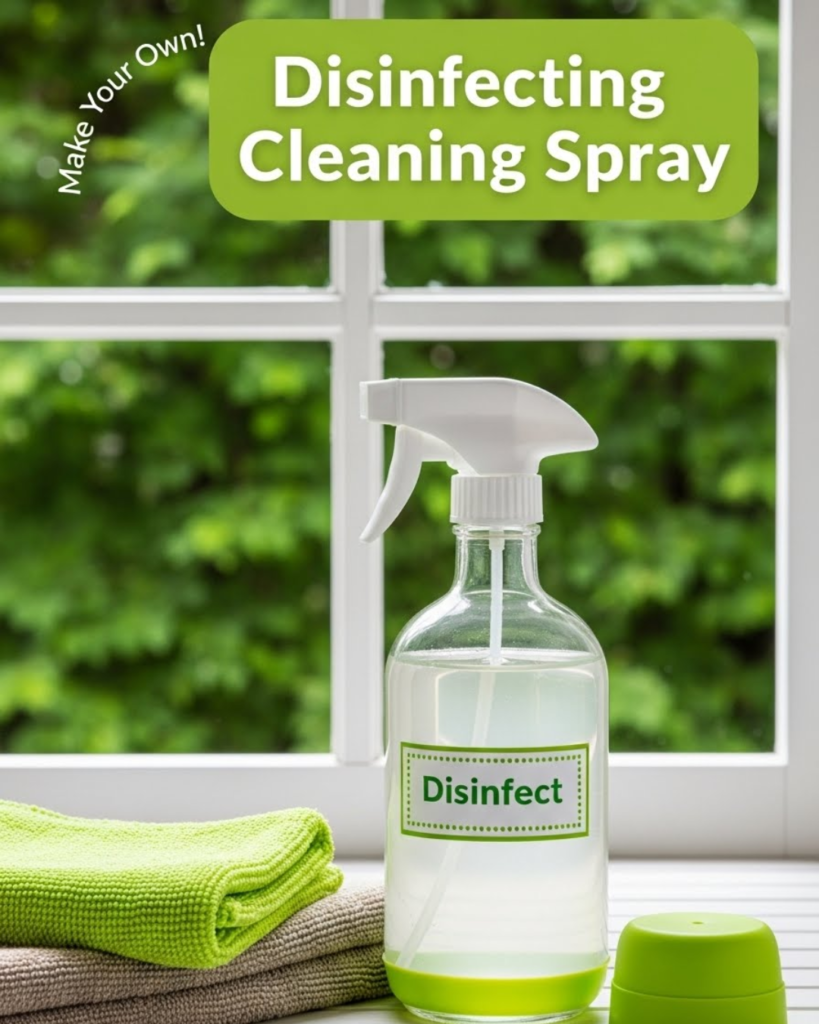
Are you looking for a powerful cleaner that tackles grime and germs without the harsh chemicals found in store-bought products? It’s time to take control of your home environment! Learning to Make Your Own Disinfecting Cleaning Spray is a foundational Home Tips & DIY project that is incredibly rewarding, offering immense cost-saving benefits while supporting important wellness topics. We promise this guide will transform the way you view household chores, giving you a simple, effective, and customizable formula you can feel great about using around your family. Get ready to discover how easy it is to achieve a sparkling clean, disinfected home using common, readily available ingredients.
🛑 Important Disclaimer
Important Disclaimer: This article is for informational purposes only and should not replace professional advice. For health-related topics, consult healthcare providers. For financial or legal matters, seek qualified professional guidance. For safety procedures, verify current best practices and local regulations. Individual results may vary, and personal circumstances should always be considered when implementing any suggestions.
🧪 Section 1: Foundation First: Understanding Disinfection vs. Cleaning
Before you Make Your Own Disinfecting Cleaning Spray, it’s crucial to build confidence with basic concepts by understanding the difference between cleaning, sanitizing, and disinfecting. Many DIY recipes only clean; true disinfection requires specific concentrations of germ-killing agents.
H3: Building Confidence with Basic Concepts: The Disinfection Requirement
The primary ingredient we will use for actual disinfection is isopropyl alcohol. Vinegar and most essential oils are excellent cleaners and sanitizers (reducing germs), but they rarely meet the concentration required to disinfect (killing specific bacteria and viruses).
- The Science of Disinfection: To effectively disinfect surfaces, you need an alcohol concentration of at least $70\%$ ethanol or isopropyl alcohol. Our recipe focuses on maintaining this crucial $70\%$ concentration in the final spray bottle volume.
- Encouraging Reassurance for Beginners: You don’t need a lab, but you do need an accurate ratio. Our formula simplifies the math, ensuring your DIY spray is both cleaning-strong and microbe-destroying.
H3: Addressing Common Concerns: Why Avoid Mixing Ingredients
The biggest safety consideration when starting a cleaning DIY project is never mixing certain chemicals. While our recipe uses mild ingredients, it’s vital to know the risks.
- Never Mix: Do not mix bleach (sodium hypochlorite) with vinegar (acetic acid) or ammonia, as this creates highly toxic chlorine or chloramine gas, respectively.
- Vinegar vs. Alcohol: While vinegar is a fantastic cleaning agent, it should generally not be used in the same spray bottle as the alcohol, as it slightly dilutes the alcohol and can reduce the disinfection power. We will focus on a separate vinegar-based all-purpose cleaner (see Section 3) versus the alcohol disinfecting spray.
🍶 Section 2: Step-by-Step Process: Core Methods for the Disinfecting Formula
This section provides the clear, actionable language for creating the $70\%$ alcohol-based formula, ensuring your spray meets the standards required to Make Your Own Disinfecting Cleaning Spray.
Ingredients and Tool Requirements
| Ingredient | Quantity for 16 oz Spray Bottle | Purpose | Tool Requirement |
| Isopropyl Alcohol ($91\%$ concentration) | $11.5 \text{ fluid ounces}$ | Disinfectant agent (ensures final $70\%$ minimum) | Sterilized Spray Bottle (16 oz) |
| Distilled Water | $4.5 \text{ fluid ounces}$ | Diluent and carrier liquid | Measuring Cup/Jigger |
| Optional: Essential Oils (Lemon, Tea Tree) | $10 \text{-} 15 \text{ drops}$ | Aromatic and mild sanitizing boost | Funnel |
| Optional: Small amount of dish soap | $1/2 \text{ teaspoon}$ | Mild surfactant for cutting grease |
Note on Alcohol Concentration (H4): If you use $70\%$ Isopropyl Alcohol, you should not add any water; use $16 \text{ oz}$ of $70\%$ alcohol and the optional additions. Using $91\%$ alcohol allows for the correct dilution to hit the ideal $70\%$ efficacy, providing a greater cost-saving benefit.
Step-by-Step Guidance (Core Methods)
- Preparation (Safety Considerations): Work in a well-ventilated area. Use a funnel to pour the liquids to avoid spills. Ensure your spray bottle is clean and dry.
- Combine Alcohol and Water (Actionable Language): Pour the $11.5 \text{ ounces}$ of $91\%$ Isopropyl Alcohol into the spray bottle. Next, add the $4.5 \text{ ounces}$ of distilled water. This crucial ratio ($\approx 72\%$ alcohol final concentration) is the secret to meeting the $70\%$ minimum for disinfection.
- Add Cleansing Agents: Add the $1/2 \text{ teaspoon}$ of liquid dish soap. This mild surfactant helps the spray penetrate oil and grime on surfaces.
- Scent and Boost: Add $10 \text{-} 15 \text{ drops}$ of essential oils. Tea Tree and Lemon are excellent choices due to their natural anti-microbial properties and fresh scent.
- Seal and Shake: Secure the spray top tightly. Gently swirl or shake the bottle to mix the ingredients. Do not shake vigorously, as this creates excessive soap suds. Your spray is ready!
- Application (Timing and Planning Considerations): Spray the surface generously. To truly disinfect, the spray must remain wet on the surface for a specific “dwell time”—usually $5 \text{-} 10 \text{ minutes}$. Allow it to air dry, or wipe clean after the dwell time has passed.
🍋 Section 3: Advanced Strategies: Customizing and Utilizing the Spray
Once you master the basic formula to Make Your Own Disinfecting Cleaning Spray, you can apply expert-level insights to customize it and pair it with other natural cleaners.
H3: Creative Solutions: Customizing Essential Oil Blends
The $10 \text{-} 15 \text{ drops}$ of essential oils is a powerful way to customize your approach and unlock specific benefits.
| Desired Effect | Essential Oil Blend (Drops) | Key Benefit |
| Kitchen/Grease Cutter | 8 Lemon, 5 Orange, 2 Rosemary | Cuts through oil and leaves a clean, bright scent. |
| Bathroom/Mold Inhibitor | 8 Tea Tree, 7 Eucalyptus | Strong anti-fungal and anti-microbial properties. |
| Calming/General Use | 10 Lavender, 5 Chamomile | Provides a soothing, non-irritating aroma for surfaces. |
H3: Encouraging Experimentation: The Vinegar Multi-Purpose Pairing
To maximize your cleaning power while minimizing cost, pair your Disinfecting Cleaning Spray with a general-purpose vinegar cleaner.
- DIY Vinegar Cleaner: Mix $1 \text{ part}$ white vinegar with $1 \text{ part}$ water. Use this for general cleaning (windows, daily wipe-downs, mopping floors). It shines chrome and dissolves mineral deposits.
- The Method: Encourage experimentation by using the vinegar cleaner for the initial cleaning (removing dirt and grime), rinsing the surface, and then applying the alcohol-based spray for the final disinfection step. This method is highly effective and utilizes the best properties of both solutions.
⚠️ Section 4: Troubleshooting and Common Challenges
Even with a simple recipe, issues can arise regarding surface safety and product stability. Here are practical troubleshooting tips for a successful experience.
Featured Snippet Potential: “Can I use homemade alcohol spray on granite and natural stone countertops?”
No, you should not use homemade alcohol disinfecting sprays on granite, marble, or any natural stone countertops. Alcohol can degrade the sealant on these porous surfaces, leading to etching and discoloration over time. For natural stone, use a mild pH-neutral dish soap and water. The alcohol-based disinfecting spray is safe for synthetic stone, laminates, tile, porcelain, and stainless steel.
Practical Troubleshooting Tips (Home Tips Focus)
- Problem: The spray leaves streaks or a dull film.
- Obstacle: Too much soap or mineral content in the water used (if you didn’t use distilled water).
- Solution: Encouragement for Setbacks: Immediately reduce the liquid soap to $1/4 \text{ teaspoon}$. If streaking persists, switch to $100\%$ distilled water, which eliminates mineral deposits.
- Problem: The spray bottle clogs easily.
- Obstacle: Using citrus oils (like Lemon or Orange) that can degrade cheap plastic spray mechanisms over time.
- Solution: Preventive Measures: Use high-quality spray mechanisms or, ideally, switch to a glass spray bottle, which is resistant to essential oil breakdown and aids in sustainable lifestyle changes.
- Problem: The scent fades quickly.
- Obstacle: Essential oils are volatile and evaporate fast, especially from alcohol.
- Solution: Offer Alternative Approaches: Add a tiny splash ($1 \text{ teaspoon}$ maximum) of high-proof vodka to the mixture; vodka acts as an anchor for the essential oil scent, helping it linger longer.
🧼 Section 5: Maximizing Results: Next Level Cleanliness
Once you are using your DIY spray successfully, focus on next level tips that enhance the cleanliness and hygiene of your home environment.
- Show How to Build Upon Basic Success: Microfiber Excellence. Pair your Disinfecting Cleaning Spray with high-quality microfiber towels. Unlike paper towels or cotton rags, microfiber traps and holds up to $99\%$ of bacteria, ensuring that when you wipe after the dwell time, you are physically removing the killed germs. This enhances the effectiveness of your spray dramatically.
- Maintenance and Long-Term Considerations: Surface-Specific Rotation. Keep your alcohol spray strictly for non-porous surfaces that require true disinfection (kitchen sinks, cutting boards, door handles, light switches). Reserve the vinegar solution for glass and routine surfaces. Labeling your bottles clearly is essential for maintenance and long-term considerations. (Internal Linking Opportunity: Check out “DIY Glass Cleaner Recipes That Eliminate Streaks.”)
- Suggest Complementary Strategies: Humidity Control. Proper cleaning supports wellness topics by managing microbial growth. Use dehumidifiers in high-moisture areas (bathrooms, basements) to keep the relative humidity below $50\%$. This simple step prevents the growth of mold and mildew, reducing the load your cleaning spray has to manage.
✅ Conclusion: Your Capability to Nurture a Clean Home
You have successfully learned how to Make Your Own Disinfecting Cleaning Spray, mastering the critical $70\%$ alcohol concentration and adopting crucial safety and application methods. By taking this simple step, you have demonstrated your capability to succeed in creating powerful, budget-friendly cleaning products, directly contributing to a healthier home environment. You have truly transformed a common household chore into a conscious act of self-care and savvy Home Tips & DIY expertise.
Ready to start mixing your first batch? Will you choose the zesty Lemon and Orange blend for the kitchen or the purifying Tea Tree blend for the bathroom?