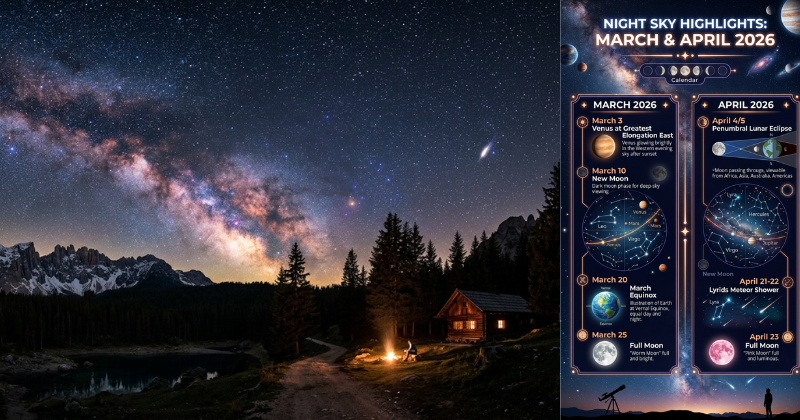
Meta description: Discover the most important astronomical events of March and April 2026, including eclipses, planetary alignments, auroras, and meteor showers visible in the night sky.
The night sky during March and April 2026 offers an impressive sequence of astronomical events ranging from a dramatic total lunar eclipse to planetary conjunctions and increasing visibility of the Milky Way’s galactic core. These months also bring seasonal celestial phenomena such as the spring equinox and meteor showers that draw the attention of both amateur stargazers and professional astronomers.
As Earth continues its orbit around the Sun, the changing orientation of the planet provides new vantage points for observing planets, deep-sky objects, and atmospheric phenomena like the aurora borealis. Advances in observational astronomy and widespread public interest in space exploration have made skywatching more accessible than ever. This guide explores the key night-sky highlights for March and April 2026, examining the scientific mechanisms behind each event and explaining how observers can best experience them.
What Are the Major Astronomical Events of March 2026?
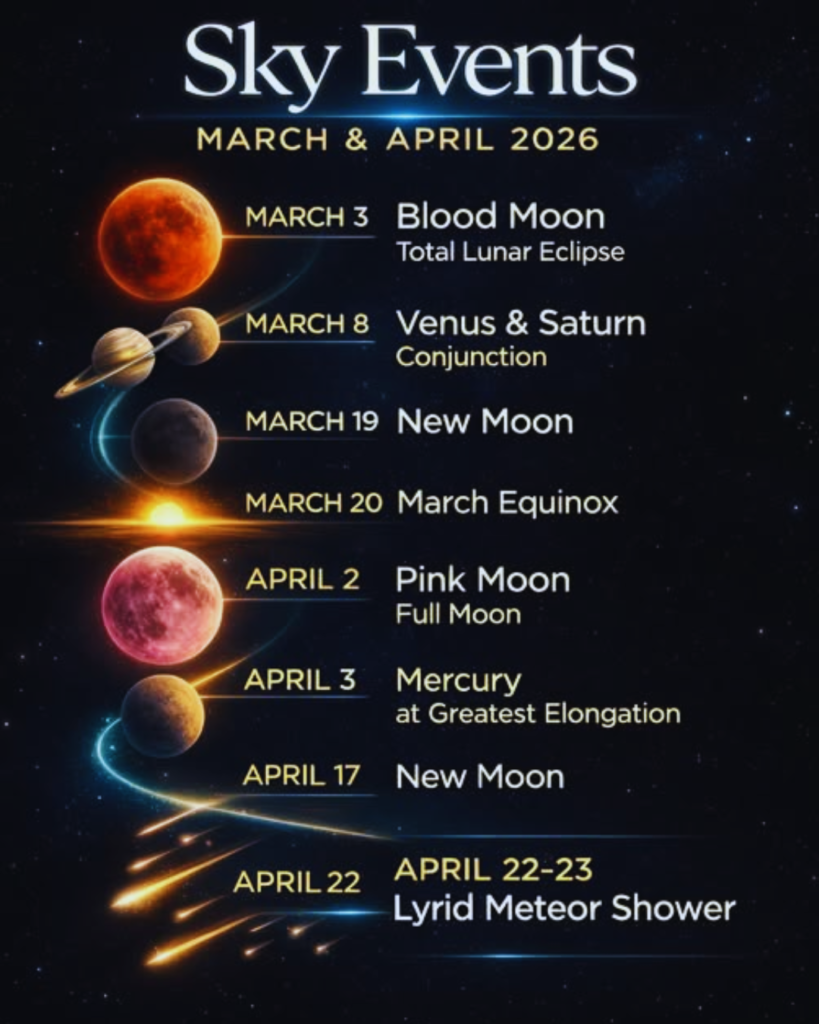
March 2026 begins with one of the most visually striking events in observational astronomy: a total lunar eclipse, often referred to as a “blood moon.” During the eclipse on March 2–3, Earth moves directly between the Sun and the Moon, casting its shadow across the lunar surface. The phenomenon produces a reddish coloration as sunlight passing through Earth’s atmosphere scatters shorter wavelengths and allows red light to reach the Moon.
This eclipse is visible from many regions across the globe, including large parts of North America, South America, Asia, and Australia. Totality—the phase when the Moon is fully within Earth’s umbra—lasts nearly an hour, providing ample time for observation and astrophotography.
In addition to the eclipse, early March features a series of planetary events. One notable alignment involves Venus and Saturn appearing close together in the evening sky, creating a bright conjunction observable shortly after sunset. These close planetary approaches occur when two planets appear near each other along the ecliptic due to their orbital geometry.
How Does a Total Lunar Eclipse Occur?
A total lunar eclipse occurs when three celestial bodies—Sun, Earth, and Moon—align in a straight line, a configuration known as syzygy. The Earth blocks direct sunlight from reaching the Moon, projecting a cone-shaped shadow called the umbra.
However, the Moon does not disappear entirely during totality. Instead, it takes on a deep copper or red hue. This effect is caused by Rayleigh scattering, the same process responsible for red sunsets on Earth. Sunlight traveling through Earth’s atmosphere bends and filters shorter blue wavelengths while allowing red wavelengths to reach the Moon’s surface.
Astronomically, lunar eclipses are significant because they demonstrate orbital mechanics and the geometry of the Earth–Moon system. They also provide opportunities for scientists to analyze Earth’s atmospheric composition by studying how light refracts during the event.
Which Planetary Conjunctions Can Be Seen in Early Spring 2026?
Planetary conjunctions are among the most accessible astronomical phenomena for observers. In March 2026, a prominent example occurs when Venus and Saturn appear very close together in the western sky shortly after sunset.
From Earth’s perspective, the planets appear to share a small region of the sky because their orbits intersect along the ecliptic plane. Despite appearing near each other visually, the planets remain separated by hundreds of millions of kilometers in space.
Conjunctions serve as valuable observational opportunities. With binoculars or small telescopes, viewers can observe the stark differences between the planets: Venus’s brilliant reflective clouds and Saturn’s iconic ring system.
Another noteworthy planetary event involves Jupiter ending its retrograde motion in March 2026, an apparent reversal in direction caused by Earth overtaking the outer planet in its orbit.
How Does the Spring Equinox Influence the Night Sky?
The spring equinox, occurring around March 20 in the Northern Hemisphere, marks the moment when Earth’s axis is not tilted toward or away from the Sun. Day and night are nearly equal in length across the planet.
This seasonal transition also influences astronomical observations in several ways:
- The night sky shifts toward spring constellations such as Leo and Virgo.
- The Milky Way’s galactic core begins to rise earlier before dawn.
- Auroral activity often increases due to geomagnetic conditions linked to Earth’s orientation relative to the solar wind.
The equinox is therefore not only a calendar milestone but also an important marker for seasonal skywatching conditions.
What Is Zodiacal Light and Why Is It Visible in Spring?
During mid-March and early April, observers under dark skies may notice a faint triangular glow extending upward from the horizon after sunset. This phenomenon is known as zodiacal light.
Zodiacal light occurs when sunlight scatters off microscopic dust particles distributed throughout the inner solar system. These particles likely originate from ancient asteroid collisions and comet debris left over from the early formation of the solar system.
Because the dust lies along the ecliptic plane—the same path followed by the Sun and planets—the glow appears aligned with the zodiac constellations. The effect becomes particularly noticeable around the equinox when the ecliptic stands nearly vertical relative to the horizon.
Astronomers study zodiacal light because it provides clues about the distribution of interplanetary dust and the dynamic processes shaping our solar system.
How Does the Milky Way Become More Visible in Early Spring?
As winter transitions into spring, the galactic core of the Milky Way gradually becomes visible in the pre-dawn sky for observers in the Northern Hemisphere.
The galactic center lies in the constellation Sagittarius and represents the densest region of stars, gas, and dust within our galaxy. This region contains a supermassive black hole known as Sagittarius A*.
During March and April, Earth’s nighttime orientation begins to face toward this region of the galaxy just before sunrise. Under dark skies far from urban light pollution, observers can see the Milky Way stretching across the sky as a luminous band.
For astrophotographers, this period marks the beginning of the “Milky Way season,” when the galaxy’s central bulge becomes increasingly prominent throughout the night.
Which Events Will Highlight the April 2026 Night Sky?
April continues the sequence of celestial highlights with both atmospheric and deep-space events.
One of the most anticipated events is the Lyrid meteor shower, which peaks around April 22. Originating from debris left by Comet C/1861 G1 Thatcher, the Lyrids typically produce 15–20 meteors per hour under dark conditions.
Meteor showers occur when Earth passes through streams of cometary debris. As these particles enter Earth’s atmosphere at high velocity, friction with atmospheric gases causes them to vaporize and produce bright streaks of light.
April also hosts International Dark Sky Week, a global initiative encouraging people to reduce light pollution and reconnect with the natural night sky.
This event highlights the growing recognition of light pollution as both an environmental and scientific issue affecting astronomical observation.
How Can Observers Best View These Night Sky Events?
Successful skywatching depends on several practical factors.
Dark skies:
Light pollution significantly reduces visibility of faint objects. Observers should seek locations far from urban lighting.
Timing:
Many astronomical events occur shortly after sunset or before dawn when the sky is darkest.
Weather conditions:
Clear skies and low humidity improve visibility and reduce atmospheric distortion.
Equipment:
While many events are visible to the naked eye, binoculars or small telescopes enhance planetary and deep-sky observations.
Safety considerations:
Observers should never attempt to view objects near the Sun directly without proper solar filters, as intense sunlight can cause permanent eye damage.
Conclusion
The night skies of March and April 2026 present a rich tapestry of astronomical events that illustrate the dynamic nature of the solar system and the broader universe. From the dramatic red glow of a total lunar eclipse to elegant planetary conjunctions and the rising prominence of the Milky Way’s core, these months offer exceptional opportunities for observation and scientific curiosity.
Seasonal phenomena such as the spring equinox and zodiacal light demonstrate how Earth’s motion shapes the appearance of the heavens, while meteor showers and auroral displays remind us of the continuous interaction between Earth and the cosmic environment.
Whether observed through a telescope, captured with astrophotography equipment, or simply appreciated with the naked eye, the celestial events of early 2026 reinforce a timeless truth: the night sky remains one of the most accessible gateways to understanding the universe.