Meta description (155–160 characters):
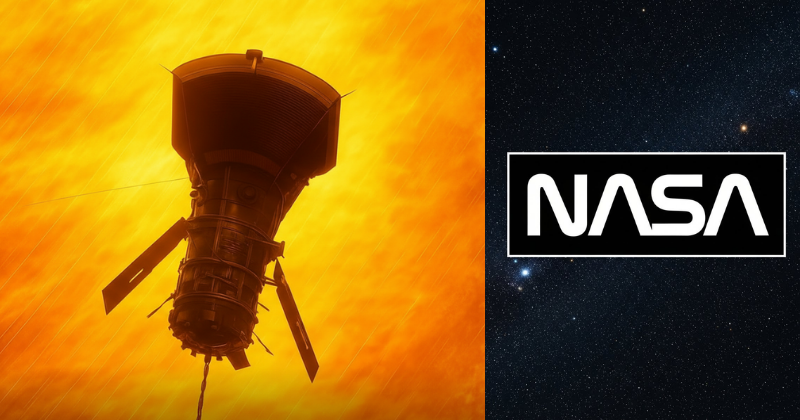
NASA’s Parker Solar Probe is the fastest human-made object ever, reaching 192 km/s as it dives through the Sun’s atmosphere to unlock solar mysteries.
Introduction
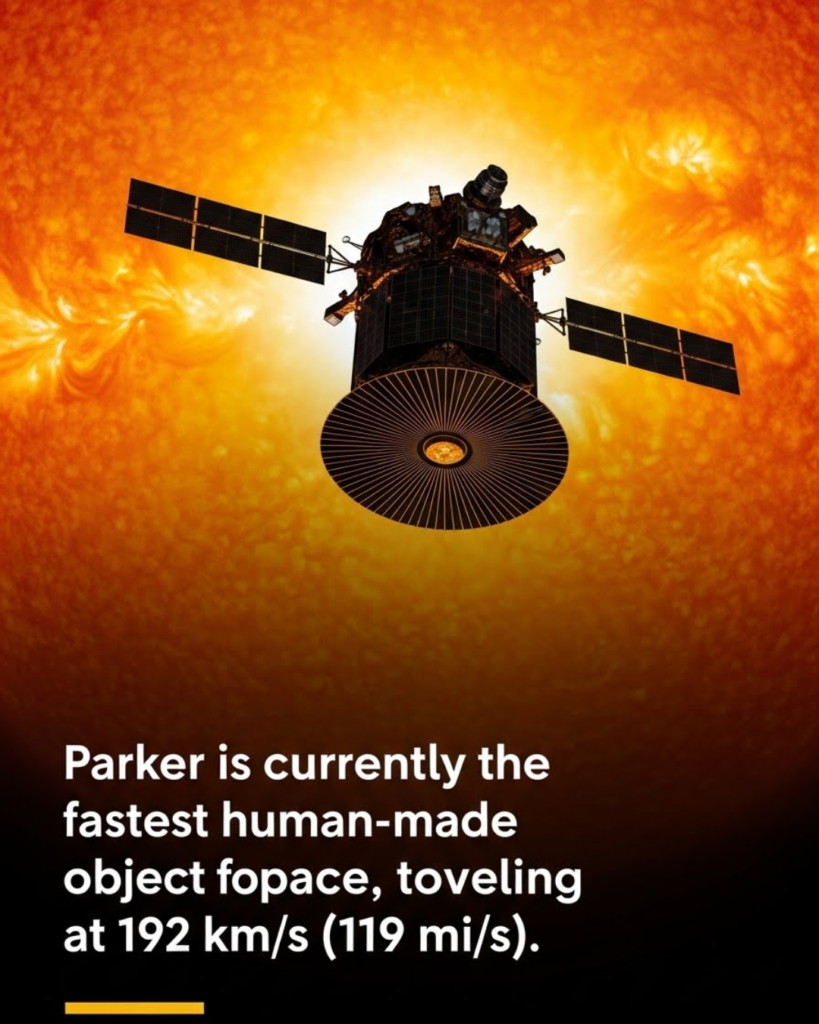
When humanity set out to touch the Sun, speed became a necessity rather than a luxury. Parker is currently the fastest human-made object in space, traveling at 192 km/s (119 mi/s)—a staggering velocity that redefines what engineered objects can achieve beyond Earth. This record-breaking speed is not about racing across the Solar System for spectacle; it is the direct consequence of a bold scientific mission to study the Sun closer than ever before.
Launched by NASA, the Parker Solar Probe uses gravity, precision navigation, and revolutionary materials to plunge through the Sun’s outer atmosphere, gathering data that could reshape our understanding of stars, space weather, and planetary systems. This article provides a comprehensive, evidence-based exploration of how Parker achieved this speed, why it matters scientifically, and what it reveals about the limits of human engineering.
What Is the Parker Solar Probe and Why Was It Built?
The Parker Solar Probe is a robotic spacecraft designed to study the Sun up close, something no previous mission had attempted. Its primary objective is to investigate the solar corona, the Sun’s outer atmosphere, which paradoxically is far hotter than the solar surface itself.
Named after astrophysicist Eugene Parker, who first theorized the solar wind, the mission aims to answer foundational questions:
- Why is the solar corona millions of degrees hotter than the surface?
- How is the solar wind accelerated?
- What mechanisms drive solar storms that affect Earth?
To answer these questions, Parker must travel extremely close to the Sun—closer than Mercury’s orbit—where intense gravity naturally accelerates it to record-breaking speeds.
How Does Parker Reach Speeds of 192 km/s?
Parker’s extraordinary velocity is not the result of massive engines firing continuously. Instead, it relies on orbital mechanics and gravity.
As the spacecraft falls toward the Sun, it converts gravitational potential energy into kinetic energy. Each close approach, known as a perihelion, accelerates Parker further. By repeatedly looping around the Sun, Parker builds speed incrementally.
At its closest passes, Parker reaches 192 km/s, making it the fastest object ever built by humans. This speed is achieved naturally through gravity rather than brute-force propulsion, highlighting the elegance of celestial mechanics.
Which Factors Make Parker the Fastest Human-Made Object?
Several critical factors combine to make Parker unmatched in speed.
Solar Gravity
The Sun contains more than 99.8% of the Solar System’s mass. Its immense gravity well allows objects falling toward it to reach extreme velocities.
Orbital Design
Parker’s trajectory is carefully planned so that each orbit brings it closer to the Sun, increasing its speed with every pass.
Minimal Drag Environment
Space near the Sun has no atmospheric drag, allowing Parker to maintain and increase velocity without resistance.
Together, these factors enable Parker to surpass all previous spacecraft, including Voyager 1 and New Horizons.
How Does Parker Survive Extreme Speeds and Temperatures?
Traveling at 192 km/s near the Sun exposes Parker to temperatures exceeding 1,300°C (2,500°F). Survival depends on advanced engineering.
Thermal Protection System
Parker’s heat shield is a carbon-composite structure approximately 11.4 cm thick. It keeps instruments at near-room temperature even while the Sun-facing side glows white-hot.
Autonomous Orientation
The spacecraft constantly adjusts its orientation to ensure the heat shield remains perfectly aligned with the Sun. A slight misalignment could expose sensitive instruments to catastrophic heat.
Radiation-Hardened Systems
Electronics are specially designed to withstand intense radiation and high-energy particles.
This combination of speed and resilience represents a landmark achievement in spacecraft engineering.
What Scientific Data Does Parker Collect at These Speeds?
Parker’s speed allows it to sample regions of space never before explored.
Solar Wind Measurements
By flying directly through the solar wind’s acceleration zone, Parker measures particle density, velocity, and magnetic fields with unprecedented precision.
Magnetic Field Analysis
The spacecraft studies how magnetic fields twist, reconnect, and release energy—processes central to solar flares and coronal mass ejections.
Plasma and Particle Detection
High-speed instruments capture the behavior of charged particles close to their source, offering insights into plasma physics applicable across astrophysics.
This data provides the clearest picture yet of how our star behaves at its most fundamental level.
How Does Parker Compare to Other Fast Spacecraft?
Before Parker, speed records were held by spacecraft leaving the Solar System.
- Voyager 1 travels at about 17 km/s relative to the Sun.
- New Horizons, after its Jupiter flyby, reached roughly 23 km/s.
By comparison, Parker’s 192 km/s is nearly an order of magnitude faster. The key difference lies in mission design: Voyager and New Horizons aimed to escape the Solar System, while Parker deliberately dives into the Sun’s gravity well.
This distinction underscores how speed in space depends on trajectory as much as propulsion.
Why Does Parker’s Speed Matter for Space Science?
Speed is not just a record—it is a scientific enabler.
At such velocities, Parker can:
- Traverse dynamic solar regions quickly, capturing rapid changes.
- Reduce exposure time to extreme heat while still collecting data.
- Observe plasma interactions in their most energetic states.
These observations improve models of stellar behavior, helping scientists predict space weather events that can disrupt satellites, power grids, and communications on Earth.
What Does Parker’s Achievement Mean for Future Missions?
Parker’s success demonstrates that extreme environments are accessible with the right design philosophy.
Future implications include:
- Missions to other stars using gravity-assisted trajectories
- Improved thermal protection for high-radiation environments
- Better understanding of how to operate spacecraft autonomously under extreme conditions
Parker sets a new benchmark, proving that speed, precision, and resilience can coexist in a single mission.
Conclusion
Parker is currently the fastest human-made object in space, traveling at 192 km/s, a milestone that reflects both scientific ambition and engineering brilliance. This speed is not a gimmick; it is the natural outcome of a mission designed to explore the Sun at distances once thought impossible.
By harnessing solar gravity, advanced materials, and precise orbital mechanics, the Parker Solar Probe has opened a new chapter in space exploration. Its data is reshaping our understanding of the Sun, influencing space weather forecasting, and laying the groundwork for future high-speed missions. In pushing the limits of velocity, Parker has also expanded the limits of human knowledge.