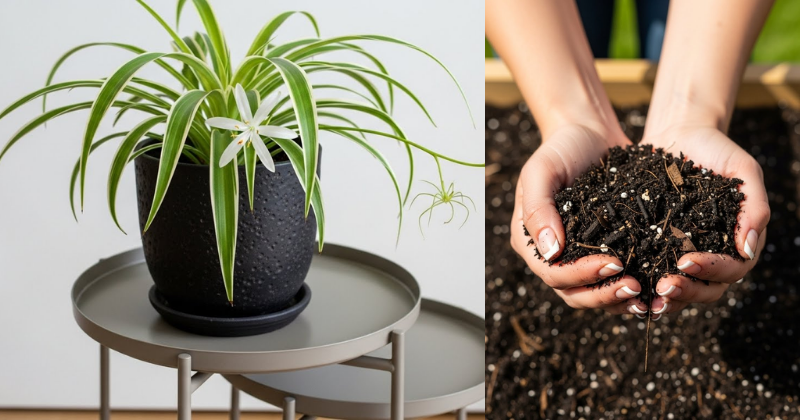
If you own a Spider Plant (Chlorophytum comosum), you know it’s a powerhouse of easy-care greenery, famous for producing those adorable “spiderettes.” But even the most resilient houseplant needs a little nutritional boost to thrive, especially if you want those lovely white and green stripes to pop and those babies to multiply! This guide on Spider Plant Fertilizer: A Beginner’s Guide will transform your approach to feeding your plant. We’ll cover the achievable, step-by-step guidance needed to choose the right fertilizer, apply it correctly, and avoid the most common beginner mistakes, empowering you to achieve lush, vibrant, and incredibly productive growth.
🌿 Section 1: Foundation First: Understanding Your Spider Plant’s Needs
Spider Plants are known for their tolerance, but they still require specific nutrients to maintain their health, vibrancy, and prolific baby production. Understanding these basic concepts is the first step in using Spider Plant Fertilizer effectively.
H3: Building Confidence with Basic Concepts: The NPK Ratio
All commercial fertilizers list three numbers, known as the NPK ratio, which represent the percentage by weight of Nitrogen (N), Phosphate (P), and Potassium (K).
- Nitrogen (N): Essential for lush, green, leafy growth. Since the Spider Plant is primarily foliage, Nitrogen is crucial for the green parts of the leaves and for producing those long, arching stems.
- Phosphate (P): Supports strong root development and overall plant structure. Although Spider Plants have robust root systems, Phosphate helps them maintain their compact, tuberous roots which store water and nutrients.
- Potassium (K): Known as the ‘regulator,’ Potassium boosts general plant health, disease resistance, and helps regulate water uptake.
H3: Addressing Common Concerns: Spider Plants and Sensitivity
Spider Plants are famously sensitive to chemicals, particularly fluorine and boron, which are often found in tap water and some synthetic fertilizers. This is a crucial distinction when selecting Spider Plant Fertilizer.
- Fluoride Toxicity: Fluoride can accumulate in the leaf tips, causing the dreaded brown tips that often frustrate beginners. Encouraging reassurance for beginners: this is usually a mineral issue, not a watering issue!
- Choosing the Right Type: To avoid chemical sensitivity, it’s generally best to use a diluted, balanced liquid fertilizer or organic options. Granular fertilizers are usually too strong for container plants.
🗓️ Section 2: Step-by-Step Process: Core Feeding Methods
The key to successful application of Spider Plant Fertilizer is consistency, dilution, and seasonal considerations. Less is always more with these hardy houseplants.
Step 1: Choosing the Right Fertilizer Type (Actionable Language)
For the best results and to minimize chemical burn, follow this achievable, step-by-step guidance for fertilizer selection.
- Select a Balanced Formula: Look for an NPK ratio that is balanced or slightly higher in Nitrogen, such as $10 \text{-} 10 \text{-} 10$ or $8 \text{-} 8 \text{-} 8$. Avoid bloom-boosting formulas (high P) unless you specifically want to encourage flowers (which are necessary before the plantlets appear).
- Opt for Liquid: Liquid fertilizers are easiest to control and dilute accurately. Organic liquid options, like diluted fish emulsion or seaweed extract, are excellent natural alternatives that provide trace minerals without high chemical salts.
- Dilution is Key: Practical tips and shortcuts dictate that you should always dilute the liquid fertilizer to half strength (or even quarter strength) of the recommended label instructions. This prevents the buildup of mineral salts that burn the sensitive roots and leaves.
Step 2: The Core Fertilizing Schedule (Timing and Planning Considerations)
Spider Plants have a distinct growth cycle, making seasonal considerations crucial for feeding.
- When to Fertilize (Spring and Summer): The active growing season runs from early spring through late summer. This is when the plant is pushing out new leaves and those signature spiderettes. Feed once every $2 \text{-} 4 \text{ weeks}$ during this period.
- When to Stop (Fall and Winter): Growth slows dramatically in the cooler, darker months. Stop fertilizing completely from late fall through early spring. The plant is dormant and cannot efficiently use the nutrients, leading to harmful salt buildup.
- The Golden Rule: Never apply fertilizer to dry soil. Always water your plant thoroughly the day before or just before applying the diluted Spider Plant Fertilizer. This prevents the concentrated salts from damaging the roots.
💡 Section 3: Advanced Strategies: Pro Tips for Lighter Feeding
Once you are comfortable with the basics, these expert-level insights and creative solutions will help you keep your Spider Plant at peak health while minimizing the risks associated with chemical fertilizers.
H3: Sharing Expert-Level Insights: The Flush Method
Even with diluted fertilizer, salts can slowly accumulate in the soil over time, contributing to brown tips and general plant stress.
- The Technique: Every three months during the active growing season, perform a “flush.” Place the potted plant in a sink or tub and slowly pour large amounts of plain, clean water (distilled or rainwater is ideal) through the pot for several minutes.
- The Goal: The idea is to leach out or dissolve the accumulated mineral salts from the soil and drain them away. This simple maintenance step drastically reduces the risk of chemical burn, allowing you to use Spider Plant Fertilizer more confidently.
H3: Creative Solutions: Organic and DIY Feeding Options
You can completely customize your approach by using organic materials you likely already have at home, reducing your reliance on commercial Spider Plant Fertilizer.
- Compost Tea: Steep a bag of high-quality compost in water for $24 \text{ hours}$. Dilute the resulting ‘tea’ until it looks like weak tea and use it as a gentle, nutrient-rich liquid feed.
- Worm Castings: Top-dress the soil with a thin layer of worm castings once or twice a year. Worm castings are a slow-release, natural fertilizer that provides beneficial microbes and nutrients without the risk of burning.
- Aquarium Water: If you have a freshwater aquarium, the water removed during a water change is incredibly nutrient-rich and makes a perfect, gentle, balanced fertilizer for all houseplants, including the Spider Plant.
🚫 Section 4: Troubleshooting: Dealing with Fertilizer Burn
Fertilizer burn is the most common challenge when using Spider Plant Fertilizer. Recognizing the symptoms and acting quickly is essential to save your plant.
Featured Snippet Potential: “What does fertilizer burn look like on a Spider Plant?”
Fertilizer burn on a Spider Plant typically manifests as rapid browning or yellowing of the leaf tips or margins, often starting as dark, crispy areas that move inward. This occurs because excess mineral salts draw moisture out of the roots or foliage. If you notice these symptoms, immediately stop fertilizing and perform a thorough soil flush with distilled or purified water to remove the excess salts and prevent further damage.
Practical Troubleshooting Tips
- Problem: Sudden, widespread browning of leaf tips/margins.
- Obstacle: Acute over-fertilization or insufficient dilution.
- Solution: Offer Alternative Approaches: Immediately stop all fertilizing. Perform the soil flush method described above at least twice over the next $48$ hours. Only use distilled or rainwater for the next month to allow the plant to recover.
- Problem: Lack of new spiderettes and slow growth in summer.
- Obstacle: The plant is underfed (nitrogen deficiency) or is root-bound.
- Solution: Ensure you are using the correct Spider Plant Fertilizer ratio (balanced or high N). If feeding correctly and growth is still slow, check if the roots are circling the pot. If so, repot the plant into fresh soil and a slightly larger container.
- Problem: Crusty white residue forming on the topsoil or pot rim.
- Obstacle: Salt buildup from repeated watering and fertilization with hard water.
- Solution: Scrape off the visible crusty residue. Switch completely to distilled or rainwater for all watering and feeding for several months. This is a crucial preventive measure against long-term salt damage.
💚 Section 5: Maximizing Results: Next Level Spider Plant Care
Beyond the basics of Spider Plant Fertilizer, these tips ensure you keep nurturing a happy, healthy plant that is continuously producing those lovely spiderette “babies.”
- Show How to Build Upon Basic Success: Propagating the Babies. Once your feeding routine is perfected, your plant will produce numerous spiderettes. Use this to your advantage! Pin the baby plant (still attached to the mother plant) into a small pot of moist soil until it roots, then snip the connecting stem. You can achieve a constant supply of new plants to share.
- Maintenance and Long-Term Considerations: Repotting: Spider Plants enjoy being slightly root-bound, which actually encourages the production of babies. However, when the roots completely fill the pot, repotting into a container only $1 \text{-} 2 \text{ inches}$ larger with fresh, nutritious potting mix every $2 \text{-} 3$ years is essential. This fresh soil provides a nutrient boost that temporarily replaces the need for heavy fertilizer.
- Suggest Complementary Strategies: Humidity Boost: Spider Plants originate in humid environments. Boosting local humidity with a pebble tray or regular misting helps reduce the appearance of brown tips, complementing your choice of low-salt Spider Plant Fertilizer. (Internal Linking Opportunity: Read “The Best Low-Tech Ways to Boost Houseplant Humidity.”)
✅ Conclusion: Your Capability to Nurture a Prolific Houseplant
You are now equipped with a complete Beginner’s Guide to effectively using Spider Plant Fertilizer. By focusing on dilution, consistent timing during the active growing season, and choosing low-salt options, you have the capability to succeed in cultivating a lush, green, and incredibly prolific houseplant. Remember, the key to success with the Spider Plant is gentleness and restraint. Use your fertilizer wisely, and watch your plant transform your living space with its cascade of greenery and adorable babies!
Ready to get started? Will you choose a balanced liquid formula or try a gentle organic feed like compost tea for your next watering?