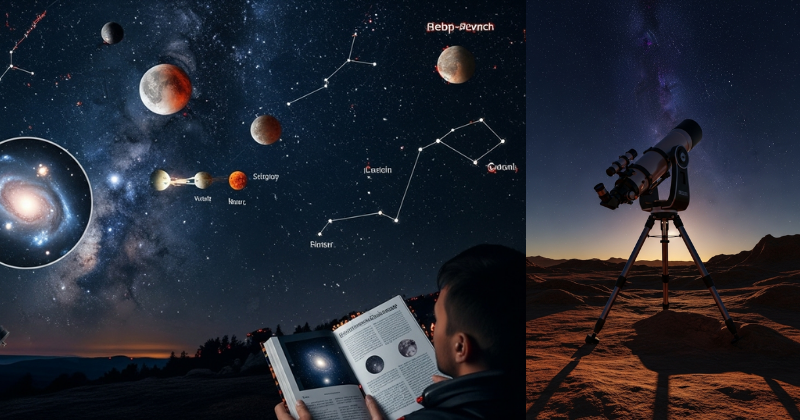
The night sky is delivering a packed schedule of wonders this February and March. Explore planetary alignments, full moons, and eclipses through a scientific lens.
As the orbital mechanics of our solar system align in specific geometric configurations, the early months of 2026 present a rare observational window for both amateur astronomers and professional researchers. The night sky is delivering a packed schedule of wonders this February and March — from brilliant full moons to planetary alignments and eclipses. These phenomena are not merely aesthetic displays; they are the result of precise celestial dynamics that allow us to witness the clockwork of the cosmos from our terrestrial vantage point. This comprehensive analysis delves into the astrophysical principles governing these events, providing the necessary context to understand the shifting tapestry of the heavens during this period.
What are the Primary Celestial Events Occurring in February 2026?
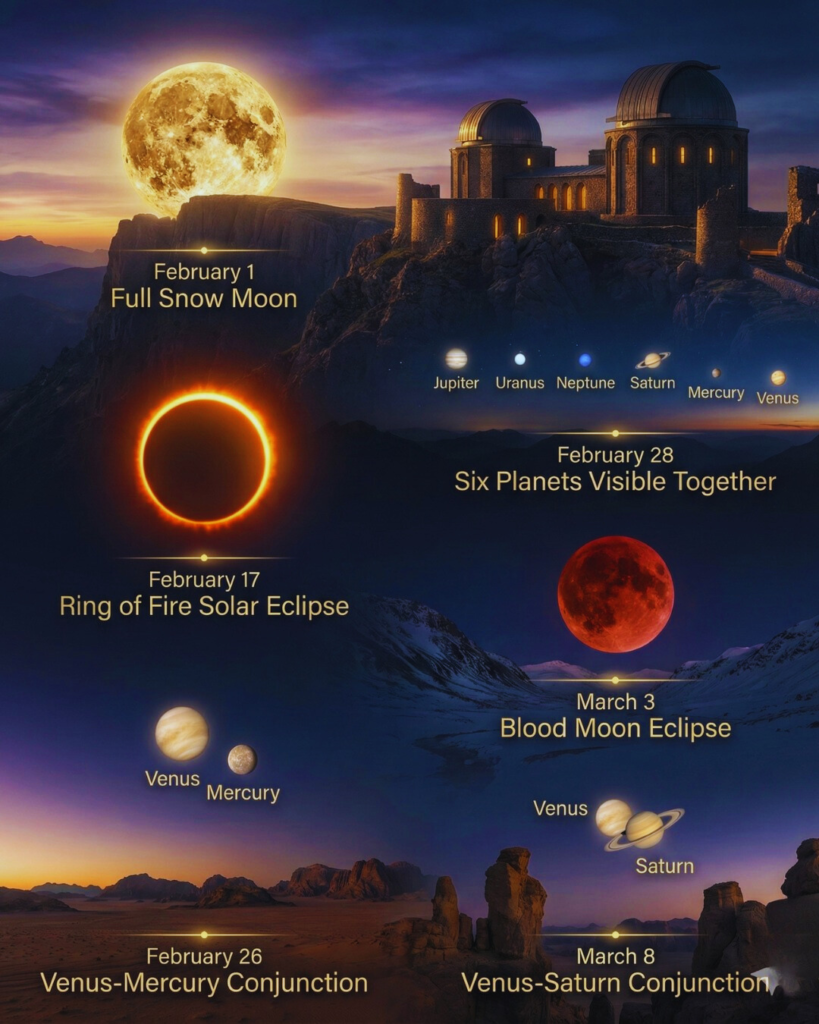
The month of February serves as a prelude to a significant seasonal transition, characterized by the increasing visibility of the outer planets and the stark brilliance of the “Snow Moon.” The Snow Moon, occurring when the Moon is on the opposite side of the Earth from the Sun, reaches its peak illumination during this month. Scientifically, this is known as syzygy, the straight-line configuration of three celestial bodies in a gravitational system.
Beyond the lunar cycle, February marks a favorable period for observing the “Morning Star” and “Evening Star” phenomena. Because the night sky is delivering a packed schedule of wonders this February and March, observers will notice Venus climbing higher in the western twilight. This visibility is dictated by the planet’s elongation—the angular separation between the Sun and the planet as observed from Earth. When Venus reaches its greatest eastern elongation, it remains visible for the maximum duration after sunset, providing a luminous anchor for the evening sky.
How Do Planetary Alignments Function Mechanically?
A planetary alignment, or conjunction, occurs when two or more planets appear close together in the sky. It is important to clarify that these bodies are not physically close in space; rather, they share a similar ecliptic longitude. The ecliptic is the apparent path of the Sun across the sky, which also represents the plane of Earth’s orbit. Since most planets in our solar system orbit in nearly the same plane, they frequently appear to pass one another from our perspective.
In late February and early March, a notable grouping of Mars, Jupiter, and Saturn becomes visible in the pre-dawn sky. This alignment is a result of the differing orbital velocities of the planets. According to Kepler’s Third Law, planets closer to the Sun move faster than those further away. As Earth moves along its shorter, faster orbit, our line of sight to the outer planets shifts, occasionally causing them to appear clustered in a small segment of the celestial sphere. This “parade of planets” offers a unique opportunity to compare the varying albedos (reflectivity) and colors of these worlds in a single viewing session.
Which Factors Determine the Visibility of the February Snow Moon?
The February Full Moon, historically termed the Snow Moon, is more than a cultural marker; it is an ideal subject for studying lunar topography. During full illumination, the Sun’s rays strike the lunar surface directly from our perspective, minimizing shadows. While this makes it difficult to see depth in craters, it highlights the lunar maria—the large, dark, basaltic plains formed by ancient volcanic eruptions—and the bright ray systems emanating from younger craters like Tycho.
Visibility is primarily influenced by the Moon’s altitude in the sky and atmospheric extinction. Atmospheric extinction refers to the absorption and scattering of light by the Earth’s atmosphere. When the Moon is near the horizon, its light must pass through a thicker layer of atmosphere, which scatters shorter blue wavelengths and allows longer red wavelengths through, often giving the Moon a golden hue at moonrise. As the night sky is delivering a packed schedule of wonders this February and March, the high winter arc of the Moon ensures it remains above the thickest parts of the atmosphere for much of the night, providing exceptionally crisp views for northern hemisphere observers.
What is the Significance of the Penumbral Lunar Eclipse in March?
One of the most technically intriguing events in this period is the penumbral lunar eclipse occurring in late March. Unlike a total lunar eclipse, where the Moon enters the Earth’s dark inner shadow (the umbra), a penumbral eclipse occurs when the Moon passes through the Earth’s faint outer shadow (the penumbra).
The scientific significance of a penumbral eclipse lies in the subtle measurement of light intensity drop. To the naked eye, the Moon may only appear slightly shaded or “dimmed” on one side. However, for researchers, these events allow for the study of the Earth’s upper atmosphere. The sunlight reaching the Moon during this time has been filtered through the various layers of the Earth’s atmosphere; by analyzing the light, scientists can gather data on ozone concentration and aerosol levels. This event confirms that the night sky is delivering a packed schedule of wonders this February and March that cater to both visual delight and scientific inquiry.
How Does the Vernal Equinox Affect Celestial Observations in March?
The March Equinox, occurring around March 20th, marks the moment the Sun crosses the celestial equator moving north. This event is a pivot point for stargazers. For those in the Northern Hemisphere, it signals the beginning of “Galaxy Season.” As the Earth’s night side begins to point away from the dense center of our own Milky Way galaxy, the sky becomes clearer, allowing us to look “out” into deep space toward distant galactic clusters like those in Leo and Virgo.
The equinox also affects the “tilt” of the crescent moon. In the weeks surrounding the March equinox, the ecliptic stands at its steepest angle relative to the western horizon after sunset. This causes the evening crescent Moon to appear “upright” like a bowl, a phenomenon often called a “Wet Moon” or “Cheshire Moon.” Understanding this geometry enhances our appreciation of how the night sky is delivering a packed schedule of wonders this February and March through predictable, yet beautiful, orbital variations.
Which Planetary Conjunctions Should Be Prioritized in March?
March 2026 features a spectacular “closeness” between Jupiter and Mars. A conjunction is measured by the angular distance between objects in degrees, arcminutes, and arcseconds. During this particular event, the two planets will be separated by less than half a degree—roughly the width of a full moon.
Jupiter, with its high albedo and massive size, will appear significantly brighter than the ruddy, smaller Mars. This contrast provides a vivid demonstration of the diversity of the solar system. For those using telescopes, this conjunction is a rare chance to see the cloud bands of Jupiter and the Galilean moons in the same field of view as the Martian disk. This highlights why the night sky is delivering a packed schedule of wonders this February and March; such tight groupings are relatively rare and provide a dramatic sense of scale and movement within our local neighborhood.
What Atmospheric Conditions are Necessary for Optimal Viewing?
To fully appreciate the wonders of the February and March sky, one must account for atmospheric stability, often referred to by astronomers as “seeing.” High-quality seeing occurs when the atmosphere is still and laminar, rather than turbulent. Turbulence causes the “twinkling” of stars (scintillation), which, while beautiful, actually blurs the fine details of planets and lunar features.
Cold winter air is often more transparent because it holds less water vapor, but the presence of the jet stream can cause high-altitude turbulence. Observers should look for nights where the stars appear steady rather than shimmering aggressively. Additionally, thermal equilibrium of equipment is vital. If a telescope is moved from a warm house to the cold outdoors, internal air currents will degrade the image. Allowing optics to “cool down” ensures that the night sky is delivering a packed schedule of wonders this February and March with the highest possible resolution.
How Can Beginners Effectively Track These Celestial Wonders?
Navigating the packed schedule of celestial events requires methodical planning. Utilizing star charts and digital planetarium software is the primary evidence-based approach to locating objects. These tools calculate the precise position of celestial bodies based on the observer’s latitude, longitude, and time.
For those interested in the planetary alignments of February and March, it is helpful to first identify the “Ecliptic Line.” By locating the Moon and then following its path across the sky, beginners can find the line where planets are most likely to appear. Because the night sky is delivering a packed schedule of wonders this February and March, starting with the brightest objects—Venus, Jupiter, and the Moon—serves as an effective way to calibrate one’s sense of celestial direction before moving on to more subtle events like the penumbral eclipse.
Conclusion
The upcoming months represent a remarkable period of astronomical activity. The night sky is delivering a packed schedule of wonders this February and March — from brilliant full moons to planetary alignments and eclipses. By understanding the underlying physics of syzygy, the geometry of the ecliptic, and the mechanics of planetary elongation, we move beyond mere observation into a deeper comprehension of our place in the solar system. Whether you are observing the subtle shading of a penumbral eclipse or the brilliant convergence of Jupiter and Mars, these events provide a tangible connection to the vast, orderly motions of the universe.