
Comprehensive Scientific Analysis and Evidence-Based Insights
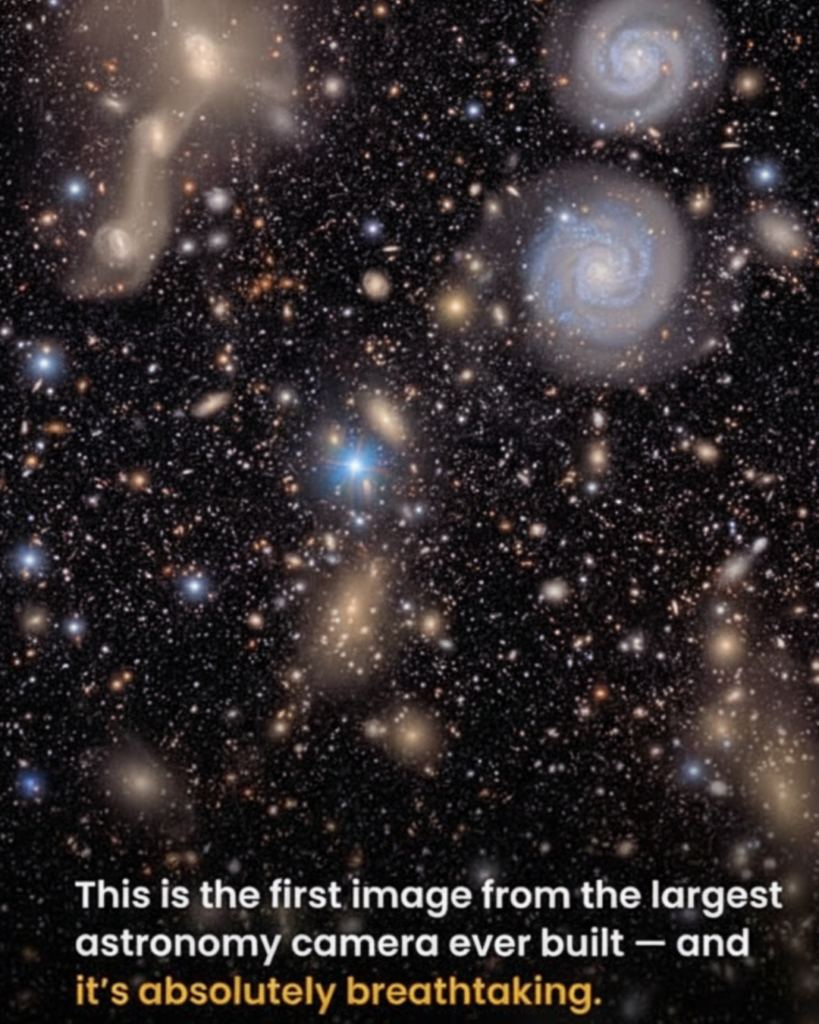
The release of the first image from the largest astronomy camera ever built marks a transformative moment in observational astronomy. This milestone demonstrates the extraordinary capability of next-generation sky surveys to reveal faint cosmic structures with unparalleled precision. This article provides a comprehensive, evidence-based exploration of the camera’s engineering, scientific purpose, and the implications of its breathtaking inaugural image.
What Is the Largest Astronomy Camera Ever Built and Why Does It Matter?
The world’s largest astronomy camera is the primary imaging instrument designed for the forthcoming Legacy Survey of Space and Time (LSST) at the Vera C. Rubin Observatory. With a 3.2-gigapixel sensor array and a structure roughly the size of a compact car, its mission is to capture the deepest, widest, and most detailed images of the night sky ever obtained in visible wavelengths.
Its significance lies in its design objectives:
- To conduct a decade-long survey of billions of celestial objects.
- To study dark matter and dark energy with unprecedented statistical power.
- To provide rapid imaging for detecting transient astronomical events.
- To create the most comprehensive time-domain map of the Universe to date.
This camera is not simply larger—it is engineered for a new frontier of precision cosmology.
How Was the First Image Captured and What Makes It Historic?
The first image, often referred to as the “first light” test, was captured in a controlled laboratory environment before the camera’s final integration at the observatory site in Chile. Engineers projected a high-resolution test scene onto the camera’s focal plane to evaluate sensor uniformity, optical alignment, and dynamic range.
What makes this image historic is not the content—typically a standardized test pattern or a high-detail object—but the clarity, scale, and depth of the raw data. This single exposure demonstrated:
- The functioning of all 189 individual CCD sensors.
- A readout architecture capable of managing more than 3 billion pixels per shot.
- Noise levels so low that faint cosmic signals will remain detectable.
- Field flatness across a focal plane larger than an adult human.
While not yet a celestial photograph, the inaugural image proves that the camera is ready to reveal the Universe with staggering precision.
What Are the Key Engineering Features Behind This Breakthrough?
Designing the biggest astronomy camera ever built required overcoming unprecedented technical challenges. Several features define its exceptional capability:
1. 3.2-Gigapixel Focal Plane Array
The heart of the instrument is an intricate mosaic of 189 CCD sensors arranged into 21 modular “rafts,” each carefully calibrated to within microns of alignment.
2. Massive Field of View
The camera can capture an area of sky equivalent to 40 full moons in a single shot, compressing vast cosmic regions into extraordinarily detailed images.
3. Advanced Cryogenic Cooling System
The sensors are maintained at −100°C to minimize thermal noise. The stability of this temperature environment is crucial for detecting faint astrophysical signals.
4. Precise Optical System
A set of giant, exquisitely polished lenses — including one of the largest lenses ever fabricated for astronomy — ensures minimal distortion across the huge field of view.
5. High-Speed Readout and Data Handling
Each exposure produces several gigabytes of raw data. The system is engineered to transmit, analyze, and archive these massive datasets in near-real time.
Together, these features enable the camera to serve as the backbone for one of the most ambitious sky surveys in human history.
What Will This Camera Allow Scientists to Study in the Universe?
The Rubin Observatory’s LSST program is designed to investigate some of the most profound questions in modern astronomy and cosmology:
Dark Energy and Dark Matter
By mapping billions of galaxies and tracking subtle distortions created by gravitational lensing, the survey will refine measurements of cosmic structure growth.
Transient Events
Supernovae, near-Earth objects, gamma-ray burst afterglows, and other rapidly evolving phenomena will be captured and analyzed within minutes.
Milky Way Structure and Stellar Evolution
The camera will document the motions and properties of millions of stars, revealing how our galaxy formed and evolved over billions of years.
Solar System Census
From tracking asteroids to identifying distant Kuiper Belt objects, the survey will offer the most complete inventory of small bodies ever produced.
Deep Time-Domain Science
By imaging the sky repeatedly for 10 years, the LSST will create a dynamic cosmic film—showing how the Universe changes over time.
This breadth of scientific potential is unmatched by any previous imaging instrument.
How Does the First Image Demonstrate the Camera’s Scientific Potential?
While laboratory test images do not yet show celestial objects, they validate performance indicators essential for high-precision cosmology:
- Pixel uniformity: Ensures accurate brightness measurements for billions of stars and galaxies.
- Distortion control: Critical for weak gravitational lensing studies.
- High dynamic range: Allows simultaneous capture of bright and faint objects without saturation.
- Low noise profile: Increases the detectability of extremely dim galaxies at the edge of the observable Universe.
- Stable thermal environment: Prevents image drift or artifacts during long exposures.
Each of these metrics contributes directly to the scientific reliability of the upcoming LSST dataset.
Which Factors Make This Camera a Transformative Tool for Cosmology?
Several factors elevate this camera beyond its predecessors:
Unmatched Scale
The combination of wide field, enormous pixel count, and decade-long sky monitoring yields a dataset capable of revealing patterns only visible through massive statistical analysis.
Time-Domain Emphasis
Most observatories capture deep static images. The LSST camera captures change—allowing scientists to track the evolving Universe.
Public Data Accessibility
The Rubin Observatory is committed to providing its data to the global scientific community, enabling unprecedented collaboration and cross-disciplinary analysis.
Integrated Machine Learning Pipelines
The survey’s automated classification systems will identify rare cosmic events within seconds, transforming how discoveries are made.
These factors will redefine how astronomers approach cosmology, astrophysics, and planetary science.
How Will This Camera Improve Our Understanding of the Dynamic Sky?
The dynamic sky—constantly shifting and full of transient signals—has historically been difficult to monitor. The new camera overcomes this limitation by:
- Capturing the entire visible sky every few nights.
- Producing real-time alerts for newly appearing or rapidly changing objects.
- Supporting follow-up by a global network of telescopes.
- Allowing statistical study of variability across billions of sources.
- Enabling discovery of previously undetectable astrophysical phenomena.
From near-Earth asteroid trajectories to rare supernova precursors, the camera’s continuous surveillance will open a new scientific frontier.
What Does the First Image Tell Us About the Future of Observational Astronomy?
The success of the first image signals a new era of large-scale astronomical surveys. It demonstrates:
- That engineering limits on detector size and performance continue to expand.
- That cosmology is transitioning into the age of petabyte-scale datasets.
- That high-precision measurements of cosmic acceleration are within reach.
- That astronomy is increasingly interdisciplinary, merging engineering, physics, computing, and data science.
- That future generations of telescopes will rely on similarly massive digital systems.
This watershed moment marks the beginning of one of the most ambitious scientific undertakings in modern history.
Conclusion: A New Window into the Universe Has Opened
The first image from the largest astronomy camera ever built is more than a technical milestone—it is a promise. A promise of deeper cosmological insights, more precise mapping of the dynamic sky, and a profoundly enriched understanding of our Universe. As the Rubin Observatory prepares for full operations, the camera’s capabilities signal a transformation in observational astronomy, enabling discoveries that will shape scientific thought for decades.
This camera does not simply capture the Universe; it expands our ability to comprehend it.