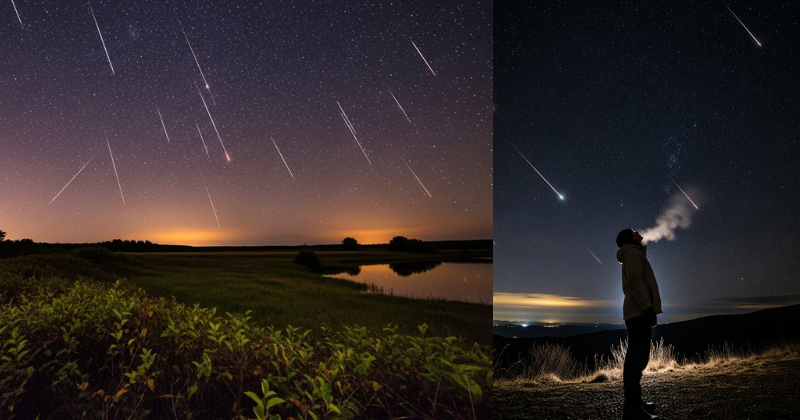
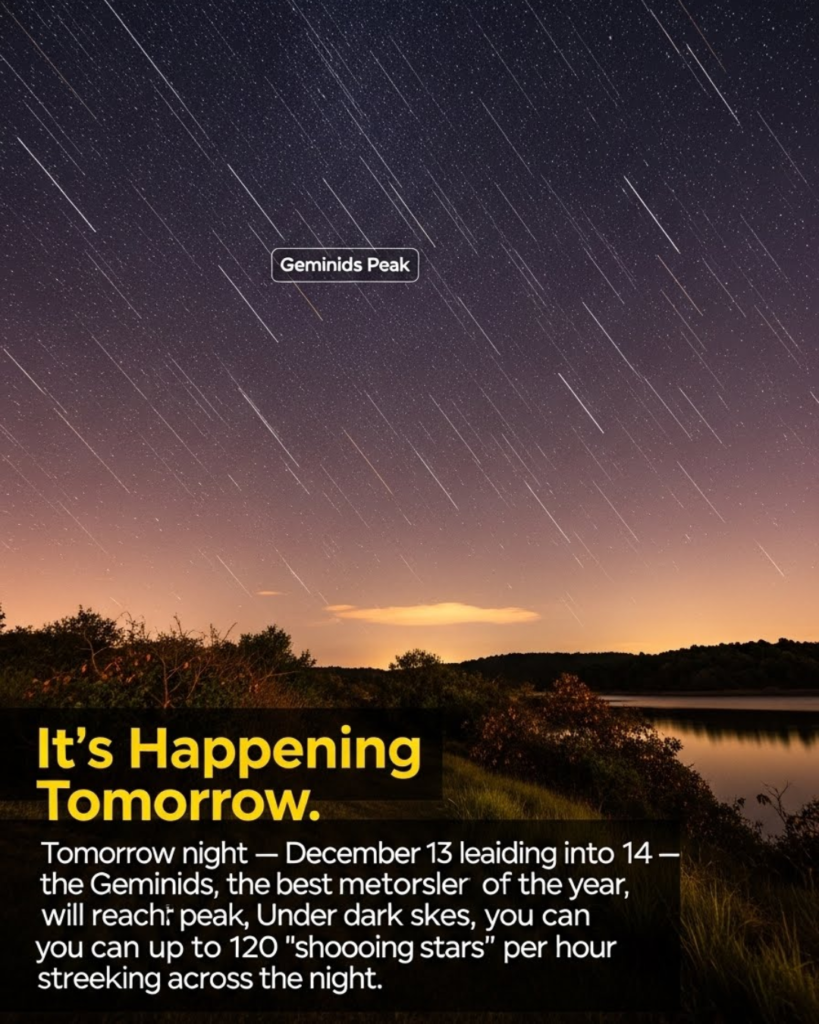
The Geminids will reach their peak tomorrow night, December 13 leading into 14, offering up to 120 meteors per hour under dark skies; this article explains the science, origins, and observation conditions behind this extraordinary annual event.
(When condensed, the first 155–160 characters serve as the meta description.)
The Geminid meteor shower has earned its reputation as the most prolific and reliable meteor display of the year. As Earth sweeps through a dense stream of cosmic debris, the sky becomes an active stage of luminous streaks, abrupt flares, and slow-burning meteors that seem almost deliberate in their descent. Tomorrow night’s peak marks the most anticipated moment of the 2024 meteor calendar, when the Geminids will produce their highest hourly rate and brightest displays. This article provides a rigorous, evidence-based exploration of their origin, composition, observational science, and the factors that will shape this year’s spectacle.
What Are the Geminids and Why Are They Considered the Best Meteor Shower of the Year?
The Geminids are an annual meteor shower active from December 4 to 17, with a sharply defined peak around the night of December 13–14. They consistently produce high meteor rates, bright fireballs, and slow-moving streams that make them unusually visible even for beginner observers.
Several factors distinguish the Geminids from other meteor showers:
- Exceptional intensity – With peak rates often reaching or exceeding 120 meteors per hour, they are one of the few showers that can be reliably described as “storm-like” under ideal conditions.
- Unique origin from an asteroid – Unlike most showers, which originate from comets, the Geminids stem from the rocky asteroid 3200 Phaethon, giving them distinct physical properties.
- High mass and density of meteoroids – Geminid particles tend to be more robust, producing slower, brighter meteors.
- Predictability – Historical observations show that the Geminids have grown stronger over the past century, indicating an increasingly dense debris stream.
Their consistency and brightness make them accessible to almost anyone willing to step under a dark sky, even for a brief moment.
What Is the Origin of the Geminids and How Does 3200 Phaethon Create This Meteor Stream?
Most meteor showers originate from icy comets that shed dust as they sublimate near the Sun. The Geminids, however, challenge this model. Their parent body, 3200 Phaethon, behaves like a hybrid—classified as an asteroid yet displaying comet-like traits during perihelion.
The Peculiar Nature of 3200 Phaethon
Phaethon follows an elongated 1.43-year orbit that brings it extremely close to the Sun—only 0.14 AU at perihelion. This intense solar heating can cause surface fracturing, thermal cracking, and dust release even without sublimating ice.
Researchers propose several mechanisms behind Phaethon’s dust production:
- Thermal fracturing: Rapid heating causes its rocky surface to split and eject debris.
- Electrostatic lofting: Charged particles may be pushed off the asteroid during solar encounters.
- Fragmentation events: Historical outbursts indicate episodic shedding of large amounts of dust.
Formation of the Geminid Stream
Over thousands of years, this dust has spread along Phaethon’s orbit, creating a thick stream of particles that Earth intersects every December. Because the particles are dense and metallic-rich, they burn brighter and penetrate deeper into the atmosphere, producing long-lasting streaks.
The Geminid stream is considered “young” in astronomical terms—only about 1,000–2,000 years old—which helps explain its strength and density compared to older, more dispersed streams.
How Does Earth’s Interaction with the Geminid Stream Produce Meteors?
Meteor showers occur when Earth travels through concentrations of interplanetary debris. The Geminids offer a particularly dense segment of the stream, which Earth encounters at high relative speed.
Atmospheric Entry Dynamics
Geminid meteoroids typically enter Earth’s atmosphere at about 35 km/s, slower than the Perseids (59 km/s) or Leonids (71 km/s). This comparatively moderate speed contributes to:
- longer visibility
- brighter ablation trails
- occasional fragmentation into multiple flares
Once entering the upper atmosphere (roughly 80–120 km altitude), friction heats each particle until it vaporizes, generating the familiar streaks of light. The dense physical composition of Geminid particles results in a higher proportion of fireballs, defined as meteors brighter than Venus.
Radiant and Sky Geometry
The meteors appear to radiate from the constellation Gemini, located near the bright star Castor. This radiant determines the direction of incoming particles but not their position in the sky—Geminids can streak across any region overhead.
Which Factors Will Influence Visibility During the December 13–14 Peak?
Optimal meteor viewing depends on several environmental and astronomical variables. Even a strong shower can be muted by adverse conditions.
1. Moon Phase
In many years, moonlight significantly diminishes meteor visibility. During the December 13–14 window in 2024, the Moon’s phase and position will determine how dark the skies remain.
2. Light Pollution
Urban and suburban lights can wash out all but the brightest meteors. Observers in rural or wilderness areas will see rates much closer to the theoretical maximum of 120 meteors per hour.
3. Atmospheric Conditions
- Clear skies
- Low humidity
- Stable air
all enhance visibility by reducing scattering.
4. Observer Adaptation
Human eyes require roughly 20–30 minutes to achieve full dark adaptation. Red-light flashlights can be used to maintain night vision while adjusting equipment or checking star maps.
What Is the Best Way to Observe the Geminids’ Peak Tomorrow Night?
Although meteor showers require no specialized equipment, strategic choices can dramatically improve the experience.
Prime Observing Time
The Geminid radiant rises in the early evening, making them unique among major showers. However, peak activity usually occurs after midnight when:
- Earth’s leading hemisphere faces the stream
- The radiant is higher in the sky
- Meteor rates increase steadily until dawn
Key Observation Strategies
- Lie back on a blanket or reclining chair for a wide field of view.
- Face away from direct light sources, including nearby buildings or roads.
- Allow your eyes to adapt fully to the dark.
- Use low-power red lights for navigation.
- Dress warmly—December nights are unforgiving.
Meteor watching is a passive activity; comfort enhances endurance and patience.
Why Are Geminid Meteors So Bright and Slow Compared to Other Showers?
Brightness and appearance are closely linked to the chemical and physical properties of the particles entering Earth’s atmosphere.
Physical Composition
Geminid meteoroids contain:
- silicates
- iron
- magnesium
- other metallic elements
This composition vaporizes at higher temperatures, creating:
- intense luminosity
- persistent trains
- glowing fragmentation
Entry Velocity
Their comparatively slower entry speed enhances their visual duration. An average Geminid meteor can appear for 1–2 seconds, long enough for viewers to track and appreciate its path.
Fireball Abundance
The American Meteor Society notes that the Geminids consistently generate a high proportion of fireballs compared to other showers—a hallmark of their dense material.
What Scientific Insights Have Been Gained from Studying the Geminids?
The Geminids play an important role in planetary science and meteoroid dynamics.
Stream Evolution
Studying the distribution and density of Geminid particles helps scientists model:
- gravitational influences from planets
- orbital decay
- long-term stream evolution
Phaethon’s Active Asteroid Behavior
Observations of Phaethon during perihelion reveal dust shedding despite the absence of sublimating ice. This supports the classification of “active asteroids”—bodies that blur the line between asteroids and comets.
Atmospheric Physics
Geminid meteor trails provide natural laboratories for studying:
- ionospheric disturbances
- plasma behavior
- energy transfer in the upper atmosphere
These insights help refine models used in satellite communication and atmospheric research.
How Can You Photograph the Geminids for the Best Results?
Capturing meteor showers requires planning, the right equipment, and patience.
Recommended Camera Settings
- Shutter speed: 10–30 seconds
- Aperture: f/2.8 or lower
- ISO: 800–3200 depending on sky brightness
- Lens: 14–24 mm wide-angle
Technique
- Point the camera toward the darkest part of the sky.
- Use a tripod to maintain stability.
- Enable continuous shooting to maximize your chances.
- Allow at least 1–2 hours of shooting for meaningful results.
Even a handful of exposures can capture dramatic streaks during the Geminids’ intense peak.
Conclusion
Tomorrow night’s December 13–14 Geminid meteor shower peak promises one of the most vivid astronomical displays of the year. With up to 120 meteors per hour under dark skies, the Geminids offer an accessible and awe-inspiring experience rooted in complex cosmic dynamics and centuries of observational history. Their unique origin from the asteroid 3200 Phaethon, their dense composition, and their reliable annual intensity make them a highlight of the astronomical calendar. Whether you’re observing casually or studying scientifically, tomorrow night’s peak provides a rare opportunity to witness the elegance and power of Earth’s interaction with the solar system