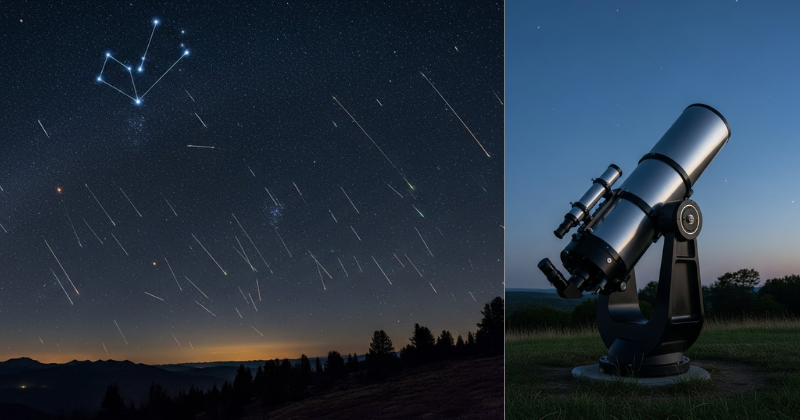
As December approaches its astronomical crescendo, the Ursid meteor shower presents a distinctive celestial spectacle for patient observers. While less renowned than its December predecessor, the Geminids, this annual phenomenon offers astronomers and enthusiasts alike an opportunity to witness the dynamic interplay between cometary debris and Earth’s atmosphere during the year’s final nocturnal displays.
What Defines the Ursid Meteor Shower and Its Celestial Origins?
The Ursid meteor shower represents an annual astronomical event occurring when Earth traverses the debris field left by comet 8P/Tuttle, a short-period comet with an orbital period of approximately 13.6 years. This periodic comet, discovered by Horace Parnell Tuttle in 1790, releases particulate matter along its orbital path, creating a stream of cosmic debris that persists long after the comet’s passage.
The designation “Ursid” derives from the constellation Ursa Minor, the Little Bear, which contains the radiant point from which these meteors appear to emanate. This radiant sits near the celestial pole, positioned close to Polaris, making it circumpolar for observers in the Northern Hemisphere. The shower’s activity typically spans from December 17 through December 26, with peak intensity concentrated in a narrow window around December 22-23 each year.
The physical composition of Ursid meteoroids reflects their cometary heritage. These fragments, ranging from millimeter-sized grains to pebble-sized particles, consist primarily of silicate minerals, organic compounds, and volatile ices that have sublimated over successive solar approaches. When these particles encounter Earth’s atmosphere at velocities approaching 33 kilometers per second, frictional heating ionizes atmospheric gases, producing the luminous phenomena we perceive as meteors.
How Does the Ursid Meteor Shower Compare to Other Annual Displays?
Understanding the Ursid meteor shower requires contextualizing its characteristics relative to more prominent annual displays. The shower exhibits a zenithal hourly rate typically ranging between 5 and 10 meteors under optimal conditions, though periodic outbursts have produced rates exceeding 50 meteors per hour during exceptional years, particularly when comet 8P/Tuttle approaches perihelion.
This variability distinguishes the Ursids from more predictable showers like the Perseids or Geminids, which consistently deliver high meteor counts. The orbital mechanics of comet 8P/Tuttle create concentrated debris streams that occasionally intersect Earth’s path more directly, producing brief but intense activity spikes. Historical records document notable outbursts in 1945, 1986, and 2000, when observers recorded enhanced rates substantially exceeding baseline expectations.
The Ursid meteoroids generate typically faint meteors, with most exhibiting magnitudes between +3 and +5, rendering them challenging to observe under light-polluted conditions. This photometric characteristic contrasts markedly with the Geminids, which produce numerous bright fireballs, or the Perseids, known for persistent meteor trains. However, the Ursids occasionally yield spectacular bright meteors, and their positioning near the celestial pole offers extended observing windows for high-latitude observers.
Which Observational Conditions Optimize Ursid Meteor Detection?
Successful observation of the Ursid meteor shower demands careful consideration of multiple environmental and astronomical factors. The shower’s circumpolar radiant position provides continuous visibility throughout the night for observers above 40 degrees north latitude, eliminating the typical constraints imposed by radiant elevation for other meteor showers.
Lunar phase represents perhaps the most critical variable affecting observational success. The proximity of peak Ursid activity to the winter solstice means lunar illumination varies significantly year to year. Optimal conditions occur during new moon phases or when the moon sets before peak activity hours. Moonlight scattered by atmospheric particles can reduce limiting magnitude by two to three magnitudes, effectively masking fainter meteors that constitute the majority of Ursid events.
Light pollution mitigation requires strategic site selection. Rural locations exhibiting Bortle scale values below 4 provide substantially enhanced detection capabilities compared to suburban or urban environments. The zenith sky brightness in dark-sky locations approaches 21.5 magnitudes per square arcsecond, while suburban skies rarely exceed 19.0, representing a hundred-fold increase in sky brightness that dramatically reduces meteor visibility.
Atmospheric transparency introduces additional complexity. Winter weather patterns at mid-northern latitudes frequently generate cloud cover, precipitation, and atmospheric instability that compromise observing conditions. Clear, stable atmospheric conditions with minimal aerosol loading optimize meteor detection by reducing light scattering and maximizing contrast between meteoric trails and the background sky.
What Techniques Maximize Scientific and Aesthetic Observation?
Effective meteor observation combines systematic methodology with patient attention to nocturnal sky dynamics. Visual observation remains the most accessible approach, requiring no specialized equipment beyond comfortable seating, warm clothing, and dark adaptation. The human eye’s wide field of view and sensitivity to motion make it ideally suited for detecting meteors across expansive sky regions.
Dark adaptation protocols significantly enhance detection capabilities. Complete dark adaptation requires approximately 30 to 45 minutes, during which rhodopsin regeneration in retinal rod cells increases sensitivity to low light levels by factors exceeding 10,000. White light exposure, even briefly, disrupts this adaptation, necessitating the exclusive use of red-filtered illumination for charts, notes, or equipment adjustment.
Observational strategy should emphasize sky regions 40 to 60 degrees from the radiant point. While meteors originate from the radiant through perspective effects, they appear longer and more conspicuous when observed at angular distances where their atmospheric trajectories present greater apparent length. Directing attention toward the zenith or slightly north thereof optimizes detection probability while maintaining comfortable viewing angles.
Photographic and video documentation have revolutionized amateur meteor astronomy. Wide-field camera systems equipped with fast lenses can record meteors continuously throughout the night, enabling subsequent analysis of meteor trajectories, brightness profiles, and temporal distribution. Modern video systems utilizing high-sensitivity sensors detect meteors invisible to visual observers, contributing valuable data to scientific databases.
How Do Atmospheric Physics Generate Meteor Luminosity?
The physical processes transforming cosmic particles into luminous meteors represent a complex cascade of thermodynamic and electromagnetic phenomena. As meteoroids encounter the upper atmosphere at hypersonic velocities, collision with atmospheric molecules generates intense frictional heating through momentum transfer at the molecular level.
Ablation commences typically at altitudes between 110 and 120 kilometers, where atmospheric density reaches thresholds sufficient for significant particle interaction. The meteoroid surface temperature rapidly escalates beyond vaporization thresholds, creating a surrounding envelope of vaporized meteoroid material mixed with atmospheric constituents. This high-temperature plasma emits electromagnetic radiation across visible wavelengths through thermal excitation and electronic transitions.
The spectroscopic signature of meteors reveals their compositional characteristics. Ionized atmospheric species, particularly nitrogen and oxygen, emit characteristic spectral lines in the blue-green region, while meteoroid composition manifests through metallic emission lines. Sodium produces distinctive yellow-orange emissions near 589 nanometers, magnesium contributes green emissions, and ionized calcium generates violet-blue features, creating a chromatic fingerprint of the meteoroid’s mineralogy.
Meteor trains, persistent luminous trails occasionally following bright meteors, result from chemiluminescent reactions in the meteor’s wake. Metallic atoms and ions deposited along the atmospheric trajectory undergo oxidation reactions, releasing energy as visible light over timescales extending from seconds to minutes. These phenomena provide unique opportunities to study upper atmospheric chemistry and dynamics.
What Scientific Value Emerges from Ursid Observations?
Contemporary meteor science transcends aesthetic appreciation, yielding fundamental insights into solar system evolution and dynamics. The Ursid meteor stream preserves information about cometary composition, orbital evolution, and the physical processes governing small body fragmentation over millennia.
Precise timing and trajectory measurements of individual Ursid meteors enable orbital reconstruction, revealing subtle perturbations induced by planetary gravitational encounters. These data constrain models of debris stream evolution, testing theoretical predictions against empirical observations. Variations in meteor flux intensity across the stream’s cross-section map the spatial distribution of particles, illuminating the complex interplay between ejection dynamics, solar radiation pressure, and gravitational perturbations.
Meteor spectroscopy provides direct sampling of cometary composition without the logistical complexities and expense of space missions. The ablation process vaporizes meteoroid material, creating spectral signatures that reveal elemental abundances and mineralogical characteristics. These measurements inform models of cometary formation conditions in the early solar nebula and subsequent alteration through solar heating and cosmic ray exposure.
Video meteor observations contribute to atmospheric science by mapping mesospheric winds and temperature structures. Meteor trail distortions reveal turbulent motion at altitudes inaccessible to conventional atmospheric probes, while systematic positional measurements across wide geographic baselines enable triangulation of meteor trajectories with sub-kilometer precision.
Which Cultural and Historical Dimensions Characterize Meteor Observation?
Human fascination with meteors extends into prehistory, manifesting across diverse cultural traditions and cosmological frameworks. Ancient texts from Mediterranean, Asian, and Mesoamerican civilizations document meteor observations, often investing these phenomena with prophetic or divine significance. The Chinese maintained systematic meteor records spanning millennia, providing modern astronomers with invaluable historical data regarding meteor shower activity and variability.
The scientific revolution transformed meteor interpretation from supernatural portent to natural phenomenon. Early astronomers recognized the atmospheric origin of meteors, distinguishing them from stellar phenomena through parallax measurements and trajectory analysis. The pioneering work of Ernst Chladni in the late 18th century established meteorites’ extraterrestrial origin, initially meeting considerable skepticism before acceptance through accumulated empirical evidence.
The discovery of meteor shower periodicity and radiant points in the 19th century revealed their connection to cometary orbits, fundamentally advancing understanding of solar system dynamics. Giovanni Schiaparelli’s recognition in 1866 that the Perseid meteor stream shared its orbit with comet Swift-Tuttle demonstrated the genetic relationship between comets and meteor showers, a principle subsequently extended to other annual displays including the Ursids.
Contemporary amateur astronomers continue this tradition, contributing observations to international databases that enable professional researchers to track meteor shower evolution over decadal timescales. Citizen science initiatives democratize astronomical research, allowing enthusiasts worldwide to participate meaningfully in advancing scientific knowledge.
How Can Contemporary Observers Maximize Their Ursid Experience?
Practical preparation transforms casual observation into rewarding engagement with celestial dynamics. Site selection requires balancing accessibility with darkness, ideally identifying locations offering unobstructed horizons and minimal artificial illumination. National parks, rural conservation areas, and designated dark-sky sites provide optimal conditions, though even moderately dark suburban locations yield reasonable results during new moon periods.
Timing considerations extend beyond identifying peak activity nights. The Ursid radiant maintains sufficient elevation throughout the night for mid-northern observers, but optimal conditions typically occur during pre-dawn hours when sporadic meteor background rates decrease and the radiant approaches its highest point. Planning observing sessions between local midnight and dawn maximizes meteor detection probability while accounting for practical constraints like temperature and fatigue.
Equipment requirements remain minimal but thoughtfully selected. Reclining lawn chairs or zero-gravity loungers enable comfortable upward viewing without neck strain during extended sessions. Multiple insulating layers, including head coverings and hand warmers, maintain comfort during winter nights when radiative cooling reduces surface temperatures substantially below ambient readings. Sleeping bags designed for winter camping provide excellent whole-body insulation for stationary observers.
Recording observations enhances both personal satisfaction and scientific value. Simple logbooks documenting meteor counts, brightness estimates, and observing conditions enable retrospective analysis and contribution to citizen science databases. Smartphone applications facilitate standardized reporting to organizations like the International Meteor Organization, which aggregates observations globally to characterize shower activity comprehensively.
Conclusion
The Ursid meteor shower embodies the intersection of accessible astronomical phenomena and sophisticated scientific investigation. While modest in typical activity compared to premier annual displays, this end-of-year celestial event offers patient observers distinctive rewards through its circumpolar accessibility and occasional spectacular outbursts. Understanding the shower’s cometary origins, physical mechanisms, and observational requirements enriches the experience beyond mere meteor counting, connecting individual observations to broader questions about solar system evolution and dynamics.
Successful Ursid observation demands minimal equipment but rewards careful planning, particularly regarding site darkness, lunar phase, and atmospheric conditions. The shower’s peak activity around the winter solstice presents practical challenges through cold temperatures and variable weather, yet these obstacles enhance the satisfaction derived from successful observations. Whether approached as aesthetic experience, scientific contribution, or contemplative engagement with cosmic processes, the Ursids provide a fitting astronomical culmination to the calendar year, reminding observers of Earth’s continuous journey through ancient cometary debris streams and our enduring connection to the broader solar system.