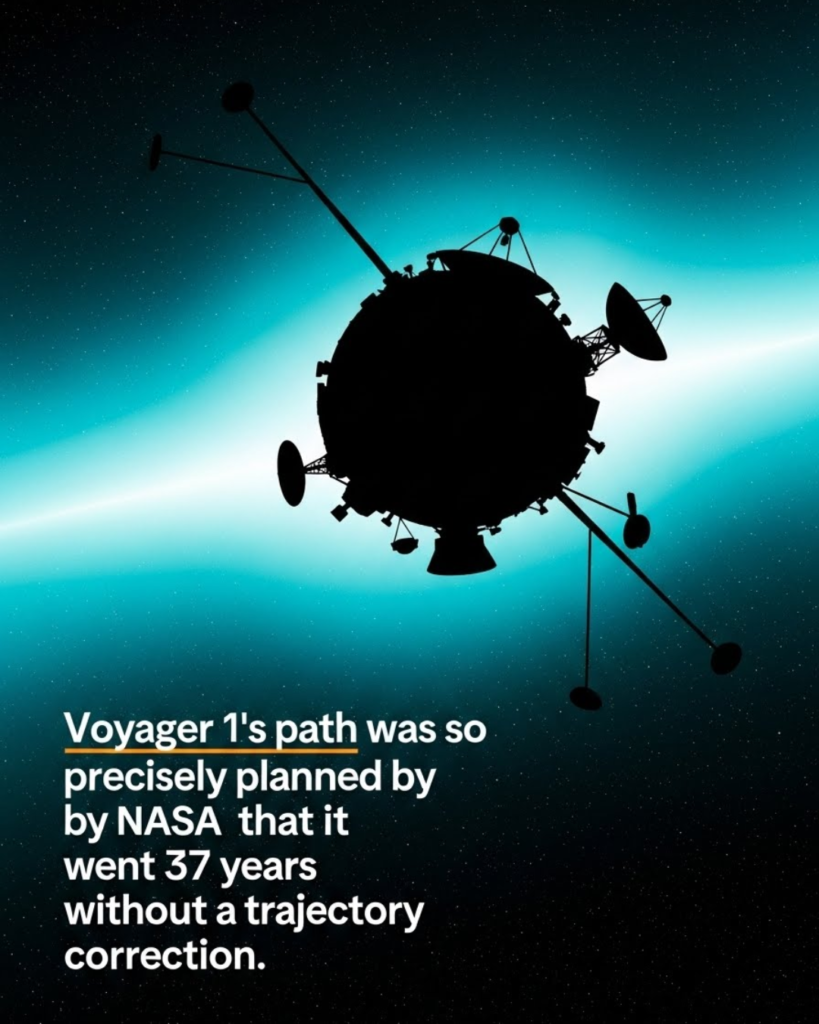
The precision of Voyager 1’s trajectory, which allowed it to travel 37 years without a single trajectory correction, stands as one of NASA’s most extraordinary achievements in spacecraft navigation and orbital mechanics. This engineering triumph saved fuel, extended mission life, and demonstrated the highest level of predictive modeling in spaceflight history.
What Is the Significance of Voyager 1’s 37-Year Trajectory Precision?
Voyager 1’s ability to coast for nearly four decades without a trajectory correction maneuver (TCM) after its planetary encounters is a landmark accomplishment in celestial navigation. Launched in 1977, its primary mission was to explore Jupiter and Saturn.
- Fuel Conservation: Spacecraft carry limited hydrazine for orientation and course corrections. Avoiding TCMs preserved this fuel for essential attitude control, significantly extending Voyager 1’s operational lifespan into interstellar space.
- Navigation Mastery: The long, uncorrected cruise validated NASA’s launch precision, early course adjustments, and the accuracy of the gravitational models used to predict motion under the influence of the Sun and giant planets.
- Extended Mission: With no fuel diverted to TCMs for decades, the mission could prioritize scientific operations, allowing Voyager 1 to continue transmitting invaluable interstellar data long after its original mission ended.
How Did the Grand Tour Concept Enable Such a Precise Trajectory?
Voyager 1’s unprecedented path was made possible by the Grand Tour — a rare, once-every-175-years alignment of the outer planets in the late 1970s.
- Planetary Alignment: Jupiter, Saturn, Uranus, and Neptune were positioned perfectly to enable sequential gravity assists.
- Gravity Assist Mechanics: By flying close to massive planets, the spacecraft gained speed and changed direction without using onboard fuel — a gravitational “slingshot.”
- Voyager 1’s Chosen Path: Voyager 1 used Jupiter and Saturn for its assists. The Titan flyby at Saturn gave it the final gravitational boost to leave the plane of the ecliptic and begin its escape into interstellar space. The precision required for this maneuver was extraordinary; any significant error would have compounded over the next decades.
Which Mathematical Models Allowed Such Accurate Predictions?
Voyager 1’s long-term accuracy was the result of advanced mathematical modeling and precise observational data.
- N-Body Problem Solutions: Engineers solved the complex N-body gravitational equations, accounting for the Sun, planets, moons, and all significant gravitational influences.
- High-Precision Ephemerides: NASA relied on exceptionally accurate ephemeris data — detailed tables of planetary positions and velocities.
- Deep Space Network Tracking: Continuous tracking using Doppler shift and ranging measurements allowed navigators to verify that the craft remained extremely close to its predicted path. The match between predictions and real-world measurements demonstrated both model accuracy and outstanding engineering.
How Were the Initial Trajectory Correction Maneuvers Minimised?
Voyager 1 did perform two small TCMs shortly after launch, but their precision enabled decades of hands-off coasting.
- Launch Error Correction: The first TCM compensated for residual errors introduced by the Titan-3E Centaur launch vehicle.
- Mid-Course Refinement: A second correction was performed to fine-tune the trajectory toward Jupiter.
- Fuel-Saving Strategy: Engineers carefully minimized hydrazine usage in these burns, preserving almost the entire fuel supply for attitude control — a key factor in the spacecraft’s longevity.
What Factors Normally Require Trajectory Corrections?
Voyager 1’s ability to avoid all trajectory corrections for 37 years means several common challenges were successfully avoided.
- Non-Gravitational Forces:
- Solar Radiation Pressure — strongest near the Sun but decreases with distance.
- Propellant Leaks — avoided due to exceptional propulsion system integrity.
- Outgassing — minor early in the mission and negligible later.
- Ephemeris Errors: Mistakes in planetary positions would have affected the gravity assists. The 1970s ephemerides proved extremely accurate.
- Micrometeoroid Impacts: While possible, none caused measurable deviation.
Why Was Voyager 1’s Saturn–Titan Targeting So Sensitive?
The trajectory designed for Voyager 1 at Saturn had to achieve two critical objectives: scientific exploration and interstellar escape.
- Titan Flyby: Required to investigate Titan’s dense atmosphere.
- Ecliptic Departure: The Titan gravity assist redirected Voyager 1 sharply out of the ecliptic plane, giving it the escape trajectory it still follows today.
- High Sensitivity: The geometry of this flyby was so delicate that even tiny errors could have forced later course corrections. The fact that none were required underscores the perfection of the approach.
What Is the Current Status of Voyager 1’s Thrusters?
Voyager 1’s thrusters, though originally intended for TCMs, now serve different essential functions.
- Attitude Control: They keep the 3.7-meter high-gain antenna aligned precisely with Earth to maintain communication across more than 24 billion kilometers.
- Fuel Management: Because no fuel was spent on TCMs for 37 years, Voyager 1 retained enough hydrazine to continue long-term communication.
- 2017 Thruster Reactivation: Engineers successfully reactivated the dormant TCM thrusters — unused since 1980 — to replace degraded attitude control thrusters. This unprecedented success was possible thanks to the preserved fuel and robust engineering.
How Does Voyager 1’s Precision Compare to Voyager 2’s Path?
Voyager 2 followed a different, more complex mission profile.
- Four-Planet Grand Tour: Voyager 2 visited Jupiter, Saturn, Uranus, and Neptune, requiring multiple gravity assists.
- Higher Complexity: The tighter navigation between planets required more frequent, small TCMs.
- Result: While both missions were extraordinarily precise, Voyager 1’s dedicated Titan flyby placed it on a cleaner ballistic trajectory, enabling the unmatched 37-year correction-free cruise.
Conclusion
Voyager 1’s 37 years of uncorrected flight stands as a monumental achievement in space navigation and engineering. Its trajectory reflects flawless gravitational modeling, precise early corrections, and an exceptionally well-designed mission architecture. This precision preserved fuel, extended operational life, and enabled Voyager 1 to become the first human-made object to reach interstellar space, continuing to relay scientific data from beyond the heliosphere.