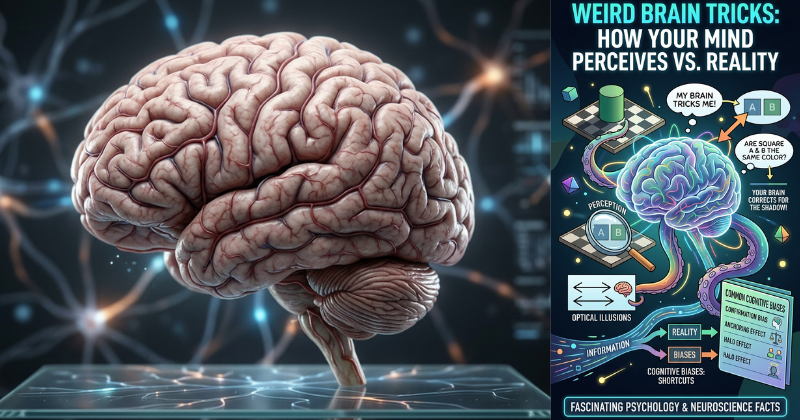
Your brain is incredibly powerful. It helps you think, solve problems, remember experiences, and make decisions every day. But surprisingly, your brain can also trick you in strange ways. Sometimes what you see, remember, or believe isn’t completely accurate.
These mental shortcuts help the brain process information quickly, but they can also lead to confusing perceptions, false memories, and unexpected reactions.
Here are some of the most fascinating ways your brain can trick you without you realizing it.
1. Your Brain Fills in Missing Information
Your brain hates incomplete information. When something is missing, it often fills in the gaps automatically.
For example, when reading a sentence with a few missing letters, your brain can still understand the meaning because it predicts what should be there.
This ability helps with fast reading and recognition, but it also means your brain can assume things that may not actually be correct.
2. You Can Create False Memories
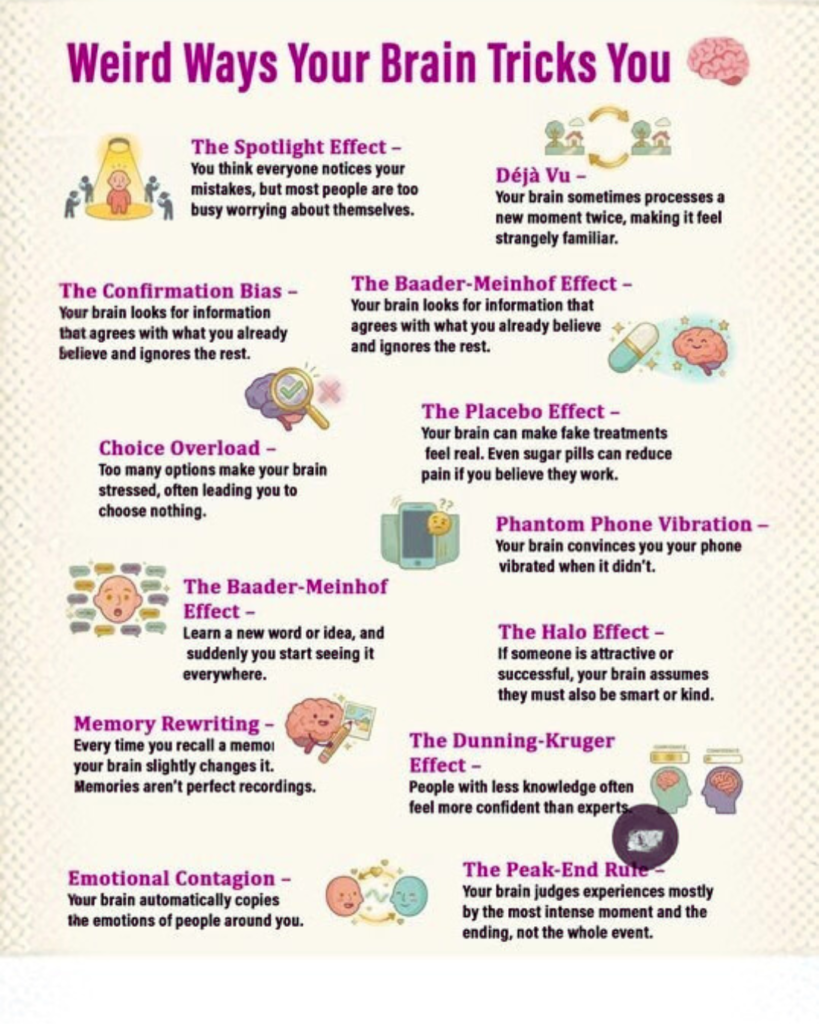
Memory doesn’t work like a perfect recording. Every time you recall a memory, your brain slightly reconstructs it.
Over time, details can change, disappear, or even be replaced with new information. This is why two people can remember the same event very differently.
Your brain isn’t lying—it’s simply trying to rebuild the memory from pieces.
3. Optical Illusions Fool Your Eyes
Sometimes your brain interprets visual information incorrectly.
Optical illusions happen because your brain tries to interpret shapes, shadows, and depth based on past experiences.
This can make:
- Straight lines appear curved
- Still images appear to move
- Colors appear different depending on surrounding colors
Your eyes see one thing, but your brain interprets it another way.
4. The “Placebo Effect”
The brain can influence how your body feels. If someone believes a treatment will help them, they may actually feel better even if the treatment contains no active ingredient.
This phenomenon is known as the placebo effect, and it shows how powerful expectations can be.
Belief alone can sometimes influence how people experience symptoms.
5. The Brain Loves Patterns
Humans are naturally wired to find patterns, even when they don’t exist.
Your brain constantly tries to connect information to make sense of the world.
This is why people sometimes:
- See shapes in clouds
- Hear hidden words in songs
- Notice patterns in random events
This ability helped humans survive by recognizing dangers quickly, but it can also lead to false assumptions.
6. Your Brain Can Misjudge Time
Have you ever noticed time feeling faster or slower depending on what you’re doing?
When you’re bored, time seems to move slowly. When you’re having fun, hours can pass quickly.
Your brain processes time based on attention and emotional engagement, not a fixed internal clock.
7. You Notice What You Focus On
When you focus on something, your brain filters out other information around you.
This is called selective attention.
A famous example shows people missing obvious events because they are concentrating on a specific task.
Your brain does this to prevent overload, but it means you can miss things happening right in front of you.
8. Expectations Shape What You See
What you expect to happen can influence what you believe you saw or heard.
For example, if someone tells you a food tastes great, you may perceive it as better.
Your brain constantly combines expectations and sensory input to interpret experiences.
9. The Brain Remembers Emotions More Than Details
When recalling past experiences, the emotional feeling is often remembered more strongly than the actual details.
You might remember how something felt, even if the exact events are blurry.
This is why emotional experiences tend to stay in memory longer.
10. Your Brain Makes Fast Judgments
The brain often makes rapid decisions based on limited information.
These quick judgments help us react quickly, but they can also lead to biases and mistakes.
Your brain is constantly balancing speed and accuracy when interpreting the world.
Conclusion
The human brain is an extraordinary organ, but it doesn’t always give us a perfectly accurate picture of reality. From false memories to optical illusions and pattern recognition, your brain is constantly interpreting information in ways that can sometimes trick your perception.
Understanding these mental quirks can help you think more critically and appreciate just how fascinating the brain truly is.
Sometimes the strangest tricks happening in the world… are happening inside our own minds.