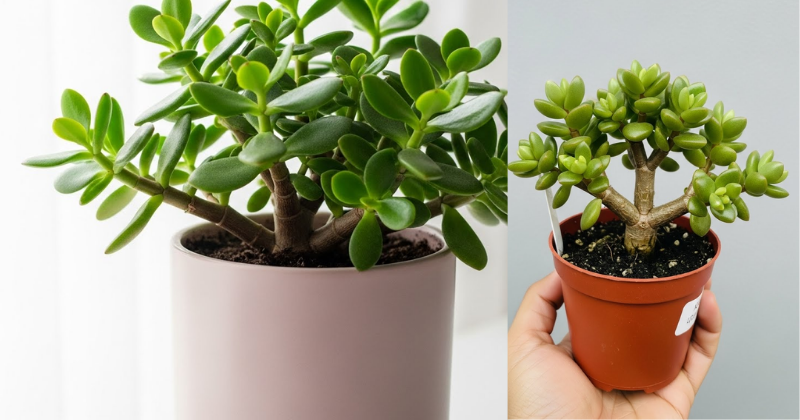
The beautiful Jade Plant (Crassula ovata) is a beloved succulent famous for its resilient nature and coin-shaped leaves, earning it the nickname “money plant.” However, even the toughest succulents have a weakness: improper watering. Knowing when to water a Jade Plant is the single most critical factor in keeping it healthy and thriving. Overwatering is the number one killer of these popular houseplants. This Gardening Topics guide will transform your approach to succulent care, teaching you the precise methods and environmental cues needed to achieve perfect hydration, ensuring your Jade Plant grows into a magnificent, long-lived specimen.
💧 Section 1: Foundation First: Understanding the Jade Plant’s Water Needs
To master when to water a Jade Plant, you must first appreciate its desert origins and how its unique anatomy stores moisture. This is key to building confidence with basic concepts.
H3: Key Components: The Succulent Advantage
Jade Plants are succulents, meaning they have evolved specialized tissues to store water during long periods of drought.
- Water Storage: The thick, fleshy leaves of the Jade Plant are essentially mini-reservoirs. This connection with nature means the plant is far more tolerant of underwatering than overwatering. Overwatering causes cells to burst, leading to fatal root rot.
- Encouraging Reassurance for Beginners: If you are new to succulents, remember this rule: When in doubt, wait one more day. This slight caution provides an achievable expectation for preventing the most common mistake.
H3: Addressing Common Concerns: The Danger of Rote Scheduling
Many new plant owners try to stick to a fixed schedule (e.g., “water every Sunday”). This is the enemy of succulent health.
- Environmental Variations: The needs of your Jade Plant fluctuate wildly based on factors like light intensity, temperature, and humidity. A Jade Plant in a sunny, dry south-facing window in summer will need water far more often than one sitting in a dim, cool spot in winter.
- The Golden Rule: Never water based on the calendar. Instead, always water based on the soil dryness and the plant’s physical cues.
🗓️ Section 2: Core Methods: How to Determine When to Water a Jade Plant
The most reliable way to know when to water a Jade Plant involves a simple two-part check: observing the soil and observing the plant itself.
Step 1: The Soil Check (Actionable Language)
Before you reach for the watering can, check the soil deeply. This is the core method for all succulent care.
- The Finger Test: Insert your finger $1 \text{ to } 2 \text{ inches}$ into the soil near the edge of the pot. Practical tips and shortcuts: For larger pots, you may need to go $3 \text{ to } 4 \text{ inches}$ deep.
- The Verdict: If the soil feels damp or cool at this depth, do not water. If the soil feels completely dry and crumbly, proceed to the plant cue check.
- The Chopstick Trick: If you prefer to keep your fingers clean, insert a wooden chopstick into the center of the pot. Leave it for a minute, then pull it out. If it comes out clean and dry, it’s time to water. If it comes out with dark, clinging soil, the pot is still moist.
Step 2: Reading Plant Cues (Practical Examples)
Jade Plants communicate their need for water through their foliage. Learning these subtle signals is key to perfect Jade Plant care.
- The Full, Firm Leaf (Not Thirsty): A well-hydrated Jade Plant has thick, rigid, plump leaves. If you gently squeeze a leaf between your thumb and forefinger, it should feel firm and resistant. Do not water.
- The Wrinkled or Soft Leaf (Thirsty!): When the plant has used up its stored water, the leaves will begin to look slightly wrinkled, shriveled, or feel soft and pliable. They may even start to look slightly deflated. Water immediately. This is the real-world scenario signaling proper timing.
Step 3: Core Watering Method (Clear, Actionable Language)
Once you confirm your Jade Plant is thirsty, use the “Soak and Dry” method.
- Soak Completely: Pour water over the soil until it runs freely out of the drainage hole at the bottom of the pot. Ensure the entire soil volume is saturated.
- Drain Thoroughly: Let the pot sit for $10 \text{ to } 15 \text{ minutes}$ to drain completely. Preventive measures: Never leave your Jade Plant sitting in a saucer full of water. Dump any excess water from the saucer. This prevents the roots from sitting in standing water, which inevitably causes root rot.
☀️ Section 3: Seasonal Strategies: Water Timing and Regional Variations
When to water a Jade Plant changes dramatically depending on the season, directly reflecting its growth cycle. Seasonal considerations are essential for healthy growth.
H3: Active Growth: Spring and Summer Watering
Jade Plants are typically active growers during the spring and summer months, when light is intense and temperatures are warm.
- Increased Frequency: During this period, you will need to water more frequently—possibly once every $1 \text{ to } 2 \text{ weeks}$, but always check the soil and plant cues first. The plant is actively consuming water to produce new branches and leaves.
- Encouraging Experimentation: Feel the weight of the pot immediately after watering. Then, when the soil is fully dry, feel the weight again. You will notice a dramatic difference. Using pot weight as an indicator is a great way to customize approach to hydration timing.
H3: Dormancy: Fall and Winter Watering
During late fall and winter, Jade Plants naturally enter a period of semi-dormancy, especially indoors where temperatures and light levels drop.
- Reduced Frequency: Water requirements slow dramatically. You may only need to water once every $3 \text{ to } 4 \text{ weeks}$, or even longer. The goal is simply to prevent the root system from desiccating entirely, not to encourage active growth.
- The Cold Factor: If your Jade Plant is kept near a cold window, keep the soil even drier. Cold, wet soil is a guaranteed recipe for root death. This is a critical factor in regional variations for indoor plants.
🚨 Section 4: Troubleshooting: Dealing with Over- and Under-Watering
The visual cues your Jade Plant provides are the best defense against common watering challenges. Learning to read them is the ultimate practical troubleshooting tip.
Featured Snippet Potential: “What does an overwatered Jade Plant look like?”
An overwatered Jade Plant often displays soft, mushy, yellowing, or translucent leaves that may drop easily from the stem. The stem itself may also feel soft and brown near the soil line, indicating fatal root rot. If you suspect overwatering, stop watering immediately, remove the plant from its pot, inspect the roots for mushiness, and repot in fresh, dry, well-draining soil.
Practical Troubleshooting Tips
- Problem: Wrinkled leaves that don’t plump up after watering (Under-watering).
- Obstacle: The soil has become so dry that it is hydrophobic (repels water). When you water, the water runs around the soil ball and out the drainage hole, never reaching the roots.
- Solution: Offer Alternative Approaches: Submerge the entire pot (up to the rim) in a bucket of water for $30 \text{ minutes}$. This allows the soil to fully rehydrate. Remove the pot and allow it to drain thoroughly before returning it to its spot.
- Problem: Lower leaves turning yellow and dropping easily (Over-watering).
- Obstacle: Root rot has begun.
- Solution: Encouragement for Setbacks: Immediately stop watering. Remove the plant from the pot. Trim away any brown, black, or mushy roots (these are dead) using sterilized scissors. Let the healthy roots air dry for $24 \text{ hours}$ before repotting in completely dry, fresh succulent mix. Do not water again for at least a week.
- Problem: White, crusty buildup on the soil surface.
- Obstacle: Mineral salts and chemicals from tap water accumulating as the water evaporates.
- Solution: Preventive Measures: Periodically flush the soil by watering deeply and slowly for several minutes, allowing extra water to leach out the minerals. Consider watering with distilled or rainwater to minimize salt buildup.
📈 Section 5: Maximizing Results: Next Level Hydration Tips
Beyond simply knowing when to water a Jade Plant, these next level tips focus on the environment and complementary strategies to ensure long-term health and impressive growth.
- Show How to Build Upon Basic Success: Soil Quality is Paramount. Ensure your plant is in a highly porous, gritty mix. Ideal succulent soil usually contains coarse sand, perlite, or pumice mixed with regular potting soil. This aids drainage and prevents water from pooling, making your watering judgment more forgiving. (Internal Linking Opportunity: Check out our guide on “Mixing the Perfect Potting Soil for Succulents.”)
- Maintenance and Long-Term Considerations: Unglazed Terracotta Pots. Choose unglazed terracotta over plastic or glazed pots. Terracotta is porous, allowing excess moisture to evaporate through the pot walls, which is an excellent long-term consideration for preventing the dreaded overwatering scenario.
- Suggest Complementary Strategies: Humidity Adjustment. If you live in a very humid environment, you must extend the time between waterings, as the soil will take longer to dry. Conversely, in dry desert climates, you may need to check the soil more frequently. This is how you inspire continued growth and learning by observing your local ecosystem benefits.
✅ Conclusion: Your Capability to Nurture Your Jade Plant
You now have the tools and knowledge to confidently determine when to water a Jade Plant. By moving away from fixed schedules and embracing the two-part check—observing the dry soil and the wrinkled leaves—you have unlocked the secret to perfect succulent hydration. Remember: a little neglect is always better than too much love when it comes to Crassula ovata. You have the capability to succeed in nurturing this beautiful plant, ensuring it thrives for decades to come.
Are you ready to check your Jade Plant’s leaves? Does it look firm and full, or is it time for a drink?