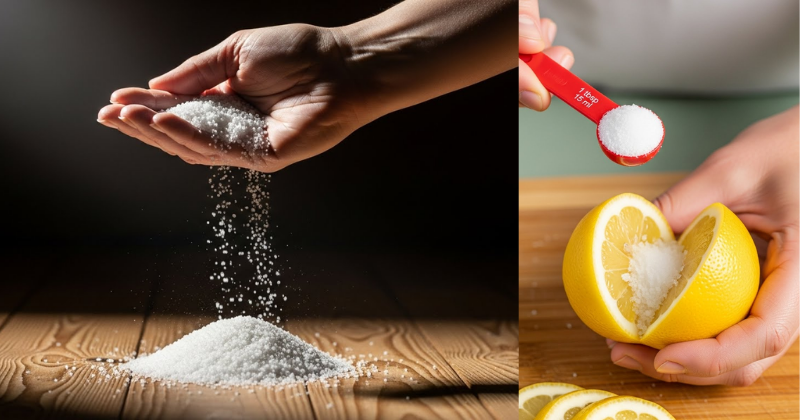
There’s a memory etched in my childhood like an ancient ritual—my grandmother, apron dusted with crystalline white, moving through her home with nothing but coarse salt and the wisdom of generations. She would smile knowingly as modern cleaners lined store shelves, her hands reaching instead for that timeless mineral that once preserved empires and purified temples. What she understood, and what I’ve rediscovered in my own home, is that salt carries within its simple granules a power that transcends chemistry—it’s an inheritance of practical magic, a bridge between the wisdom of our ancestors and the conscious choices we make today.
When I first watched her sprinkle salt along her kitchen counter and scrub with the confidence of someone who knew exactly what would happen, I thought it was merely nostalgia guiding her hands. But years later, standing in my own kitchen surrounded by bottles of chemicals I couldn’t pronounce, I remembered that quiet certainty in her movements. I reached for the salt, and in that moment, everything changed.

The Ancient Wisdom Behind Salt’s Cleaning Power
Salt has walked alongside humanity for millennia, serving as currency, preservative, and sacred substance. But its role as a cleaning agent runs deeper than folklore—it’s rooted in genuine science that our grandmothers understood intuitively.
The Natural Chemistry of Salt
Salt crystals possess an abrasive structure gentle enough for most surfaces yet powerful enough to lift stubborn residues. When dissolved, salt creates an environment hostile to bacteria and certain microorganisms, acting as a natural disinfectant without harsh chemical compounds. The hygroscopic nature of salt means it draws moisture from its surroundings, making it exceptionally effective at addressing dampness and the problems that follow—mold, mildew, and lingering odors that cling to forgotten corners.
My grandmother never spoke of sodium chloride molecules or osmotic pressure, yet she knew that salt could transform a stained cutting board into a pristine surface, that it could breathe freshness into musty drains, that it could restore the gleam to tarnished copper pots that had witnessed decades of family meals.
Why Traditional Methods Endure
There’s a reason these practices survived generations without the backing of marketing campaigns or colorful packaging. Salt cleaning works because it addresses fundamental problems with fundamental solutions. It doesn’t mask odors—it neutralizes them. It doesn’t coat surfaces with artificial shine—it actually cleans. And perhaps most importantly, it doesn’t introduce unknown substances into our homes, onto our hands, or into the water systems that connect us all to the wider world.
The Salt Cleaning Rituals I’ve Inherited and Refined
Watching my grandmother clean was like witnessing a dance where every movement had purpose, every application had been perfected through countless repetitions. These are the techniques that now grace my own home, adapted for modern life yet faithful to their origins.
Kitchen Transformations with Salt
The kitchen was grandmother’s domain, and salt was her most trusted ally. For cutting boards that absorbed the essence of onions and garlic, she would create a paste of coarse salt and lemon juice, letting the combination work its alchemy for several minutes before scrubbing in circular motions that seemed almost meditative. The salt lifted stains while the citric acid brightened and deodorized, leaving behind nothing but clean wood and the fresh scent of lemons.
Cast iron skillets received similar devotion. Rather than harsh soaps that would strip the seasoning her mother had built up over years, she used salt as a gentle abrasive, scrubbing away food particles while preserving that precious patina. A handful of coarse salt, a splash of warm water, and a vigorous scrub with a cloth—the pan would emerge ready for another generation of family recipes.
Coffee and tea stains that clung stubbornly to cups met their match in a simple combination of salt and a touch of vinegar. The gentle abrasion combined with mild acidity dissolved even the most persistent discoloration, restoring ceramics to their original brightness without scratching or dulling.
Bathroom Brilliance Through Salt
The bathroom presented different challenges, but salt rose to meet them all. Drains that threatened to slow or smell would receive a treatment of boiling water followed by generous amounts of salt, sometimes combined with baking soda for particularly stubborn situations. The salt would scour the pipes naturally while discouraging buildup and eliminating odors at their source.
Tile grout, that perpetual challenge of bathroom maintenance, responded beautifully to a paste of salt and vinegar. The combination would sit on the grout lines, working its way into microscopic crevices before being scrubbed away with an old toothbrush—a technique that required patience but delivered results no commercial cleaner could match.
Beyond the Basics: Creative Salt Applications
My grandmother taught me that salt’s versatility extended far beyond obvious cleaning tasks. Fresh spills on carpets or upholstery would receive an immediate covering of salt, which absorbed the liquid before it could set into permanent stains. Wine, coffee, even blood—salt would draw out the moisture, and with it, the potential for lasting damage.
Vases that developed that cloudy film from hard water and flower stems would be filled with warm water, salt, and a handful of raw rice, then swirled vigorously. The combination of salt’s dissolving power and rice’s gentle abrasion would restore clarity to glass that seemed permanently hazed.
Refrigerators and coolers, prone to developing unpleasant odors, would be wiped down with salt water solutions that neutralized smells rather than covering them with artificial fragrances. The same technique worked for lunch boxes, thermoses, and any container that held food and developed that distinctive stale smell.
The Modern Benefits of This Timeless Practice
Returning to salt cleaning isn’t simply nostalgia or a rejection of progress—it’s a conscious choice that addresses very real concerns in our contemporary world.
Environmental Harmony
Every time we rinse chemical cleaners down our drains, we’re sending complex compounds into water systems that must process and filter them. Salt, by contrast, is a mineral already present in nature. It dissolves harmlessly, requires no special treatment, and poses no threat to aquatic ecosystems. When I clean with salt, I know that what flows from my home into the wider world carries no burden of synthetic chemicals or mysterious ingredients.
The packaging alone tells a story—salt comes in simple containers, often recyclable, requiring no special disposal. There are no warning labels about keeping it away from children or pets, no emergency hotline numbers for accidental exposure, no cautionary symbols indicating hazards to humans or environment.
Health and Safety Considerations
My grandmother’s hands, even in her later years, remained soft and untroubled by the irritation so common among those who clean regularly with commercial products. Salt doesn’t trigger allergies or sensitivities. It doesn’t release volatile organic compounds into the air we breathe. Children and pets can be present during cleaning without concern, and surfaces don’t need to be rinsed multiple times to ensure safety.
For those with respiratory sensitivities, chemical sensitivities, or simply a desire to reduce exposure to unnecessary substances, salt cleaning offers a path forward that doesn’t compromise effectiveness for safety.
Economic Wisdom
A large container of quality salt costs less than a single bottle of specialized cleaner, yet it can address dozens of cleaning challenges throughout the home. There’s no need for separate products for kitchen, bathroom, floors, or surfaces—salt adapts to the task at hand. This simplicity doesn’t just save money; it saves space, reduces decision fatigue, and eliminates the clutter of multiple bottles and sprays.
Mastering the Art: Advanced Salt Cleaning Techniques
As I’ve deepened my practice with salt cleaning, I’ve discovered refinements and combinations that enhance its already impressive capabilities.
Creating Effective Salt Combinations
Salt pairs beautifully with other natural cleaning agents, creating synergies that address specific challenges. Combined with baking soda, it tackles tough scrubbing jobs and neutralizes odors with exceptional effectiveness. Mixed with lemon juice or vinegar, it gains acidic power for dissolving mineral deposits and cutting through grease. Blended with essential oils, it can provide pleasant scents while maintaining cleaning power—though my grandmother would argue that clean has its own beautiful smell that needs no embellishment.
For routine maintenance, I keep several mason jars filled with different salt combinations—one with salt and dried lavender for refreshing carpets, another with salt and lemon zest for kitchen cleaning, a third with salt and baking soda for bathroom applications. These pre-mixed blends save time while maintaining the natural approach that drew me back to these methods.
Seasonal and Preventive Applications
Salt’s uses extend beyond active cleaning into preventive maintenance. During humid months, small bowls of salt placed in closets and cabinets absorb excess moisture, preventing the musty smells and potential mold growth that plague spaces with poor air circulation. This simple practice keeps clothes and linens fresh without chemical moisture absorbers or artificial fragrances.
In winter, salt solutions can prevent frost buildup on windows and mirrors, while in summer, they can discourage ants and certain insects from establishing trails into the home—a discovery that would have delighted my grandmother, who viewed pests as problems requiring strategic thinking rather than chemical warfare.
Embracing the Salt Cleaning Journey
The shift from chemical-dependent cleaning to salt-based methods isn’t always instantaneous. Some surfaces and situations genuinely benefit from modern products, and there’s no shame in using them when appropriate. But what I’ve discovered, following in my grandmother’s footsteps, is that the vast majority of cleaning needs can be met with salt, water, and occasionally a few complementary natural ingredients.
The transformation goes beyond clean surfaces. There’s a different quality to a home cleaned with salt—a freshness that doesn’t announce itself with artificial fragrances, a cleanliness that feels somehow more honest, more connected to the earth that provided both the mess and the means of cleaning it.
When visitors comment on how fresh my home feels, how it somehow smells clean without smelling like cleaning products, I think of my grandmother. I imagine her knowing smile, the way her hands moved with such confidence through tasks that seemed complicated only because we’d forgotten their essential simplicity.
Salt cleaning taught me that the old ways persisted not because our ancestors lacked innovation, but because they’d discovered solutions so effective, so elegant in their simplicity, that no improvement was necessary. In a world increasingly complex, increasingly full of choices and chemicals and concerns, there’s profound peace in reaching for that simple container of salt, in knowing that what worked for generations will work for me, and perhaps someday for my own grandchildren, who might watch me with the same curiosity I once directed toward my grandmother.
The secret was never really secret at all—it was simply waiting, patient as salt itself, for us to remember that sometimes the most powerful solutions are the ones that have been with us all along.