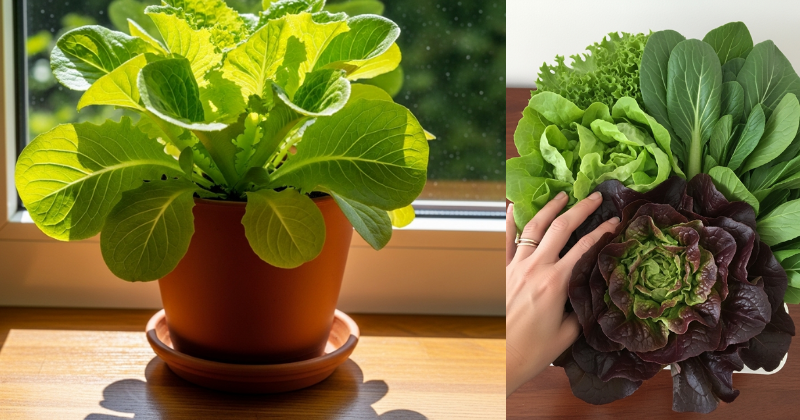
Dreaming of crisp, homegrown salads year-round, regardless of the weather outside? Learning how to grow the best lettuce indoors is a highly rewarding gardening project that brings fresh flavor right to your kitchen. While growing lettuce seems easy, achieving the lush, non-bitter, best lettuce indoors requires mastering a few surprising techniques. This guide reveals 7 little-known secrets to help you transform a simple window box into a productive, continuous salad bar, empowering you to discover the joy and achieve ongoing success with your indoor greens.

💡 Foundation First: The Indoor Lettuce Mindset
Growing lettuce successfully inside is about replicating its preferred outdoor environment—a cool, breezy spring day—and maintaining that condition consistently. This requires an encouraging reassurance for beginners: while you control the environment, lettuce plants are sensitive and thrive on consistency.
H3: Building Confidence with Basic Concepts
Lettuce (Lactuca sativa) is a cool-season crop. When stressed by heat, lack of water, or insufficient light, it undergoes a process called “bolting,” where the plant shifts its energy from leaf production to seed production, causing the leaves to become tough and bitter.
| Basic Need | Indoor Challenge | Beginner Reassurance |
| Light | Low indoor light leads to leggy, weak growth. | Affordable grow lights solve this challenge completely. |
| Temperature | High indoor heat triggers premature bolting and bitterness. | Strategic placement and ventilation are key components. |
| Water | Overwatering causes root rot, underwatering causes bitterness. | Use the “finger test” for perfect soil moisture balance. |
If you can master the cool temperature and light requirements, you are already halfway to growing the best lettuce indoors.
🤫 Section 1: The 7 Little-Known Secrets to Superior Indoor Lettuce
This section dives into the 7 little-known secrets that differentiate decent indoor lettuce from the absolute best. These techniques are often overlooked but are crucial for maximizing flavor, texture, and harvest duration.
Secret 1: The “Cool-Root” Phenomenon (Temperature Control)
It is widely known that lettuce prefers cool air, but the soil temperature is even more critical. Lettuce roots hate being warm.
- The Secret: Aim to keep the root zone cool, ideally between $50^{\circ}\text{F}$ and $65^{\circ}\text{F}$ ($10^{\circ}\text{C}$ to $18^{\circ}\text{C}$). If you are growing and nurturing lettuce near a sunny window or on top of a heat-emitting appliance, the soil will warm up too much.
- Pro Tip: Place pots directly on a cool stone, tile, or concrete surface, or use clay pots, which allow for better evaporative cooling than plastic.
Secret 2: Pre-Chilling Seeds for Optimal Germination (Timing Consideration)
While lettuce germinates easily, many seeds won’t sprout if the temperature is too high—a phenomenon known as thermal dormancy.
- The Secret: Before planting, place your lettuce seeds, wrapped in a damp paper towel inside a sealed plastic bag, in the refrigerator for 2-3 days. This simulated “cold snap” breaks dormancy and ensures a higher, faster germination rate, especially beneficial for seasonal considerations when starting indoors.
Secret 3: The Blue-Light Bias (Light Optimization)
The type of light matters just as much as the duration.
- The Secret: Lettuce thrives under light with a higher concentration of blue spectrum light. While red light encourages flowering (which we want to avoid), blue light promotes vigorous vegetative growth and compact, crisp leaf structure.
- Pro Tip: When choosing an $\text{LED}$ grow light, select a “cool white” or “full spectrum” light that has a high Kelvin rating (around 6,500K) or specifically emphasizes blue wavelengths. Ensure the lights are kept very close—just 4-6 inches above the growing leaves. (Internal Linking Opportunity: For detailed guidance on specific lights, see our article, “Choosing the Best LED Lights for Indoor Edibles.”)
Secret 4: The 16-Hour Photosynthesis Cycle (Duration)
More light isn’t always better for lettuce.
- The Secret: Lettuce requires 12 to 16 hours of light per day for optimal growth, but it must have a mandatory period of darkness (at least 8 hours). This darkness is crucial for the plant’s biological cycles and prevents tip burn, a common indoor gardening frustration.
- Actionable Tip: Use a simple appliance timer to automate your light schedule, ensuring consistency.
Secret 5: The “Bottom Watering” Rule (Moisture Management)
Overhead watering can splash soil onto leaves, inviting fungal diseases like downy mildew, and doesn’t promote deep root development.
- The Secret: Always water your indoor lettuce from the bottom. Place your pots in a saucer or tray filled with 1 inch of water and allow the soil to soak it up through the drainage holes for 20-30 minutes.
- Benefit: This forces the roots to grow downward, strengthening the plant and ensuring the water reaches the entire root ball uniformly.
Secret 6: Fertilizer Dilution (Nutrient Management)
Lettuce is a “light feeder,” meaning it needs nutrients but is easily burned by concentrated fertilizers.
- The Secret: Use a balanced, water-soluble fertilizer (like a $5$-$5$-$5$ or $10$-$10$-$10$ NPK) but dilute it to half or even quarter strength of the recommended dosage.
- Actionable Tip: Apply the ultra-diluted fertilizer every second watering, not every time. This provides the necessary boost of Nitrogen for leaf growth without risking fertilizer burn or bitterness.
Secret 7: The “Haircut” Harvest Method (Maximizing Yield)
Many beginners harvest the entire head, ending the plant’s life prematurely.
- The Secret: For non-heading varieties (like loose-leaf or butterhead), use the “cut and come again” method. Use scissors to snip off the outer, mature leaves, leaving the inner four to six leaves to continue growing.
- Result: This ensures a continuous harvest from the same plant for weeks or even months, greatly increasing your total yield and maintaining a fresh supply.
🪴 Step-by-Step Process: Setting Up Your Indoor Salad Garden
Now that you know the 7 little-known secrets to grow the best lettuce indoors, here is the actionable setup process.
Core Methods: Getting Started
- Choose the Right Container: Select shallow containers, as lettuce roots are shallow. A depth of 6-8 inches is sufficient. Ensure excellent drainage.
- Soil Selection: Use a high-quality, sterile potting mix that is light and fluffy. Avoid garden soil, which compacts easily and can introduce pests. (Internal Linking Opportunity: Learn how to create your own sterile potting mix in our article, “Sterilizing Soil for Indoor Gardening.”)
- Sow the Seeds: Plant seeds thinly on the surface and cover with just 1/8 inch of soil. Water gently from the bottom.
- Thinning: Once seedlings develop their second set of true leaves, thin them out immediately. Leafy varieties need about 4-6 inches of space between plants to grow large and crisp. Encouraging reassurance for beginners: removing excess seedlings can feel wasteful, but it’s essential for the survival and quality of the remaining plants.
🐛 Troubleshooting: Common Challenges and Solutions
Even when following the secrets, indoor gardening presents unique issues. Applying these practical troubleshooting tips will help you address frequent obstacles with solutions.
Featured Snippet Potential: “Why is my indoor lettuce tasting bitter and getting leggy?”
Your indoor lettuce is tasting bitter and getting leggy because it is stressed by insufficient light and high heat. Leggy growth is a sign the plant is stretching for light, and bitterness (bolting) is the result of warm soil temperatures (above $75^{\circ}\text{F}$) or inconsistent watering. To fix this, move your $\text{LED}$ grow light closer (4-6 inches away) and use the “Cool-Root” secret by placing the pot on a cool surface.
Practical Troubleshooting Tips
- Problem: Small, Pale Leaves.
- Likely Cause: Nitrogen deficiency (lack of food) or insufficient light intensity.
- Solution: Begin applying the ultra-diluted fertilizer (Secret 6) every two waterings. If the leaves are still pale, increase the light duration or move the light source closer to the leaves.
- Problem: Fungus Gnats or Mold on Soil Surface.
- Likely Cause: Overwatering. Fungus gnats and mold thrive in perpetually damp, overly organic soil.
- Solution: Immediately adopt the “Bottom Watering” rule (Secret 5). Allow the top 1-2 inches of soil to dry out completely between waterings. For a quick fix, sprinkle a thin layer of sand or diatomaceous earth on the soil surface to deter gnats.
🥬 Maximizing Results: Next Level Tips for Continuous Harvest
Now that you are producing great lettuce, the next level is achieving a truly continuous, long-term harvest.
- Succession Planting: Start a new batch of seeds every 10-14 days. This ensures that when one plant reaches the end of its harvest life, a new batch is ready for picking, maintaining a constant supply. This maintenance and long-term consideration is the cornerstone of sustainable indoor gardening.
- The Refrigerator Rinse: Before serving your harvested leaves, give them a quick soak in ice-cold water for 5-10 minutes. This crisping process firms up the leaves, removing any residual bitterness and guaranteeing that incredible crunch you look for in the best lettuce indoors.
- Complementary Strategy: Integrate easy-to-grow herbs, like basil or chives, alongside your lettuce. They often thrive under similar conditions and create a self-contained “salad bowl” ecosystem, supporting continued growth and learning in your indoor garden.
✅ Conclusion: Your Capability to Grow Crispness
You are now equipped with the 7 little-known secrets to grow the best lettuce indoors, transforming the dream of year-round greens into a crisp, delicious reality. By focusing on root temperature control, specialized lighting, and tailored nutrient management, you have the achievable, actionable steps needed to sustain a vibrant indoor garden.
Embrace the empowering satisfaction of harvesting your own crisp, non-bitter leaves whenever you wish. Your capability to master indoor gardening is now unlocked!
Which of the 7 little-known secrets—The “Cool-Root” Phenomenon or The Blue-Light Bias—will you implement today to transform your current indoor setup?