Introduction (Meta Description)
Astronomers have observed a supermassive black hole belching winds at 30,000 miles per second, revealing how extreme outflows shape galaxies and cosmic evolution.
What does it mean when a supermassive black hole “belches” ultra-fast winds?
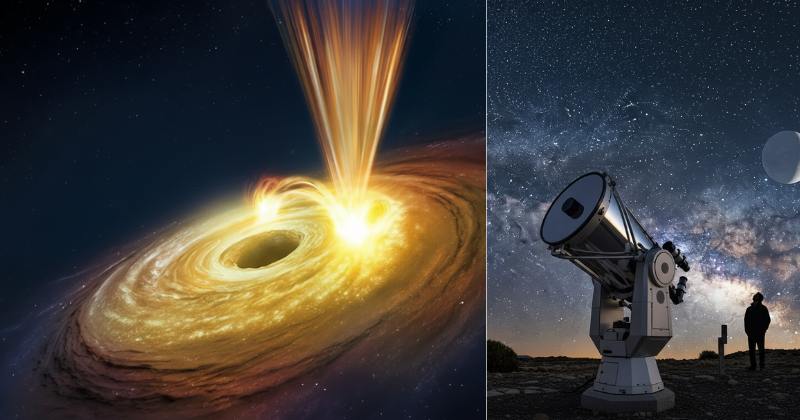
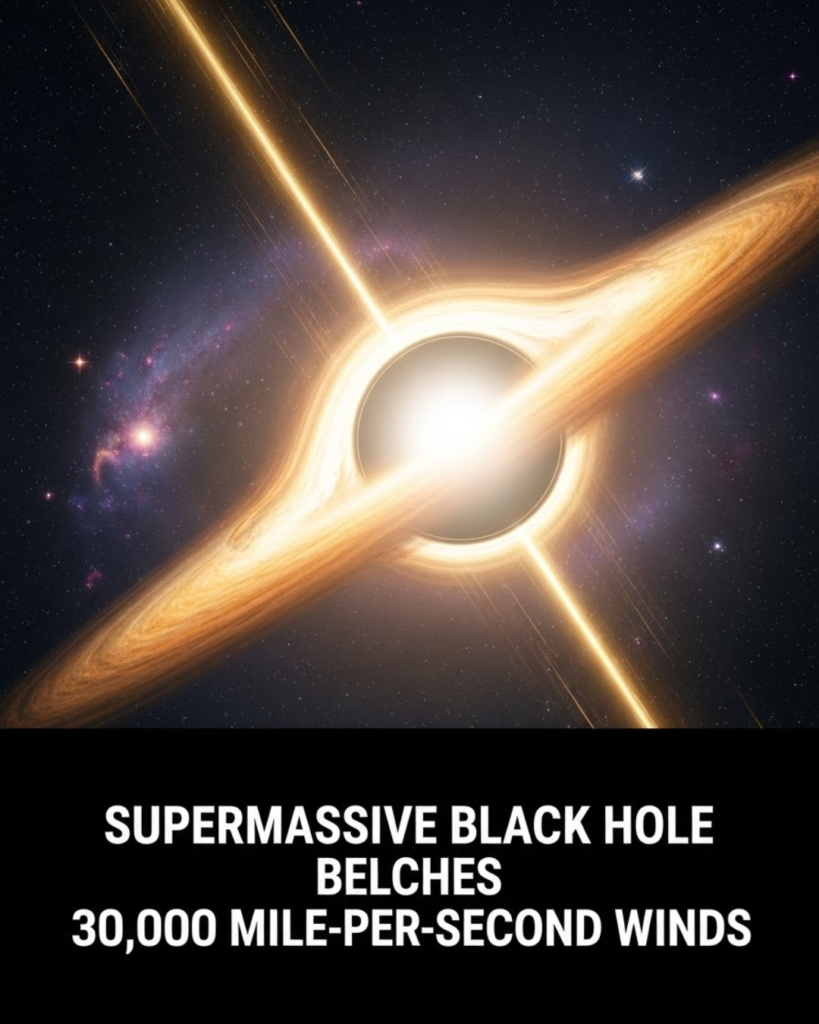
When scientists say a supermassive black hole “belches” winds traveling at 30,000 miles per second—roughly 0.16 times the speed of light—they are describing a powerful astrophysical outflow launched from the region just outside the black hole’s event horizon. These winds are not gentle breezes. They are torrents of ionized gas expelled with immense energy as matter spirals toward the black hole.
Supermassive black holes themselves do not emit matter from inside the event horizon. Instead, the winds originate in the accretion disk, the superheated, rapidly rotating disk of gas and dust surrounding the black hole. As material heats up and compresses, part of it is violently ejected outward rather than swallowed.
The term “belching” reflects the episodic and explosive nature of these events. Observations show that such winds can switch on and off, sometimes strengthening dramatically over short cosmic timescales. This makes them critical clues for understanding black hole feeding behavior and energy release.
How were 30,000 mile-per-second black hole winds detected?
Detecting winds moving at tens of thousands of miles per second requires precision instruments and indirect measurement techniques. Astronomers rely primarily on X-ray spectroscopy to identify these extreme outflows.
When ultra-fast winds pass between a black hole and Earth, they absorb specific wavelengths of X-ray light. These absorption lines appear blue-shifted, meaning they are displaced toward higher energies due to the Doppler effect. The amount of shift reveals the wind’s velocity.
Space-based observatories such as XMM-Newton, Chandra, and NuSTAR are particularly effective at identifying these signatures. In several recent observations, astronomers detected iron absorption lines shifted so dramatically that only winds traveling at around 30,000 miles per second could explain them.
Repeated observations confirm that these winds are not measurement errors. Their consistency across different telescopes and time periods strengthens the conclusion that such extreme outflows are real, persistent phenomena.
What physical processes launch winds at such extreme speeds?
Launching matter at 30,000 miles per second requires extraordinary forces. Three primary mechanisms are believed to work together near supermassive black holes.
Radiation pressure from the accretion disk
As matter falls toward the black hole, it heats up and emits intense radiation. This radiation can exert pressure on surrounding gas, pushing it outward. When luminosity approaches a critical threshold, radiation pressure becomes strong enough to expel material at relativistic speeds.
Magnetic field acceleration
Powerful magnetic fields threading the accretion disk can act like cosmic slingshots. Twisted magnetic field lines transfer rotational energy into kinetic energy, flinging plasma outward along magnetic channels.
Thermal and relativistic effects
Near the black hole, temperatures reach millions of degrees. This extreme heat contributes additional pressure, helping overcome gravitational pull. Combined with relativistic effects, it allows gas to escape at astonishing velocities.
These processes do not operate in isolation. The fastest winds likely result from a synergistic interaction between radiation, magnetism, and gravity.
Which supermassive black holes produce the fastest winds?
Not all supermassive black holes generate ultra-fast outflows. Observations suggest that the most extreme winds are associated with actively feeding black holes, known as active galactic nuclei (AGN).
AGN-powered galaxies often display:
- High accretion rates
- Intense X-ray and ultraviolet emission
- Variable luminosity over short timescales
Black holes with masses ranging from millions to billions of solar masses can produce such winds, but speed correlates more strongly with accretion activity than mass alone.
Quasars—among the brightest objects in the universe—are especially prone to generating these powerful outflows. Their enormous energy output provides ideal conditions for launching winds at a significant fraction of light speed.
How do ultra-fast black hole winds affect their host galaxies?
The discovery of 30,000 mile-per-second winds has major implications for galaxy evolution. These outflows are a key component of what astronomers call black hole feedback.
As winds slam into surrounding gas, they can:
- Heat interstellar material
- Disrupt star-forming regions
- Expel gas from galactic centers
This process can suppress star formation, effectively starving galaxies of the raw materials needed to create new stars. In some cases, winds may even regulate galaxy size and structure.
Ironically, while these winds can shut down star formation locally, they may also trigger star formation farther out by compressing gas clouds. The net effect depends on wind strength, geometry, and the galaxy’s environment.
Why are 30,000 mile-per-second winds important for black hole growth models?
For decades, astronomers struggled to explain why black hole mass correlates so tightly with galaxy properties such as bulge size and stellar velocity dispersion. Ultra-fast winds provide a missing piece of this puzzle.
By ejecting material, winds:
- Limit how fast black holes can grow
- Regulate gas inflow into galactic centers
- Establish feedback loops between black holes and galaxies
Models that include these winds better reproduce observed galaxy populations across cosmic time. Without them, simulations tend to produce galaxies that are too massive and too bright compared to reality.
The presence of such powerful outflows suggests that black holes are not passive cosmic sinks but active architects of structure.
What role do these winds play in cosmic evolution?
On the largest scales, supermassive black hole winds influence the chemical and thermal evolution of the universe.
As winds travel beyond their host galaxies, they enrich intergalactic space with heavy elements forged in stars. They also contribute to heating diffuse cosmic gas, affecting how matter clumps and cools over billions of years.
In the early universe, when quasars were more common, such winds may have played a crucial role in shaping the first massive galaxies. Their influence likely extends far beyond what early astronomers imagined.
Understanding these winds helps bridge the gap between small-scale physics near black holes and the large-scale structure of the cosmos.
What unanswered questions remain about ultra-fast black hole winds?
Despite major advances, many mysteries remain.
Key open questions include:
- How stable are these winds over long timescales?
- What determines their direction and geometry?
- How efficiently do they transfer energy to galactic gas?
Future observatories, including next-generation X-ray telescopes, will provide sharper spectral resolution and time-sensitive data. These tools will allow astronomers to track wind evolution in unprecedented detail.
As observational capabilities improve, scientists expect to uncover even faster, more complex outflows—pushing the boundaries of known astrophysical processes.
Conclusion
The observation of a supermassive black hole belching winds at 30,000 miles per second marks a pivotal moment in modern astrophysics. These ultra-fast outflows are not rare anomalies but fundamental features of actively feeding black holes. They reveal how gravity, radiation, and magnetism combine to produce some of the most energetic phenomena in the universe.
More importantly, they demonstrate that black holes are deeply connected to the fate of galaxies and the broader cosmic environment. By shaping star formation, regulating growth, and redistributing matter and energy, these winds help sculpt the universe on grand scales. As research continues, ultra-fast black hole winds are poised to remain at the center of our quest to understand cosmic evolution.