
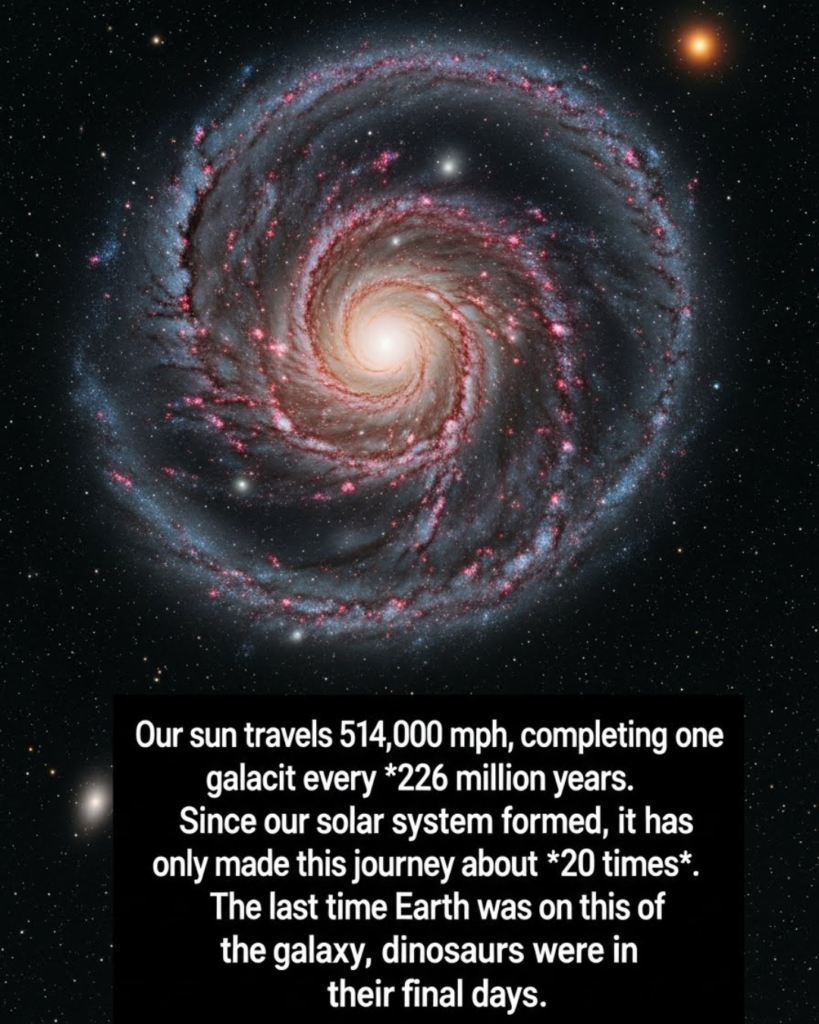
Our Sun travels at 514,000 mph, completing one galactic orbit every 226 million years. Since our solar system formed, it has only made this journey about 20 times. The last time Earth was on this side of the galaxy, dinosaurs were in their final days. This staggering reality underscores the immense scale of our cosmos and the relative youth of human civilization within the grand timeline of the Milky Way.
What is the Galactic Year and how is it measured?
To understand the Sun’s movement, we must first define the “Galactic Year,” also known as a cosmic year. This is the duration of time required for the Sun to complete one full revolution around the center of the Milky Way galaxy. While we are accustomed to the Earth’s 365-day journey around the Sun, the solar system itself is part of a much larger orbital dance.
Scientists estimate the length of a galactic year to be between 225 and 250 million Earth years. The variation in these estimates arises from the difficulty of measuring our position from within the galactic disk. Using VLBI (Very Long Baseline Interferometry) and data from the Gaia space observatory, astronomers track the parallax and proper motion of distant stars and masers. By calculating our distance from Sagittarius A*—the supermassive black hole at the galactic center—and our tangential velocity, we arrive at the figure of approximately 226 million years for a single circuit.
How fast does the Sun travel through the Milky Way?
While we feel stationary on Earth, we are actually hurtling through space at a velocity that defies terrestrial intuition. Our Sun travels 514,000 mph (approximately 828,000 kilometers per hour) relative to the galactic center. This speed is necessary to maintain a stable orbit against the immense gravitational pull of the galaxy’s concentrated mass.
If the Sun were to move any slower, it would be drawn toward the chaotic inner regions of the galaxy; any faster, and it might escape into intergalactic space. This velocity is roughly 1/1300th the speed of light. Even at this blistering pace, the Milky Way is so vast that it still takes hundreds of millions of years to complete one lap. To put this in perspective, at 514,000 mph, a spacecraft could circle the Earth’s equator in less than three minutes.
Where was Earth during its last visit to this galactic coordinates?
The last time Earth was in this specific region of the Milky Way, the planet looked radically different. Approximately 226 million years ago, during the Late Cretaceous period, the tectonic plates were arranged in a manner unrecognizable to modern eyes. The supercontinent Pangea had already begun to break apart, but the Atlantic Ocean was merely a narrow rift.
Most notably, the biological landscape was dominated by the “terrible lizards.” The last time we were here, dinosaurs like the Triceratops and Tyrannosaurus Rex were in their final days of evolutionary dominance. We are currently passing through the same “neighborhood” of space that saw the final chapters of the Mesozoic Era. It serves as a humbling reminder that in the time it takes the Sun to make just one lap, entire dominant classes of life can rise, flourish for eons, and vanish into the fossil record.
How many times has the solar system orbited the galaxy?
Since our solar system formed approximately 4.6 billion years ago, it has only made this journey about 20 times. This number is surprisingly low when compared to the 4.6 billion orbits Earth has made around the Sun. In “galactic terms,” our solar system is barely out of its infancy, having just celebrated its 20th “cosmic birthday.”
During the first few orbits, the Sun was a volatile young star, and the planets were still coalescing from a disk of dust and gas. By the 5th or 6th orbit, the first microbial life may have appeared on Earth. It wasn’t until the most recent two or three orbits that complex multicellular life exploded in diversity. We are currently in the middle of our 21st lap, a journey that has seen the transformation of Earth from a molten rock to a blue marble teeming with intelligence.
Which factors influence the Sun’s orbital path?
The Sun’s path is not a perfect circle. It is influenced by the complex distribution of mass within the Milky Way, including dark matter, gas clouds, and other star systems. Our orbit follows a wavy, sinusoidal pattern, moving up and down through the plane of the galactic disk like a horse on a carousel.
The primary factors influencing this path include:
- The Galactic Bulge: The high density of stars at the center provides the central gravitational anchor.
- Spiral Arms: As the Sun passes through the Orion Arm and near the Perseus and Sagittarius arms, the local increase in mass causes gravitational perturbations.
- Dark Matter Halo: Evidence suggests that a vast “halo” of invisible dark matter surrounds the galaxy, providing the extra gravitational “glue” that keeps the Sun moving at 514,000 mph without flying off into the void.
How does the galactic journey affect life on Earth?
There is ongoing scientific debate regarding whether our position in the galactic orbit correlates with mass extinction events. As our Sun travels 514,000 mph and bobs through the galactic plane, we periodically pass through regions of higher interstellar dust and gas density.
Some researchers hypothesize that passing through the dense mid-plane of the galaxy increases the risk of gravitational disturbances in the Oort Cloud. These disturbances could send a barrage of comets toward the inner solar system. Additionally, being in a “crowded” part of a spiral arm might expose Earth to higher levels of cosmic radiation or the shockwaves of nearby supernovae. While the “Great Dying” and the K-Pg extinction happened at different points in our orbit, the cyclical nature of these journeys remains a key area of study for astrobiologists.
What is the Solar Apex and how does it relate to our movement?
The Sun does not just move around the center; it also moves relative to the “Local Standard of Rest” (the average motion of stars in our neighborhood). This specific direction of travel is known as the Solar Apex. Currently, the Sun is headed toward a point in the constellation Hercules, near the bright star Vega.
This local movement is layered on top of the broader 514,000 mph orbital velocity. Understanding the Solar Apex helps astronomers map the local interstellar medium (LISM) that our solar system is currently plowing through. We are presently moving through a region known as the Local Interstellar Cloud, a “warm” patch of gas that the Sun entered within the last 10,000 to 100,000 years—a mere blink in the 226-million-year orbit.
Why does the scale of galactic time matter for modern science?
Studying the Sun’s orbit allows us to place human existence in a meaningful context. Because our solar system has only made this journey about 20 times, we realize that the conditions allowing for “Goldilocks” stability (a habitable planet) are both precious and potentially rare.
Furthermore, this research informs our search for exoplanets. By understanding how our Sun maintains a stable, circular-ish orbit far from the dangerous radiation of the galactic center (the “Galactic Habitable Zone”), we can better predict which other stars in the Milky Way might host life. It highlights that we are not just residents of a planet or a solar system, but active travelers in a massive, rotating celestial structure.
Conclusion
The realization that our Sun travels 514,000 mph, completing one galactic orbit every 226 million years, reshapes our understanding of time and space. Since our solar system formed, it has only made this journey about 20 times, marking the long-term milestones of planetary evolution. The fact that the last time Earth was on this side of the galaxy, dinosaurs were in their final days, serves as a poignant reminder of the fleeting nature of biological eras compared to cosmic cycles. As we continue our 21st journey around the galactic center, our increasing ability to measure and understand this trek represents a triumph of human curiosity and scientific rigor. We remain passengers on a celestial vessel, moving through a galaxy that is as much a graveyard of the past as it is a cradle for the future.