Discover the best herbal teas for every phase of your cycle to balance hormones, reduce bloating, and boost energy naturally throughout the month.
Have you ever felt like your body is a complete stranger depending on the week of the month? One day you’re brimming with confidence and energy, and the next, you’re curled up with a heating pad, wondering where your motivation went. This constant internal shift isn’t a flaw—it’s your biological rhythm. While many of us reach for an extra cup of coffee to push through the fatigue, there is a more gentle, supportive way to nourish your body.
In this guide, you will unlock the soothing power of nature by discovering the best herbal teas for every phase of your cycle. By matching specific herbs to your hormonal shifts, you can transform your monthly experience from a struggle into a period of self-care. Imagine sipping on a warm, fragrant brew that actually speaks your body’s language, helping to ease cramps, clear “brain fog,” and stabilize your mood. You have the power to achieve hormone harmony, one cup at a time. Let’s dive into the world of botanical support and discover how you can feel empowered every single day.
Important Disclaimer: This article is for informational purposes only and should not replace professional advice. For health-related topics, consult healthcare providers. For financial or legal matters, seek qualified professional guidance. For safety procedures, verify current best practices and local regulations. Individual results may vary, and personal circumstances should always be considered when implementing any suggestions.
Section 1: The Foundation of Tea for Hormonal Health
To find the best herbal teas for every phase of your cycle, you first need to understand that your body isn’t static. It moves through four distinct hormonal “seasons.” Each phase—menstrual, follicular, ovulatory, and luteal—presents unique physiological needs. Conventional wellness often treats every day the same, but your nutritional and hydration requirements fluctuate as your estrogen and progesterone levels rise and fall.
Herbalism is an ancient tool that modern science is increasingly validating. Many plants contain phytoestrogens, minerals, and anti-inflammatory compounds that gently nudge your endocrine system back into balance. If you’ve been practicing [Eating According to Your Cycle], adding targeted teas is the perfect “next step” to amplify your results. For beginners, the goal isn’t to become an overnight apothecary expert, but rather to build a small, reliable collection of herbs that make you feel supported.
H3: Why Choose Tea Over Supplements?
- Hydration: Tea provides a flavorful way to increase water intake, which is crucial for flushing out excess hormones.
- Bioavailability: Liquid extracts and infusions are often easier for your digestive system to process than hard pills.
- The Ritual: The act of brewing and sipping tea encourages a [Rest Routine] that lowers cortisol—the “stress hormone” that often disrupts your cycle.
H3: Selecting High-Quality Herbs
Not all tea is created equal. To truly benefit from the best herbal teas for every phase of your cycle, you should aim for organic, loose-leaf varieties whenever possible. This ensures you aren’t consuming pesticides that can act as “endocrine disruptors,” mimicking hormones and confusing your body’s natural signals.
Section 2: Your Phase-by-Phase Tea Guide
Let’s break down exactly which herbs to reach for as you move through your month. This step-by-step approach ensures you are always giving your body exactly what it needs to thrive.
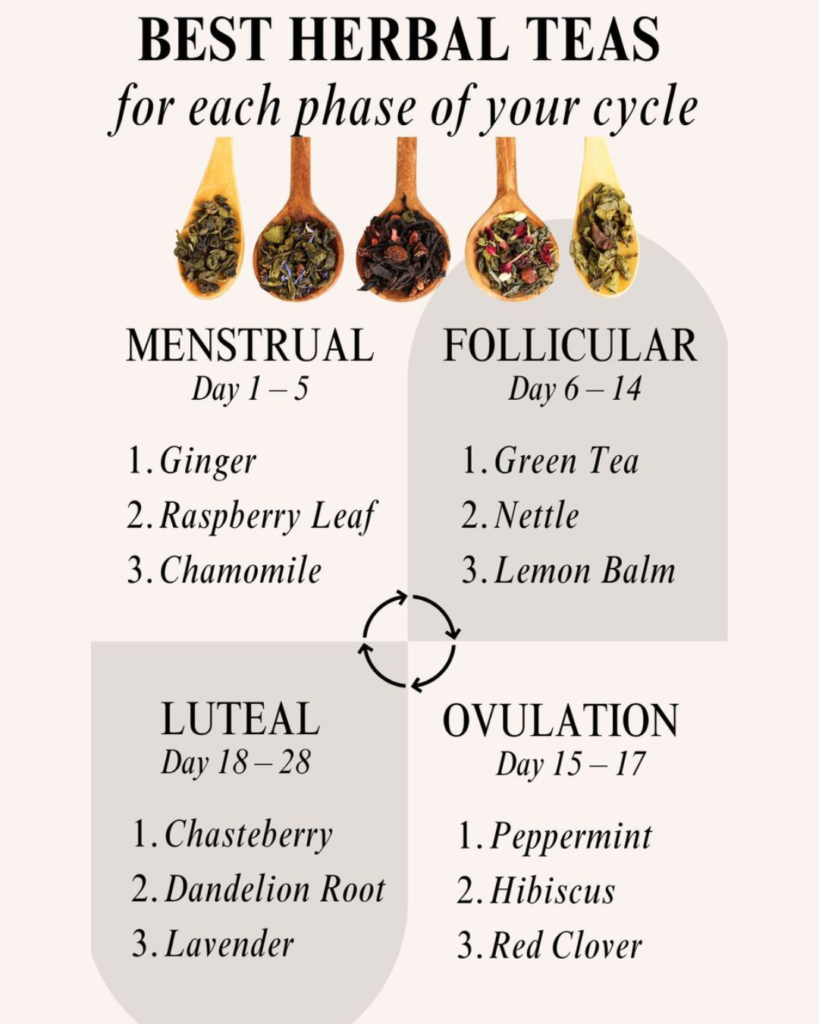
Phase 1: Menstrual Phase (The Winter)
When your period arrives, your energy is at its lowest. Your body is working hard to shed the uterine lining, which can lead to inflammation and iron loss.
- The Best Tea: Red Raspberry Leaf and Ginger.
- Why it works: Raspberry leaf is known as a uterine tonic that helps tone the muscles of the uterus, potentially shortening your period and easing cramps. Ginger is a potent anti-inflammatory that rivals over-the-counter painkillers for menstrual distress.
- Action Step: Brew a strong cup of raspberry leaf tea twice a day starting on Day 1 of your bleed.
Phase 2: Follicular Phase (The Spring)
As your period ends, estrogen begins to rise. You feel a surge of creativity and physical energy. This is the time to support your liver as it prepares for the upcoming hormonal peak.
- The Best Tea: Nettle and Oatstraw.
- Why it works: Nettle is a “multivitamin in a cup,” packed with iron, calcium, and magnesium to replenish what you lost during your period. Oatstraw supports the nervous system, helping you stay grounded as your energy levels climb.
- Action Step: Enjoy an infusion of nettle in the morning to fuel your daily activities.
Phase 3: Ovulatory Phase (The Summer)
You are now at your most vibrant. Estrogen and testosterone are peaking, and you might feel a bit warmer or more social.
- The Best Tea: Dandelion Root and Hibiscus.
- Why it works: Dandelion root supports liver detoxification, ensuring that once estrogen has done its job, it is properly cleared from your system. Hibiscus is rich in antioxidants and helps maintain healthy circulation.
- Action Step: Drink a cup of dandelion root tea after your largest meal to aid digestion and hormone metabolism.
Phase 4: Luteal Phase (The Autumn)
Progesterone rises, and for many, this brings PMS, bloating, and irritability. Your body needs grounding and “calming” support during this ten-to-fourteen-day stretch.
- The Best Tea: Lemon Balm, Chasteberry (Vitex), and Peppermint.
- Why it works: Lemon balm reduces anxiety and improves sleep quality. Vitex is a heavy-hitter for balancing the progesterone-to-estrogen ratio, helping to reduce breast tenderness and mood swings.
- Action Step: Sip lemon balm tea in the evening to help soothe the “Luteal blues” and ensure a restful night.
Section 3: Advanced Strategies and Personal Adaptation
Once you are comfortable with the basics, you can start to customize your blends. Best herbal teas for every phase of your cycle can be adapted to your specific symptoms and lifestyle.
- Cold Infusions: For the Ovulatory “Summer” phase, try making “sun tea” or cold-brewing your hibiscus and nettle overnight in the fridge. It’s refreshing and maintains the integrity of heat-sensitive vitamins.
- The “Tonic” Method: Instead of a quick 5-minute steep, try an “infusion.” Place 1 ounce of dried herbs in a quart-sized mason jar, fill with boiling water, and let it sit for 4-8 hours. This extracts the maximum mineral content.
- Synergy Blending: Don’t be afraid to mix! A blend of Peppermint (for bloating) and Ginger (for digestion) is a Luteal phase powerhouse.
- Cycle Tracking Integration: Use a cycle-tracking app to set “tea reminders.” This helps you anticipate your needs before the symptoms even start.
Section 4: Troubleshooting and Common Challenges
Even with the best intentions, you might run into obstacles. Here is how to navigate common hurdles in your herbal journey.
- Challenge: “I don’t like the taste of earthy teas like Nettle.”
- Solution: Add a squeeze of lemon or a splash of apple juice. The Vitamin C in lemon actually helps your body absorb the iron in the tea more effectively!
- Challenge: “I’m not seeing results immediately.”
- Solution: Herbs are “gentle medicine.” It typically takes 2-3 full cycles of consistent use to notice a significant shift in your hormonal symptoms. Be patient with your body.
- Challenge: “I have a very irregular cycle.”
- Solution: Follow the moon phases. Brew your “Menstrual” teas during the New Moon and your “Ovulatory” teas during the Full Moon to help encourage your body back into a natural rhythm.
Preventive Measures
Always check for herb-drug interactions. For example, Vitex (Chasteberry) should not be taken with certain birth control or antipsychotic medications. If you are pregnant or breastfeeding, always consult your midwife or doctor, as some herbs that “tone the uterus” can be too stimulating during pregnancy.
Section 5: Maximizing Your Results with Next-Level Habits
To truly see a transformation, your tea ritual should be part of a larger wellness ecosystem. Here is how to build upon your success:
- Sync Your Environment: Pair your Luteal phase tea with a [Body Detox] bath using Epsom salts to further reduce bloating and muscle tension.
- Mindful Sipping: Instead of scrolling on your phone, spend five minutes just breathing while you drink your tea. This lowers your heart rate and signals to your body that it is safe to prioritize hormonal health.
- Proper Storage: Keep your herbs in dark, glass jars away from direct sunlight. This preserves the essential oils and medicinal potency for up to a year.
- Listen to Your Cravings: If you find yourself craving your Luteal tea a few days early, your body might be entering that phase ahead of schedule. Trust your intuition over the app!
Conclusion: Empower Your Monthly Rhythm
You have taken a massive step toward health by learning about the best herbal teas for every phase of your cycle. By swapping synthetic fixes for natural, botanical support, you are honoring the incredible complexity of your body. Remember, this journey is about progress, not perfection. Whether you start with just one cup of Raspberry Leaf during your period or a full month of synced infusions, you are making a choice to live in harmony with your biology.
You are the expert on your own body. As you continue to discover what works best for you, you will unlock a level of energy and balance you never thought possible. Happy brewing!