Anxiety affects approximately 31% of adults at some point in their lives, manifesting as persistent worry, physiological arousal, and behavioral avoidance that can significantly impair daily functioning. Understanding how to reduce anxiety requires examining both the neurobiological mechanisms underlying anxious states and the evidence-based interventions that can modulate these systems. This article presents a systematic approach to anxiety reduction grounded in contemporary neuroscience and clinical psychology, offering you practical strategies supported by empirical research that you can implement to achieve measurable improvements in your psychological well-being.
Understanding the Neurobiological Architecture of Anxiety
Before implementing anxiety reduction strategies, it’s essential to understand the fundamental mechanisms generating anxious states. This knowledge transforms anxiety from an incomprehensible threat into a comprehensible biological process that can be systematically addressed.
The Amygdala-Prefrontal Cortex Circuit
Anxiety originates primarily from hyperactivation of the amygdala, a subcortical structure that processes threat-related information and initiates the fear response. When the amygdala detects potential danger—whether real or perceived—it triggers a cascade of physiological responses including increased heart rate, cortisol release, and heightened vigilance. In anxiety disorders, this system becomes dysregulated, responding to non-threatening stimuli as though they pose genuine danger.
The prefrontal cortex, particularly the ventromedial prefrontal cortex (vmPFC), normally exerts inhibitory control over amygdala activity through top-down regulation. This executive control system evaluates threats rationally and suppresses unnecessary fear responses. However, chronic stress and anxiety can weaken these inhibitory connections, allowing the amygdala to dominate cognitive processing. Understanding this circuit helps explain why anxiety feels overwhelming—your threat detection system is operating without adequate regulatory oversight.
The Hypothalamic-Pituitary-Adrenal Axis
Anxiety activates the hypothalamic-pituitary-adrenal (HPA) axis, your body’s primary stress response system. This neuroendocrine cascade begins with the hypothalamus secreting corticotropin-releasing hormone (CRH), which signals the pituitary gland to release adrenocorticotropic hormone (ACTH), ultimately stimulating cortisol production in the adrenal glands. Cortisol mobilizes energy resources and enhances alertness—adaptive responses for acute threats but problematic when chronically elevated.
Sustained HPA axis activation creates a positive feedback loop where elevated cortisol levels further sensitize the amygdala to threat cues while simultaneously impairing prefrontal cortex function. This neurobiological state perpetuates anxiety, making intervention at multiple system levels necessary for effective reduction.
Neurotransmitter Systems Implicated in Anxiety
Multiple neurotransmitter systems contribute to anxiety regulation. Gamma-aminobutyric acid (GABA), the brain’s primary inhibitory neurotransmitter, reduces neuronal excitability and promotes calmness. Anxiety often correlates with reduced GABAergic tone in key brain regions. Serotonin modulates mood and emotional regulation, with dysregulation contributing to anxiety and depressive symptoms. Norepinephrine mediates arousal and vigilance, with excessive noradrenergic activity producing physical anxiety symptoms like rapid heartbeat and sweating.
Understanding these systems reveals why comprehensive anxiety reduction requires interventions targeting multiple neurobiological mechanisms rather than single-pathway approaches.
Evidence-Based Physiological Interventions
Physiological interventions directly modulate the biological systems generating anxiety, offering rapid symptom relief while creating conditions for longer-term neuroplastic changes.
Controlled Breathing and Parasympathetic Activation
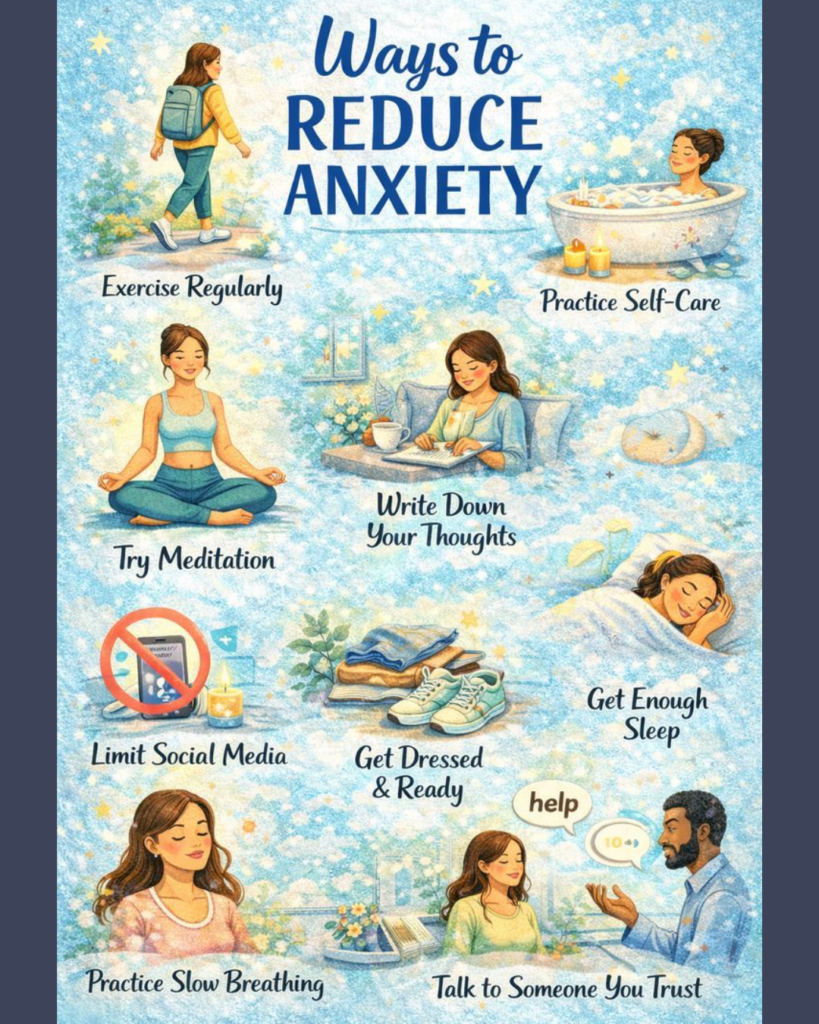
Controlled breathing represents one of the most empirically validated immediate anxiety reduction techniques. Slow, diaphragmatic breathing at approximately 6 breaths per minute activates the parasympathetic nervous system through vagal nerve stimulation, directly counteracting sympathetic arousal. This physiological shift reduces heart rate, lowers blood pressure, and decreases cortisol levels within minutes.
The mechanism involves respiratory sinus arrhythmia—the natural variation in heart rate that occurs during breathing cycles. During inhalation, heart rate increases slightly; during exhalation, it decreases. By extending exhalation relative to inhalation (for example, inhaling for 4 counts and exhaling for 6-8 counts), you maximize vagal tone and parasympathetic activation. Research demonstrates that consistent practice of controlled breathing for 10-15 minutes daily can reduce baseline anxiety levels over weeks through sustained improvements in autonomic nervous system regulation.
Progressive Muscle Relaxation and Somatic Awareness
Progressive muscle relaxation (PMR) systematically reduces physical tension that both results from and contributes to anxiety. The technique involves sequentially tensing and releasing muscle groups throughout the body, typically starting with the feet and progressing toward the head. This practice increases interoceptive awareness—your ability to perceive internal bodily states—which research shows is often impaired in anxiety disorders.
The efficacy of PMR operates through multiple mechanisms. Physically releasing muscle tension reduces proprioceptive feedback signaling danger to the brain. The focused attention required for systematic muscle tension-release cycles engages executive function networks, strengthening prefrontal control over limbic reactivity. Meta-analyses indicate that regular PMR practice produces moderate to large effect sizes in anxiety reduction, with benefits accumulating over 4-6 weeks of consistent application.
Cardiovascular Exercise and Neurochemical Modulation
Aerobic exercise constitutes one of the most robust anxiety reduction interventions, with effect sizes comparable to some pharmaceutical treatments. Exercise modulates anxiety through multiple simultaneous pathways: increasing endorphin and endocannabinoid production (which produce anxiolytic effects), promoting neurogenesis in the hippocampus (enhancing stress resilience), reducing inflammatory markers associated with anxiety, and improving sleep quality.
Research indicates that moderate-intensity cardiovascular exercise for 30-45 minutes, performed 3-5 times weekly, produces significant anxiety reduction within 2-4 weeks. The optimal intensity appears to be approximately 60-70% of maximum heart rate—vigorous enough to induce physiological adaptation but not so intense as to activate stress responses excessively. Both acute exercise sessions provide immediate anxiety relief (lasting 2-4 hours post-exercise) and chronic training produces sustained baseline anxiety reduction through neuroplastic changes.
Cognitive Interventions and Metacognitive Strategies
Cognitive interventions target the thought patterns and interpretive biases that generate and maintain anxious states, addressing the psychological content rather than just physiological arousal.
Cognitive Restructuring and Probability Estimation
Anxiety frequently involves catastrophic thinking—overestimating threat probability and severity while underestimating coping resources. Cognitive restructuring systematically challenges these distorted appraisals through structured evaluation of evidence. The process begins with identifying automatic anxious thoughts, then examining evidence supporting and contradicting these thoughts, and finally generating more balanced alternative interpretations.
A particularly effective cognitive technique involves explicit probability estimation. When anxiety generates catastrophic predictions, quantify the actual statistical probability of the feared outcome. For example, if you experience anxiety about public speaking leading to professional humiliation, examine: What percentage of presentations actually result in such outcomes? What evidence exists that this will occur? This quantification engages analytical prefrontal cortex processes, reducing amygdala dominance and providing realistic threat assessment.
Research on cognitive restructuring shows that systematic practice over 8-12 weeks produces substantial anxiety reduction, with effects maintained at 6-12 month follow-up. The key is consistent application rather than episodic use—neuroplastic changes require repeated activation of alternative cognitive pathways.
Metacognitive Awareness and Defusion Techniques
Metacognition—thinking about thinking—provides another powerful anxiety reduction approach. Rather than engaging with anxious thought content directly, metacognitive strategies create psychological distance from thoughts through defusion techniques. This involves recognizing thoughts as mental events rather than facts, observing them without judgment, and allowing them to pass without engagement.
Practical defusion exercises include labeling thoughts explicitly (“I’m having the thought that…”), visualizing thoughts as clouds passing across the sky, or repeating anxious thoughts rapidly until they lose semantic meaning. These techniques reduce cognitive fusion—the tendency to treat thoughts as literal reality—which research identifies as a key maintaining factor in anxiety disorders.
Neuroimaging studies demonstrate that metacognitive practices activate regions associated with self-reflection and decentered perspective-taking, including the dorsomedial prefrontal cortex. Regular practice strengthens these metacognitive networks, creating greater capacity to observe anxious thoughts without reactive engagement.
Attentional Control Training
Anxiety correlates with attentional bias toward threat-relevant stimuli—your attention automatically orients toward and maintains focus on potential dangers. Attentional control training exercises systematically redirect attention away from threat cues toward neutral or positive stimuli, gradually retraining automatic attentional patterns.
Evidence-based attention training involves practicing sustained focus on neutral or positive stimuli while threat-relevant distractors are present, then redirecting attention when it drifts toward threats. Digital training programs utilizing this approach show significant anxiety reduction after 2-4 weeks of daily 15-minute sessions. The mechanism involves strengthening dorsolateral prefrontal cortex control over automatic attentional capture by the amygdala.
Behavioral Interventions and Exposure-Based Approaches
Behavioral strategies target avoidance patterns that maintain anxiety by preventing the disconfirmation of feared outcomes and the development of adaptive coping skills.
Systematic Desensitization and Graduated Exposure
Exposure therapy represents the gold-standard treatment for anxiety disorders, with robust empirical support across multiple anxiety subtypes. The fundamental principle involves confronting feared stimuli or situations in a controlled, graduated manner, allowing anxiety to naturally decrease through habituation while disconfirming catastrophic predictions.
Effective exposure requires careful hierarchy construction—creating a ranked list of anxiety-provoking situations from least to most challenging. You then systematically work through this hierarchy, remaining in each situation until anxiety decreases by approximately 50% (typically 20-45 minutes). This process facilitates inhibitory learning—forming new, non-threatening associations with previously feared stimuli that compete with and ultimately override anxious associations.
Critical to exposure efficacy is violating expectancies—ensuring that feared outcomes don’t occur, thereby providing disconfirming evidence for anxious predictions. Research shows that exposure combined with cognitive interventions produces larger effect sizes than either approach alone, suggesting synergistic benefits from addressing both behavioral avoidance and cognitive distortions simultaneously.
Response Prevention and Compulsion Interruption
For anxiety involving safety behaviors or compulsive rituals, response prevention proves essential. Safety behaviors are actions performed to prevent feared outcomes (checking, reassurance-seeking, avoidance), which paradoxically maintain anxiety by preventing natural extinction of fear responses. Response prevention involves deliberately refraining from these behaviors while experiencing anxiety, allowing you to discover that feared outcomes don’t materialize without these protective actions.
Implementing response prevention requires graduated reduction rather than abrupt elimination. Begin by delaying safety behaviors incrementally, gradually extending the delay until you can eliminate them entirely. This approach reduces the initial anxiety spike associated with complete behavior cessation while still facilitating corrective learning.
Values-Based Behavioral Activation
Behavioral activation—systematically increasing engagement in valued activities—reduces anxiety through multiple mechanisms. Activity scheduling counteracts avoidance patterns, provides positive reinforcement that competes with anxiety, and creates opportunities for mastery experiences that build self-efficacy. Research demonstrates that behavioral activation produces anxiety reduction comparable to cognitive interventions, with some evidence suggesting particular efficacy when anxiety co-occurs with depressive symptoms.
Effective behavioral activation requires explicit identification of personal values—the qualities and directions you find intrinsically meaningful—then scheduling specific activities aligned with these values. This values-based approach enhances motivation and persistence compared to activity scheduling focused solely on pleasure or symptom reduction.
Lifestyle Modifications and Environmental Optimization
Comprehensive anxiety reduction requires addressing lifestyle factors that influence neurobiological vulnerability to anxious states.
Sleep Hygiene and Circadian Rhythm Regulation
Sleep disruption bidirectionally relates to anxiety—poor sleep increases next-day anxiety, while anxiety impairs sleep quality. This relationship reflects shared neurobiological substrates, with sleep deprivation impairing prefrontal cortex function and increasing amygdala reactivity. Prioritizing sleep optimization therefore constitutes a foundational anxiety reduction strategy.
Evidence-based sleep hygiene includes maintaining consistent sleep-wake schedules (including weekends), limiting blue light exposure 2-3 hours before bed, maintaining cool bedroom temperatures (approximately 18-20°C), and avoiding caffeine after midday. Additionally, treating the bed as exclusively for sleep creates strong associative conditioning between bed and sleep onset.
Research indicates that addressing sleep problems produces indirect anxiety reduction, with some studies showing 30-50% anxiety symptom improvement following successful sleep intervention. This highlights sleep as a high-leverage modification point in comprehensive anxiety management.
Nutritional Factors and Gut-Brain Axis Modulation
Emerging research on the gut-brain axis reveals bidirectional communication between intestinal microbiota and central nervous system function, with implications for anxiety. Certain dietary patterns—particularly those high in processed foods, refined sugars, and saturated fats—promote inflammatory processes and microbiome dysbiosis associated with increased anxiety. Conversely, Mediterranean-style diets rich in omega-3 fatty acids, fiber, and polyphenols show associations with reduced anxiety symptoms.
While nutritional psychiatry remains an evolving field, provisional recommendations include reducing caffeine intake (which can trigger or exacerbate physical anxiety symptoms), ensuring adequate magnesium consumption (involved in GABA receptor function), and considering probiotic-rich foods that may support beneficial microbiome populations. Importantly, dietary modifications should complement rather than replace evidence-based psychological interventions.
Social Connection and Attachment Security
Social isolation increases anxiety vulnerability, while secure social connections buffer against anxiety through multiple pathways including oxytocin release, enhanced perceived social support, and opportunities for emotional co-regulation. Prioritizing meaningful social interaction—even when anxiety promotes social avoidance—represents an important behavioral strategy.
Research on social baseline theory suggests that humans evolved to process threats within social contexts, with proximity to trusted others literally reducing the metabolic cost of threat vigilance. Regular social engagement with supportive individuals can therefore reduce baseline anxiety levels over time through both psychological and neurobiological mechanisms.
Integrating Multiple Approaches for Sustained Reduction
Optimal anxiety reduction typically requires integrated multi-component approaches rather than reliance on single interventions.
Developing Personalized Intervention Protocols
Individual differences in anxiety etiology, symptom presentation, and treatment response necessitate personalized intervention selection. Some individuals respond preferentially to physiological interventions (breathing techniques, exercise), while others benefit more from cognitive approaches (restructuring, metacognitive strategies). Systematic experimentation with different techniques—tracking anxiety levels before and after implementation—enables identification of personally effective interventions.
A pragmatic approach involves implementing foundational lifestyle modifications (sleep, exercise) while simultaneously introducing one specific technique from each category (physiological, cognitive, behavioral). After 2-3 weeks, evaluate relative efficacy and adjust emphasis accordingly. This empirical approach to personal anxiety management mirrors single-case experimental designs used in clinical research.
Recognizing When Professional Intervention Becomes Necessary
Self-directed anxiety reduction proves effective for mild to moderate symptoms, but certain presentations require professional intervention. Indicators include anxiety severely impairing occupational or social functioning, co-occurring substance use, suicidal ideation, or failure to improve after 2-3 months of consistent self-directed intervention. Professional options include cognitive-behavioral therapy (the most empirically supported psychological treatment), acceptance and commitment therapy, and in some cases pharmacological interventions that can facilitate engagement with psychological treatments.
Professional treatment doesn’t represent personal failure but rather appropriate matching of intervention intensity to symptom severity—parallel to seeking medical care for physical health conditions exceeding self-management capacity.
Conclusion
Reducing anxiety requires a comprehensive, scientifically informed approach addressing the multiple neurobiological and psychological systems generating anxious states. By implementing physiological interventions that modulate autonomic arousal, cognitive strategies that challenge distorted threat appraisals, behavioral techniques that reduce avoidance patterns, and lifestyle modifications that optimize biological vulnerability factors, you can achieve substantial and sustained anxiety reduction. The key lies in consistent application of evidence-based techniques matched to your specific symptom profile, combined with realistic expectations about the timeframe for neuroplastic changes—typically 6-12 weeks for meaningful baseline shifts. Your capacity to reduce anxiety systematically through these approaches reflects not just behavioral change but fundamental reshaping of the neural circuits underlying emotional regulation.
Important Disclaimer: This article is for informational purposes only and should not replace professional advice. For health-related topics, consult healthcare providers. For financial or legal matters, seek qualified professional guidance. For safety procedures, verify current best practices and local regulations. Individual results may vary, and personal circumstances should always be considered when implementing any suggestions.